
Marketing is not sales.
For some reason, this seems to be the largest misconception business owners have.
I’ve been meaning to make a post about this for a long time because I think it’s important to create a distinction for people so they know what real success looks like for marketing. Not going to go on a rant, but this definitely needed to be said.
It’s not responsible for hitting your monthly revenue number; it’s not a lever you pull when the pipeline looks thin, and it’s definitely not the department to put immediate blame on when a bad quarter happens. I know a lot of people might become defensive hearing that, but it’s the truth.
I’ve sat across from enough founders and marketing leads to know the pattern. Revenue dips, leadership panics, and the first question in the room is “what is marketing doing about this?” Or even worse, “which part of marketing should we cut?”
Never mind that the product had a rough launch, or the sales team lost two reps, or the market itself softened. Marketing gets treated like a faucet you can just turn up. It isn’t, and treating it that way is quietly wrecking a lot of good marketing teams and businesses.
The Misconception That Is Killing Your Marketing Team
Maybe we’ve got bias since we’re a digital marketing studio, but we know where we stand in marketing compared to the rest of the company. So many things affect marketing, and marketing can help or damage every other part of the business.
Think about it: Marketing is meant for getting your brand’s message out there and reaching your consumers.
Sales is for hitting concrete numbers and knocking down doors.
Here’s the pattern I keep running into: leadership wants every dollar of marketing spend tied to a specific closed deal. Sounds reasonable on paper, but in practice, it doesn’t work.
Direct revenue attribution works fine for the last click before checkout. It falls apart the moment you try to apply it to everything marketing actually does, because most of marketing’s job isn’t the last click: it’s the twelve touchpoints before the purchase.
It’s the blog post someone read eight months before they became a lead. It’s the brand impression that made them open your email instead of deleting it. The social post that made a stranger recognize your logo when a competitor pitched them. None of that shows up cleanly in a CRM report, but none of it is any less real, and it’s hard to measure.
When a marketing team is judged purely on what can be attributed to a dollar figure this month, something predictable happens: they stop taking risks.
Why would they publish anything that doesn’t have an obvious, immediate payoff? Why pitch the bold campaign when the safe one is easier to defend in a meeting? I’ve watched genuinely talented marketers get boxed into producing the same three “safe” content types on repeat, not because they lacked better ideas, but because leadership made it clear that anything else wouldn’t be forgiven if it didn’t convert.
That’s how you end up with a marketing team full of smart people producing forgettable work.
What Marketing Is Actually For
Strip away the KPI dashboards for a second and ask what marketing is actually supposed to do. It comes down to three things.
Brand awareness.
Before anyone buys from you, they have to know you exist. Sounds obvious, but it’s the part businesses skip past fastest when they’re impatient for results. That long-term investment matters because most potential customers aren’t ready to buy today anyway. In fact, research from the Ehrenberg-Bass Institute and LinkedIn’s B2B Institute found that 95% of B2B buyers are out of market at any given time. That means most of the people you’re trying to reach aren’t ready to buy today—but they still need to know who you are when they eventually are.
Industry authority and positioning.
This is the work that makes you the name people think of first in your category. Content, social presence, PR, showing up consistently with a point of view. It’s the reason some businesses get inbound leads that already trust them, while their competitors are cold-calling into a void.
Perception building.
How someone feels about your brand before they ever talk to a salesperson. Great marketing pre-sells. It shapes the story in someone’s head before your sales team says a word, which is exactly why sales conversations go faster and close rates go up when marketing has done its job well upstream.
None of these three things are optional add-ons or side benefits to marketing. They are the job. They are the foundation that makes sales easier in the first place.
Marketing Supports the Entire Customer Journey
Every customer moves through a journey before making a purchase. Marketing supports every stage of that journey by building awareness, establishing credibility, and creating positive brand experiences long before someone reaches out to your sales team.
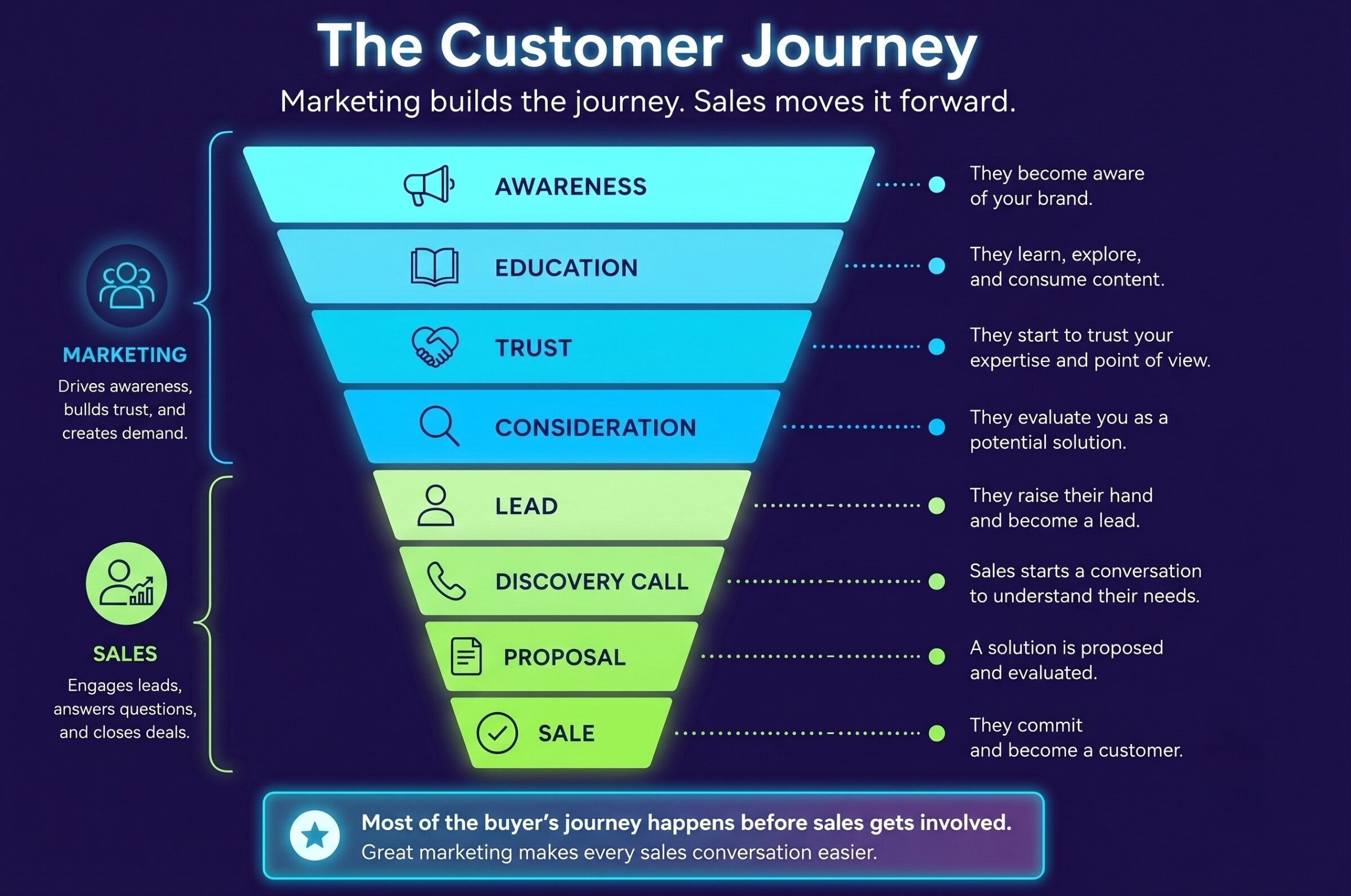
Marketing vs. Sales: The Real Distinction
Sales is a conversation. It’s a pipeline, a series of calls, a close. Marketing builds the world in which that conversation is even possible in the first place.
Think of it like this: sales is the person knocking on the door. Marketing is the reason the person on the other side already recognizes the name on the business card and decides to answer. You can have the best closer in the world, but if nobody’s ever heard of you and nothing about your brand feels credible, that closer is starting every single conversation from zero.
The mistake I see over and over is businesses asking marketing to do sales’ job: close the deal, hit the number, own the revenue outcome directly. That’s not marketing’s function, and forcing it into that role doesn’t make your revenue problem go away. It just makes your marketing worse at the thing it’s actually good for.
Marketing and Sales Measure Success Differently
One of the biggest mistakes businesses make is assuming marketing and sales should be judged by the same metrics. While both contribute to revenue, they do so in different ways. Marketing builds the foundation that makes sales easier, while sales focuses on converting that momentum into customers.
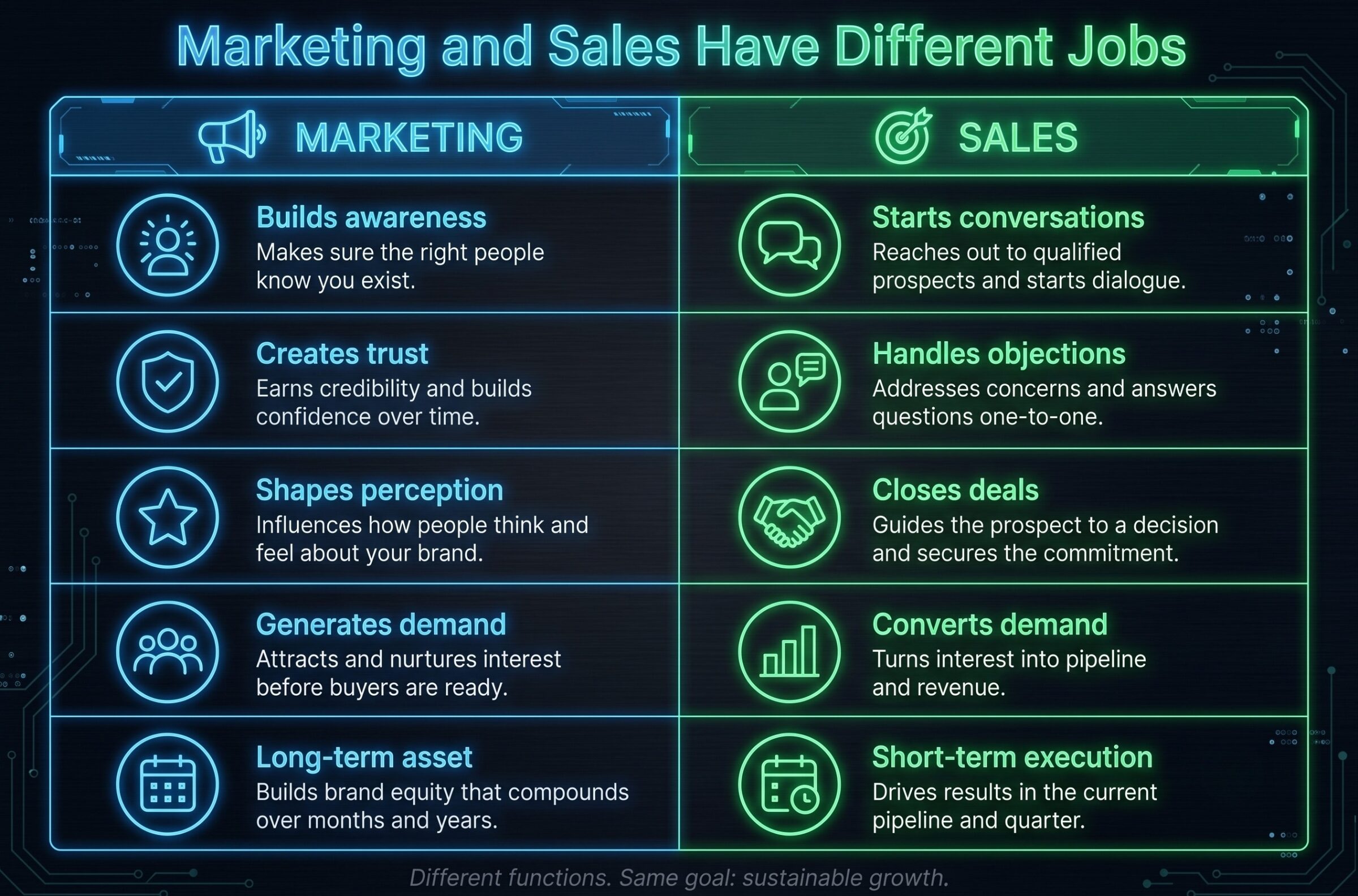
The KPI Trap: What Marketing Metrics Should Actually Look Like
I’m not telling you to throw out measurement. Direct revenue attribution to a single campaign is often genuinely misleading, though, because brand-building doesn’t move in a clean straight line from touchpoint to close.
The better question isn’t “did this post make us money this week.” It’s whether share of voice in your category is growing. Whether organic traffic is trending up over months, not days. Whether people are searching your brand name more than they used to. Whether engagement quality is improving, not just impression counts. Whether the leads coming through content are converting at a healthier rate over time, even if you can’t point to the exact post that did it.
Redefine what you’re measuring instead of measuring nothing. A marketing team with no accountability is its own problem. But holding brand-level work to a sales-level yardstick just guarantees you’ll misjudge the work every time.
None of this means marketing exists separately from business outcomes. Great marketing should, of course, ultimately contribute to growth. The mistake is expecting every activity to produce immediate, directly attributable revenue when much of marketing works by influencing decisions over time.
Modern SEO/GEO strategies and thoughtful website design are good examples of this long-term approach to marketing. When properly implemented, success compounds over time rather than delivering instant revenue.
What Happens When Everyone Starts Dictating Marketing
Once every stakeholder in the building has an opinion on marketing’s output, creative work starts getting run through committee. Every post gets softened until it says nothing controversial, and nothing controversial usually means nothing memorable either. Marketers who joined the company because they wanted to make sharp, opinionated work end up spending their time defending safe, forgettable work instead. Eventually the good ones leave, and you’re left with a team that’s optimized for not getting blamed rather than for actually building the brand.
I’ve seen this exact cycle play out at businesses of every size: a marketing team starts strong, leadership gets nervous about a slow quarter, oversight increases, creative risk drops, results flatten out, and leadership concludes marketing “isn’t working”… never connecting that the flattening happened right after they started micromanaging it.
How to Set Marketing Expectations That Actually Work
If you want marketing that actually moves your business forward, here’s where to start.
- Define marketing’s role in writing, before the campaigns launch, not after a bad quarter forces the conversation.
- Agree on brand-level metrics that are separate from sales metrics, so nobody’s comparing apples to a completely different fruit.
- Give the team creative autonomy inside a clearly defined brand framework, so they know the boundaries without having every decision run through a dozen people.
- Separate your marketing budget from your sales budget, measuring each against its own goals instead of one number that neither was ever designed to hit alone.
Implementing these changes requires drawing clearer lines. However, it does not require a bigger marketing budget.
What Great Marketing Actually Looks Like
Marketing is not a revenue machine you can turn up and down on demand. When it’s working, you’ll know. Here are some of the telltale signs that your marketing team is doing a great job:
- Consistent brand presence that builds recognition over months and years, not a single viral moment.
- Content that educates and positions the brand well before the audience is anywhere near ready to buy.
- Marketing that makes people want to work with you before your sales team ever picks up the phone.
- A team that’s trusted enough to do good work without fifteen rounds of committee approval standing between an idea and the world.
These are the things you’re actually paying for when you invest in marketing. Marketing is a long-term asset that makes every other part of your business easier, sales included. Set it up that way, and stop asking it to be something it was never built to be.
Ready to build a marketing strategy that supports long-term growth? Let’s talk.