81% of customers research a business online before they buy anything from it. If they search for yours and find nothing, where do you think they go instead?
Straight to a competitor. That’s just how people shop now.
And they’re doing it on Google and AI Search platforms (ChatGPT, Gemini, Perplexity, etc.).
We get asked some version of “do I really need a website?” more than almost any other question in our line of work, usually from a business owner who’s doing fine on Instagram, gets most of their customers from referrals, and doesn’t see the point of paying for something they’re not sure anyone will use. I get the skepticism.
But in 2026, not having a website means you don’t really exist to Google, and you certainly don’t have all of the required information for the AI assistant your next customer just asked for a recommendation. That’s especially true for online retailers that don’t have an e-commerce storefront that’s their own. Agentic Commerce is getting adopted more every day.
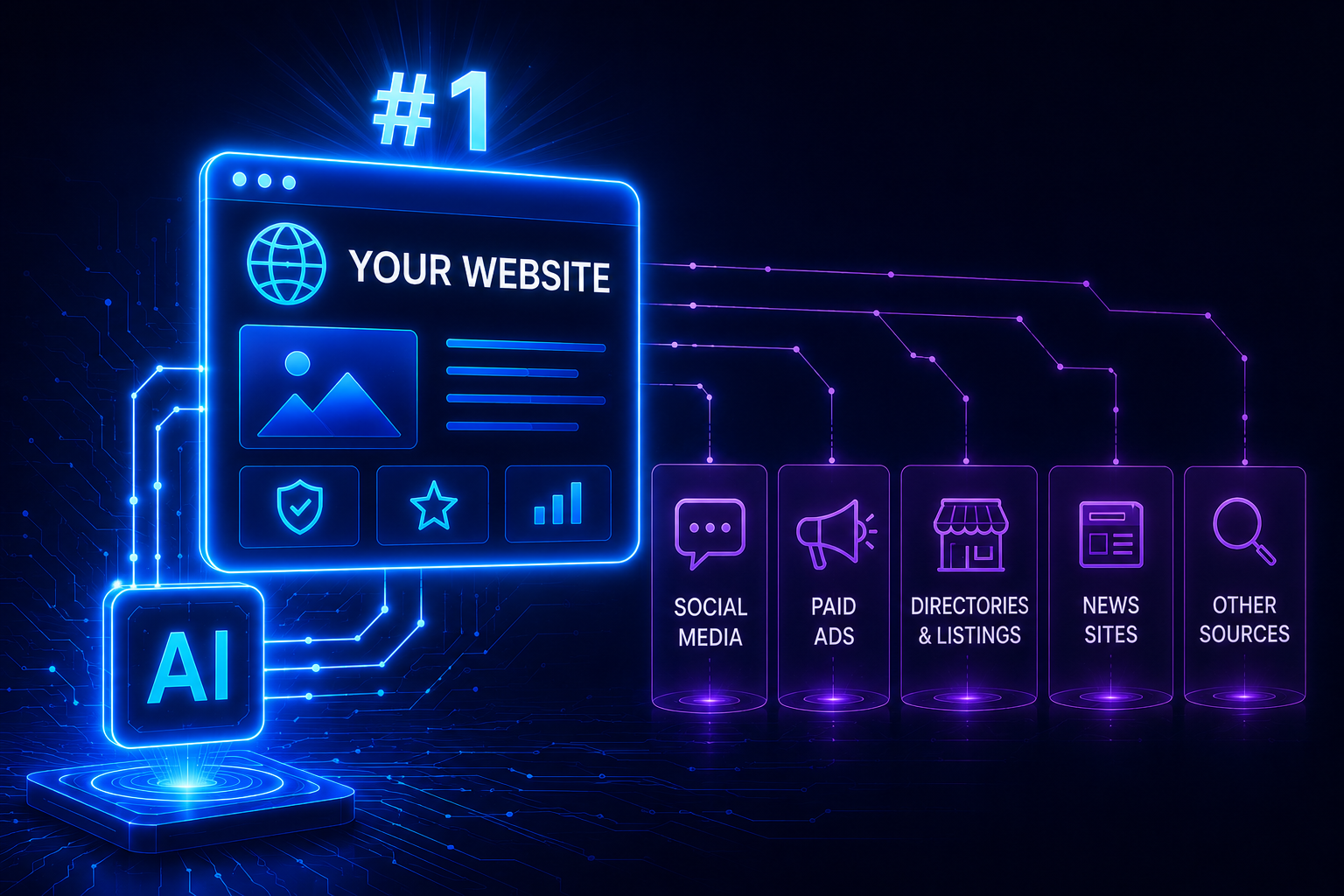
Unlike social media posts, which are buried by an algorithm you don’t control, a website is the one piece of digital real estate that’s actually yours. And it’s also become the thing that determines whether AI tools even know your business is an option.
The Numbers Behind the Web
Let’s ground this in scale for a second, because the size of the web says a lot about what you’re competing against.
There are somewhere around 1.34 billion websites on the internet right now, though only about 15% of them are actually active and maintained. That huge gap means most of the web is noise, parked domains, and abandoned projects. The businesses that show up when it counts are the ones in that smaller, active slice.
As for how all these websites were created, WordPress alone powers roughly 43% of all websites globally, which tells you how standardized the tools for building one have become. (There’s genuinely no excuse for “it’s too technical” anymore.)
On the human side, there are over 6 billion internet users worldwide, representing close to three-quarters of the planet. And boy, do we buy a lot of stuff online. Global online retail sales are on track to cross $6.88 trillion in 2026. Despite all that, nearly one in five small businesses still doesn’t have a website. About 83% do, which sounds like a lot until you realize that means millions of businesses are virtually invisible to search engines and AI assistants by default.
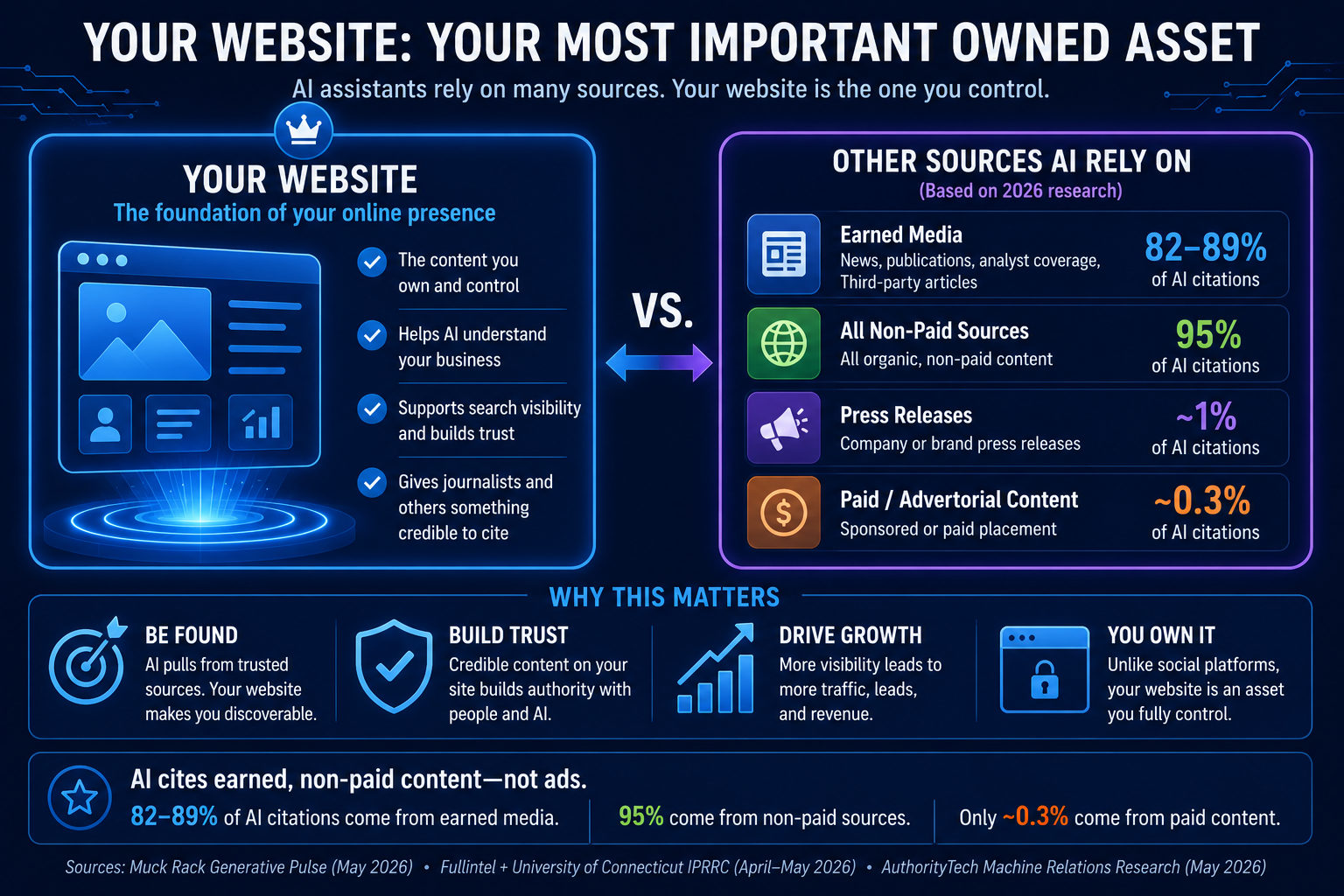
AI assistants like ChatGPT, Perplexity, and Google’s AI Overviews build their answers from information they can crawl and understand across the web. That includes websites, news articles, review sites, forums, and other authoritative sources. Research shows that 82% to 95% of AI citations come from earned, non-paid web content, highlighting the importance of having a credible online presence. While a website isn’t the only source AI systems use, it’s the one place where you control how your business is presented and the information those systems can access.
The Typical Three Types of Business Websites
Not every business needs the same kind of website, and part of why people get overwhelmed is that they’re picturing the wrong one. There are really three categories, and figuring out which one fits you makes this whole decision a lot less abstract.
Business Card Sites
This is your digital identity: your name, what you do, your services, your contact info, maybe a few reviews. Low complexity, high necessity. Think local service providers, consultants, contractors, a boutique law practice. You’re not trying to sell online; you’re trying to make sure that when someone searches your name or “plumber near me,” something legitimate shows up.
Lead Gen Sites
These are built to capture contact info and move people toward a decision: landing pages, forms, clear calls to action, content that answers objections before a salesperson has to. This is the sweet spot for B2B companies, agencies, coaches, and service-based businesses where the sale usually happens inside of a conversation (not a checkout screen).
E-commerce Sites
You’re selling products directly online. This is the highest complexity option, but also the highest ROI potential, and it’s absolutely not reserved for big retailers anymore. A small business with a well-built ecommerce site can compete directly with much larger players, especially now that AI shopping assistants are starting to evaluate and recommend products directly from structured product data.
Look at that list and be honest with yourself about where you land. Most of the businesses I talk to who are on the fence about “needing a website at all” are actually just picturing the wrong type and assuming it has to be complicated. It doesn’t.
Your Website in the Era of AI
This is the part of the conversation that’s changed the fastest, and it’s the reason I’d push back hard on anyone still asking whether a website is optional.
AI assistants are increasingly the first stop for people researching a purchase. When someone asks one of these tools “what’s a good [your industry] near me” or “which brand should I buy,” the assistant is pulling its answer from content it can actually crawl and understand. If your business doesn’t have a website, or has one with thin, outdated, or poorly structured content, you’re not in the running. And you’re not just ranked lower, like in traditional Google search results. In the world of agentic AI search, you’re not even being considered at all.
The businesses most likely to show up in AI-generated answers are the ones with real, content-rich, well-structured websites that give these systems something solid to reference. We’ve written before about how unreliable and even malicious web content can shape what AI models learn about a topic or a brand, and separately about why AI-generated websites still fall short without real substance behind them (both are worth a read if you want the deeper technical picture). But the business takeaway is simple: a website is more than a place potential customers visit; it’s the primary source material AI tools use to decide whether to recommend you at all.
What Happens When Customers Can’t Find You
Let’s make this concrete, because “you’ll lose customers” is easy to say and easy to ignore.
Someone in your market searches for what you offer. You don’t have a website, or yours hasn’t been touched since 2022. A competitor does have one, and it’s decent. Guess who gets the click, the call, and eventually the sale? It’s not always the better business that wins here. It’s the one that comes up on Google.
Or, say that an AI assistant gets asked for a recommendation in your category. It has nothing to pull from for your business, so it either leaves you out entirely or, worse, surfaces outdated or incorrect information about you from a third-party listing you don’t control. You don’t get a say in how you’re represented, because you never gave the system anything better to work with. More likely than not, the AI agent won’t even mention your business as an option at all.
What about other ways customers might find you apart from your website? Word of mouth, as good as it is, has a ceiling. Referrals only reach people who are already one degree away from someone who knows you. Social media reach is dictated by an algorithm that changes its mind about your content constantly. None of that scales the way a website does, and none of it shows up when someone Googles you at 11pm trying to decide if you’re legit.
Website vs. Social Media: Why You Need Both
I want to be clear about something: I’m not telling you to abandon social media. It’s genuinely valuable for reach, for personality, for staying top of mind. But social media and a website do different jobs, and treating one as a replacement for the other is where businesses get into trouble.
Here’s the core issue: you don’t own your social media presence. You’re a tenant. The platform can change its algorithm overnight and tank your reach. It can update its policies in a way that limits what you can post. It can, in rare but real cases, shut down or lock you out entirely. Everything you’ve built on that platform lives at the pleasure of a company that owes you nothing.
Your website is the one piece of digital real estate you fully own. Nobody can deprioritize it in a feed. Nobody can change the rules on what you’re allowed to say about your own business. Social media is where you amplify and build relationships. Your website is where you convert, and where AI systems and search engines actually go to understand who you are. You need both, working together, but only one of them is truly yours.
The Real ROI of a Business Website
I know the objection that’s still sitting there: it costs money, and you’re not sure it pays off. Let’s talk numbers.
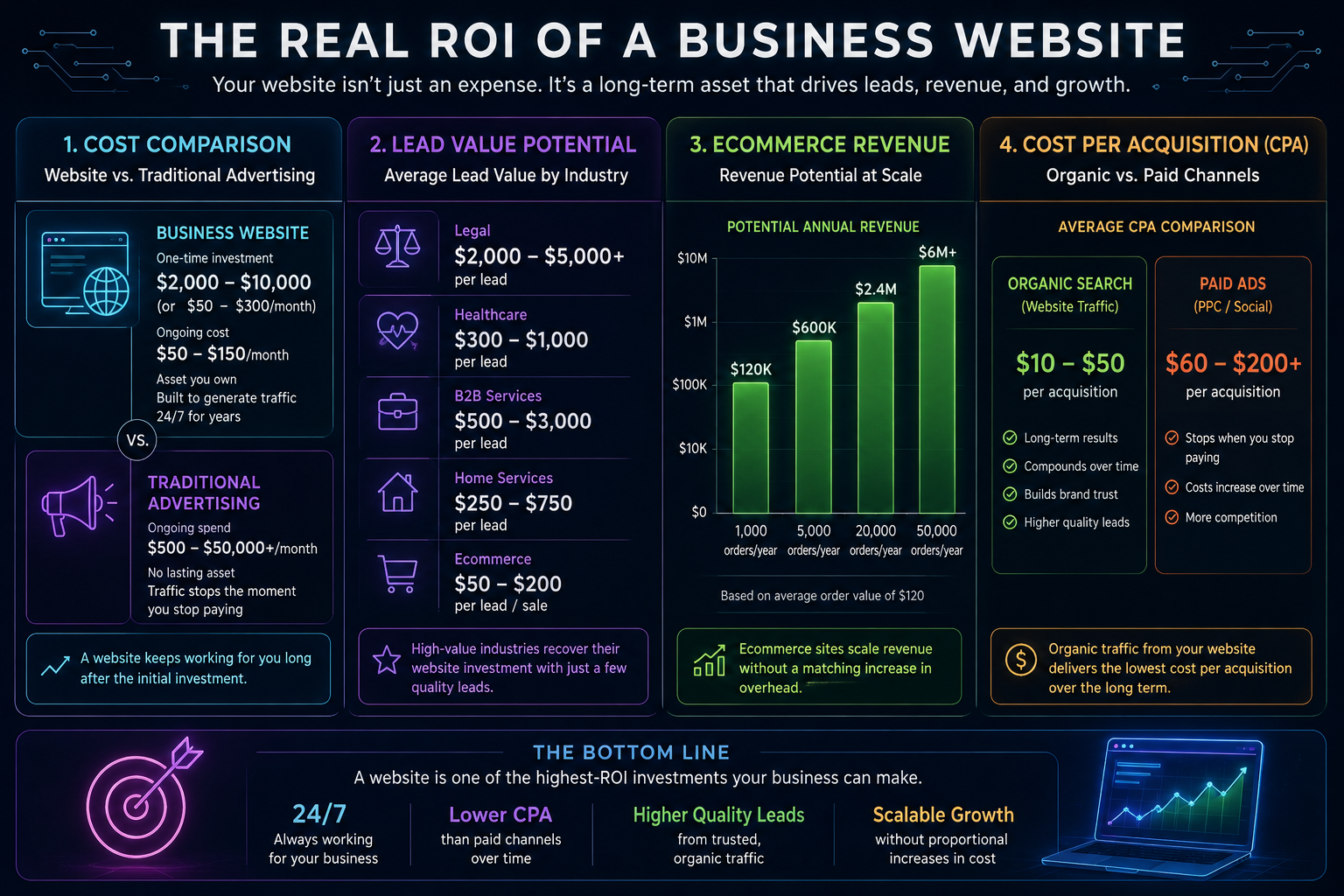
Compare the cost of a well-built website against traditional advertising. A website is a one-time build with modest ongoing maintenance that keeps working for you 24 hours a day, every day, indefinitely. A print ad or a billboard stops working the moment you stop paying for it. Organic traffic from a website that’s built to rank, and increasingly to be cited by AI tools, has a dramatically lower cost per acquisition over time than most paid channels, because you’re not paying per click for the same visitor twice.
Lead value varies by industry, but the math tends to work in your favor if a site is built to actually convert, not just exist. And for ecommerce specifically, the revenue potential scales with your catalog and your traffic in a way that a physical storefront or a social presence alone simply can’t match.
It’s true that a website that just sits there, unmaintained, with no real content, isn’t going to move the needle much. But a website that’s built intentionally, kept current, and structured so both people and AI tools can actually understand what you offer? This is the foundation for everything else your marketing sits on top of.
The numbers below illustrate why a website is one of the highest-return marketing investments a business can make. While the exact return varies by industry, a well-built website continues generating value long after it’s launched.
Common Questions We’re Asked
Do I really need a website if I’m already on social media?
Yes. Social media builds reach and relationships, but you don’t own the platform, and algorithms decide who sees your content. A website is the one asset you fully control, and it’s what search engines and AI assistants actually pull information from when someone’s looking for what you offer.
How much does a business website cost to build and maintain?
It varies widely based on complexity, from a few hundred dollars for a simple business card site on a platform like WordPress or Squarespace, to a much larger investment for a full ecommerce build. Ongoing maintenance is typically a small monthly cost, but it’s a meaningful one; an outdated, unmaintained site can hurt you more than having none at all.
Can I build a website myself or do I need a developer?
For a simple business card or lead gen site, modern website builders and AI website generators make DIY genuinely realistic. For e-commerce, or any site where performance, structure, and AI visibility really matter, working with someone who knows what they’re doing pays for itself. You can vibe code a website yourself if you really want to do everything on your own. Tread carefully though. There’s a lot of factors to think about like security that make this a very unsafe option.
Does a website help with AI search engines like ChatGPT or Perplexity?
Absolutely, and increasingly this is the whole game. These tools build their answers from real, crawlable web content. A well-structured, content-rich website gives them something to reference and recommend. No website, or a thin one, means you’re simply not part of the conversation.
How long does it take to see results from a new website?
Immediate value comes from having a credible, findable presence the moment it goes live. SEO and AI visibility results tend to build over a few months as search engines and AI systems index and trust your content. This is a compounding asset, not a one-time campaign.
Not having a website in 2026 isn’t a neutral choice anymore. It’s an active decision to be invisible to the tools that an increasing number of your future customers are using to make decisions. The good news is that fixing it is more achievable than it’s ever been, and the businesses that get this right now are the ones that will still be found five years from now, no matter how people are searching.
Ready to make your business easier to find online?
Whether you’re launching your first site or improving an existing one, bgood media can help you create a website that’s built for search, AI visibility, and long-term growth. Reach out to us.
Sources for statistics: