Last month, I built a custom CRM integration tool in a few hours.
Ok, it was more like 30 hours but I’m picky with what I want in my builds. I used Claude Code with Opus 4.8 before Fable 5 came out.
Three years ago, that same project would’ve taken months and probably required hiring a software engineer, costing me tens of thousands of dollars. No way I wanted to spend that kind of cash.
The difference was vibe coding: a new way of building software by having conversations with AI instead of writing code line by line.
Agent loops weren’t really a thing so I only used back-and-forth chat prompts.
AI-assisted development has completely transformed how software gets created. Marketing automation tools, client dashboards, and custom analytics platforms are now being built without writing traditional code. Not to be dramatic, but this has been game-changing for businesses across industries, ours included.
When Andrej Karpathy (former AI director at Tesla and OpenAI) coined the term “vibe coding” in February 2025, he perfectly captured what we’d been experiencing: a fundamental shift in how software gets made. Instead of meticulously typing out every function and debugging syntax errors at 2 AM, we’re having conversations with AI that turn ideas into working applications.
But vibe coding isn’t magic, and it’s definitely not without its challenges. After spending a lot of time in this world, I’ve learned what works, what doesn’t, and when you should absolutely not rely on AI to write your code. Let’s walk you through everything.
What Is Vibe Coding? The Simple Definition
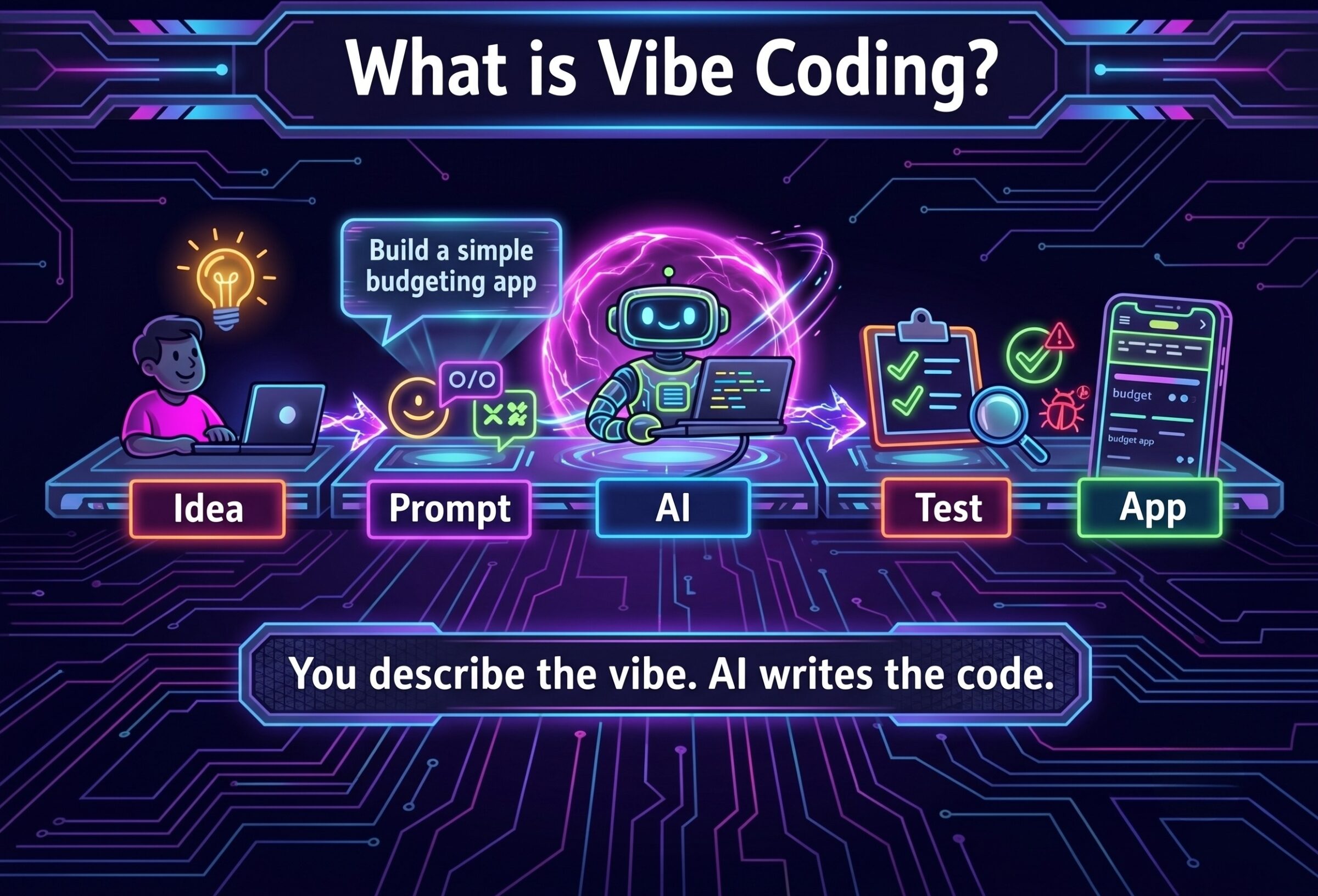
Vibe coding is a development approach where you describe what you want to build in natural language, and AI assistants generate the code for you. Instead of writing code yourself, you’re essentially having a conversation with an AI about your vision, then refining and iterating on what it creates.
This represents a fundamental shift in how software development works. Traditionally, developers spent their time writing code line by line—typing out every function, every variable, every conditional statement. With vibe coding, the developer’s role changes from being the writer to being the guide. You’re directing the AI, explaining what you need, reviewing what it produces, and steering it toward the right solution. The AI handles the actual code writing while you focus on the problem-solving and decision-making.
Think of it like this: traditional coding is like building furniture by hand with individual tools and materials. Vibe coding is like describing the furniture you want to an expert craftsperson who then builds it while you provide feedback and adjustments.
Now, I need to make an important distinction here. There are really two types of vibe coding:
“Pure” vibe coding is exploratory and experimental. You’re throwing ideas at AI, seeing what sticks, building throwaway prototypes to test concepts. This is perfect for side projects, learning, or rapid prototyping where code quality isn’t critical.
Responsible AI-assisted development is what professionals use for actual client work and production applications. You’re still using AI to generate code, but you’re reviewing it, understanding it, testing it thoroughly, and maintaining professional standards. The AI is your assistant, not your replacement.
Both are valuable, but knowing which approach you’re using makes all the difference in outcomes.
How Vibe Coding Actually Works
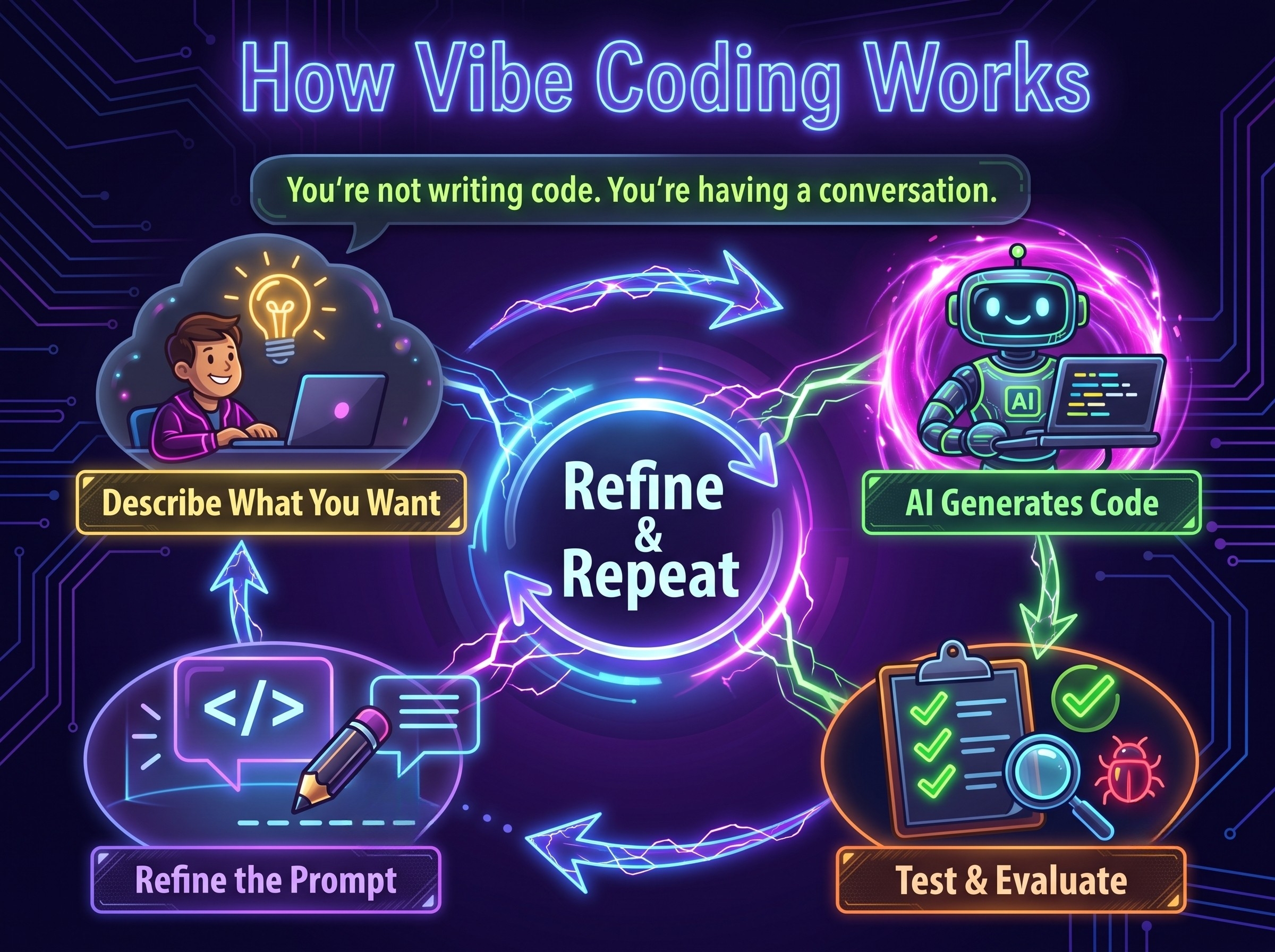
The vibe coding process follows a conversational back-and-forth that feels almost nothing like traditional programming.
Here’s how it works:
Step 1: Describe what you want. You tell the AI what you’re trying to build using natural language. The more specific you are, the better the results. You can do this using traditional prompt styles like magic, markdown, or CO-STAR.
Step 2: The AI generates code. Based on your description, the AI writes the initial code, sets up file structures, and even suggests libraries or frameworks.
Step 3: Test and evaluate. You run the code, test the functionality, and see how close it is to your vision.
Step 4: Refine and iterate. You provide feedback, point out issues, request changes, and the AI updates the code accordingly.
Let me give you a real example. Say you need a tool to automatically pull Instagram engagement metrics and format them for client reports. In the past, building something like this would take a developer 15-20 hours of work. Today, with vibe coding, you can have a working version in under two hours.
Here’s roughly how it goes:
Your prompt: “I need a Python script that uses the Instagram Graph API to pull engagement metrics for the last 30 days and export them to a formatted Excel spreadsheet with charts showing engagement trends over time.”
What the AI generates: A complete Python script with API authentication, data fetching logic, pandas for data manipulation, and openpyxl for Excel generation including basic charts.
What you refine: “The chart colors don’t match our brand. Use #2C5F8D for the primary color. Also, add error handling for when the API rate limit is hit, and include a progress indicator.”
Final result: A production-ready tool built in a fraction of the time traditional development would require.
The full application lifecycle for vibe coding looks like this: ideation (what problem are you solving?) → generation (AI creates initial code) → refinement (iterative improvements through conversation) → deployment (shipping to production with proper testing and review).
Vibe Coding vs. Traditional Programming
Understanding when to use vibe coding versus traditional programming is crucial. Here’s how vibe coding compares to traditional programming:
| Aspect |
Vibe Coding |
Traditional Programming |
| Development Speed |
5-10x faster for standard features |
Slower but more precise control |
| Required Expertise |
Basic technical understanding, strong problem-solving |
Deep programming knowledge, syntax mastery |
| Developer Role |
Product manager, reviewer, guide |
Hands-on builder, architect |
| Learning Curve |
Shallow—start building immediately |
Steep—months to years of learning |
| Best For |
Prototypes, internal tools, standard applications |
Complex algorithms, performance-critical systems, novel solutions |
| Code Quality |
Variable—depends on prompts and review |
Consistent with developer skill level |
| Debugging |
Can be challenging without code knowledge |
More straightforward with expertise |
When deciding which approach to use, consider these factors:
Use vibe coding when:
- You need something built quickly
- The application is relatively standard (CRUD apps, dashboards, integrations)
- You’re prototyping or validating ideas
- Development resources are limited
- You understand the domain even if you can’t code it yourself
Stick with traditional programming when:
- Performance is absolutely critical
- You’re building novel algorithms or unique solutions
- Security requirements are extremely high
- The codebase will need extensive long-term maintenance
- You’re working on large-scale, complex systems
For most business applications and marketing tools, vibe coding wins hands down.
Vibe Coding vs. AI-Assisted Development
It’s also worth noting that you don’t have to choose pure vibe coding or traditional programming; you can also choose AI-assisted development, which is basically traditional coding with some help from AI.
Vibe coding sits at one end of the spectrum (fully conversational, AI generates entire features), traditional programming at the other end (hand-coding everything), and AI-assisted development falls somewhere in between (developers still write code but get AI suggestions and autocomplete).
Related approaches like no-code or low-code platforms exist as well, but they’re a different category entirely: these rely on drag-and-drop templates and visual builders rather than generating fully custom code through conversation with AI. They can be faster for simple apps, but much less flexible for complex or unique solutions.
Popular Vibe Coding AI Tools & Platforms
The vibe coding ecosystem has exploded over the past year. If you’re wondering what the best vibe coding AI tools are, here’s a breakdown of the major vibe coding AI tools and what they’re each good for:
Google AI Studio / Firebase Studio / Gemini Code Assist Google’s suite of vibe coding tools integrates beautifully if you’re already in their ecosystem. AI Studio is great for quick prototypes, Firebase Studio excels at full-stack applications with database integration, and Gemini Code Assist works within your existing IDE for code generation and assistance.
Replit This is where most people start with vibe coding. Replit’s interface is incredibly intuitive, and you can go from idea to deployed application without leaving the browser. Their AI agent handles everything from environment setup to deployment. Perfect for rapid prototyping and learning.
Cursor If you’re a developer who wants AI assistance within a professional code editor, Cursor is probably your best bet. It’s built on VS Code, so it feels familiar, but with powerful AI integration that can edit across multiple files and understand your entire codebase context.
GitHub Copilot More of a coding assistant than a pure vibe coding tool, but incredibly powerful for developers who want AI suggestions while they write. It autocompletes entire functions based on comments and context.
Claude Code A newer command-line tool that’s excellent for developers who live in the terminal. It’s particularly good at understanding complex codebases and making architectural decisions.
If you’re just starting, begin with Replit. Once you understand the fundamentals, you can experiment with the others based on your specific needs.
Real-World Applications: What You Can Build with Vibe Coding
Here’s where this gets exciting. We’re already using vibe coding at bgood media to build real tools that solve real business problems, fast. We can use vibe coding to build:
Business applications and internal tools: We’ve used vibe coding to spin up custom internal tools like lightweight CRMs, content production dashboards, and client reporting systems tailored to how we actually work. The kind of tools that replace $50–$200/month SaaS subscriptions — without forcing us into someone else’s workflow. Instead of adapting our processes to software, we build software around our processes. And we do it in days, not quarters.
Rapid prototypes for client projects: When a client comes to us with “what if we built…” energy, vibe coding lets us answer with “cool, let’s see it.”
We’ve used AI-assisted development to create working prototypes for new services, internal tools, and data workflows in hours instead of weeks. That means clients can validate ideas before committing serious budget to full-scale development. It’s faster feedback, lower risk, and way fewer expensive surprises.
Marketing automation tools: This is where vibe coding shines for marketing teams. We’ve built custom tools for things like:
- Content planning and publishing workflows
- SEO audits tailored to specific industries
- Campaign tracking dashboards that pull from multiple platforms
Unlike bloated expensive marketing software, our AI marketing tools are built to do exactly what’s needed — nothing more, nothing less.
Custom integrations: Some of the most powerful use cases we’ve seen involve stitching systems together that were never meant to talk. With vibe coding, we’ve created tools that pull data from multiple sources, clean it, analyze it, and generate reports automatically — workflows that used to require a developer team, long timelines, and ongoing maintenance contracts.
And this isn’t just us experimenting on the fringes.
According to Y Combinator, 25% of their Winter 2025 batch had codebases that were 95% generated by AI. That’s not a future prediction; it’s happening right now. These are funded startups building real products that real customers use.
The Benefits of Vibe Coding for Businesses
Here’s why this matters for your business (TLDR: higher ROI):
Faster time-to-market: Development times are 5-10x faster than traditional coding for standard applications. Ideas that would’ve taken months can now ship in weeks or even days.
Lower barriers to entry: You don’t need to hire a full development team to build custom software anymore. Someone with business domain expertise and good communication skills can now build functional applications.
Democratization of development: Marketing teams can build their own tools. Operations managers can create custom dashboards. Sales teams can prototype new customer experiences. The power to create software is spreading beyond traditional engineering teams.
Significant cost savings: Traditional development might cost $50,000-$150,000 for a custom application. With vibe coding, you can build comparable solutions for 10-20% of that cost, especially if someone internal learns to do it.
Innovation enablement: When the cost and time to test ideas drops dramatically, you can experiment more. Multiple prototypes can be built and tested to discover what actually works.
For small to medium businesses especially, vibe coding levels the playing field. You can now build custom solutions that previously only enterprises with huge IT budgets could afford.
The Limitations & Challenges You Need to Know
Vibe coding is powerful, but it’s not perfect. Here are the challenges you need to understand:
Technical complexity for advanced use cases: When you need complex algorithms, intricate data structures, or highly optimized performance, AI-generated code often falls short. Complex projects may still require traditional developers.
Code quality and maintainability issues: AI sometimes generates code that works but is poorly structured, uses outdated patterns, or includes unnecessary dependencies. Without review and refactoring, technical debt builds up quickly.
Debugging difficulties: When something breaks in code you didn’t write and don’t fully understand, fixing it can be frustrating. Hours can be spent debugging AI-generated code that might have taken minutes with traditionally written code.
Security vulnerabilities: This one is serious. One cautionary example comes from the vibe coding platform Lovable: security researchers discovered that projects generated with Lovable were exposing sensitive data due to insufficient Row Level Security on database endpoints, highlighting the need to carefully review and secure AI-generated code (Matt Palmer, CVE-2025-48757).
When vibe coding is NOT appropriate:
- Financial systems handling transactions
- Healthcare applications with HIPAA requirements
- Large-scale systems serving millions of users
- Applications where downtime costs thousands per minute
- Systems requiring custom algorithms or novel approaches
There’s also what some call the “vibe coding hangover.” It’s that moment when you realize the prototype built in two hours now needs to be production-ready, and you’re staring at AI-generated code you don’t fully understand. The key is building in time for review and refactoring from the start.
Best Practices for Effective Vibe Coding
Here’s what actually works when using vibe coding:
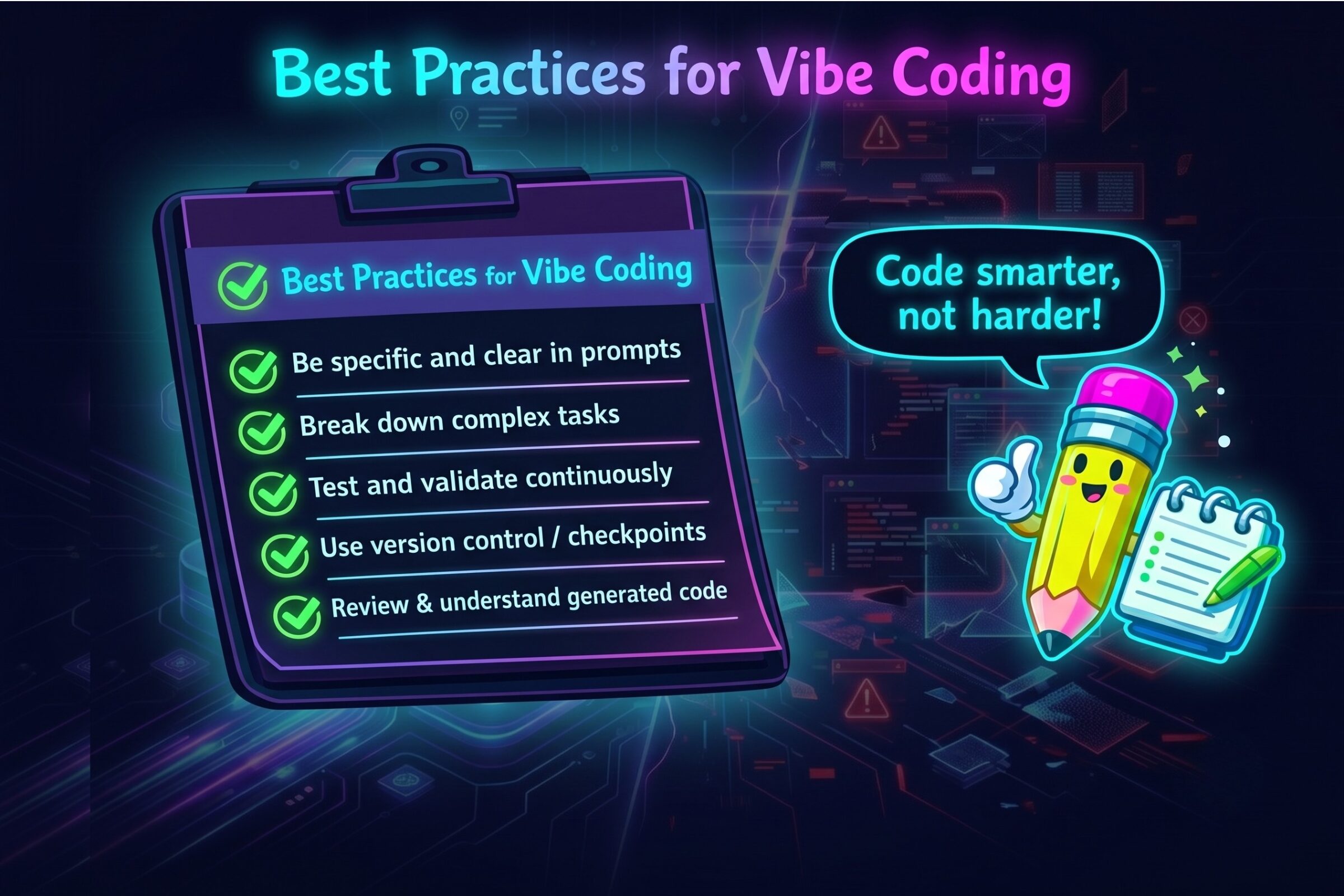
Be specific and clear in prompts. “Build a website” will get you garbage. “Build a landing page for a yoga studio with a hero section featuring a background video, three class package options with pricing cards, an instructor bio section with headshots, and a contact form that emails to studio@example.com” will get you something useful.
Break down complex tasks. Don’t ask the AI to build your entire application in one prompt. Build it piece by piece: first the data model, then the API endpoints, then the UI components, then the integration logic. This makes debugging much easier.
Test and validate continuously. Don’t wait until the AI has generated thousands of lines of code to test it. Test each component as it’s built to catch issues early.
Implement version control and checkpoints. Even with AI-generated code, use Git. Commit frequently. When something breaks (and it will), you want to be able to roll back to the last working version easily.
Review and understand generated code. You don’t need to understand every line, but you should understand the general approach, key functions, and data flow. If you can’t explain what the code does at a high level, you’re setting yourself up for problems.
Security considerations:
- Never trust AI with authentication code without review
- Always sanitize user inputs
- Use environment variables for sensitive data, never hardcode
- Run security scans on generated code
- Have a security-knowledgeable person review anything customer-facing
Successful vibe coders treat AI as a junior developer who’s incredibly fast but needs supervision, not as a senior architect who can be trusted blindly.
The Future of Vibe Coding & What It Means for Your Business
The future of software development isn’t just for developers anymore. It’s for anyone with good ideas and the willingness to learn.
Here’s where vibe coding/AI-assisted development is headed:
Multimodal programming is already emerging. Instead of just typing descriptions, we’re starting to see vibe coding that accepts sketches, screenshots, voice commands, and even video demonstrations. Imagine drawing a UI mockup on a napkin, taking a photo, and having AI generate the working application.
The evolution toward VibeOps means AI won’t just generate code—it’ll manage deployments, monitor performance, auto-scale infrastructure, and even debug production issues. We’re moving from “AI helps you code” to “AI manages your entire technical stack.”
Developer roles are shifting. The role isn’t disappearing, but it is changing. Developers are becoming architects, reviewers, and system designers rather than syntax writers. The valuable skill is knowing what to build and how systems should work together, not memorizing programming language syntax.
What businesses should prepare for:
- Everyone needing to understand the tech, not just developers
- Faster innovation, which means making decisions quickly and iterating often
- Using software as a growth and strategy tool, not just a task manager
- Teams creating their own custom tools instead of waiting on IT
Within three years, most business software will be at least partially AI-generated (you’ll be seeing a lot more AI-generated websites, too). The companies that learn to leverage vibe coding now will have a massive advantage over those who wait.
Frequently Asked Questions
Is vibe coding the same as AI coding? Vibe coding is a type of AI coding. The term specifically refers to describing what you want in natural language and having AI generate complete applications, rather than line-by-line coding assistance.
Do I need to know how to code to use vibe coding? Not necessarily, but basic technical understanding helps. You should understand concepts like variables, functions, databases, and APIs even if you can’t write them from scratch.
What skills are needed for vibe coding? You need a basic understanding of how software works, clear communication skills to explain what you want, and enough technical judgment to review, test, and refine AI-generated code. You don’t need to be an expert programmer—but you do need to know when something works, when it doesn’t, and how to guide the tool in the right direction.
Can you vibe code with ChatGPT or Claude? Yes, but with limitations. Chat interfaces can generate code snippets but aren’t full vibe coding platforms. For serious vibe coding, you’ll want dedicated platforms like Replit or Cursor that can execute and deploy code.
Is vibe coding suitable for production applications? It depends. For standard business applications and internal tools, yes—with proper review and testing. For critical systems handling sensitive data or high-traffic applications, use vibe coding cautiously with expert review.
Will vibe coding replace developers? No. Developers are becoming more productive and focusing on harder problems. Meanwhile, non-developers are building things they never could before. The demand for software is growing faster than AI can replace human developers.
Getting Started with Vibe Coding
The best way to understand vibe coding is to try it. Start small, be patient with the learning curve, and don’t expect perfection immediately.
Your next steps:
- Create a free account on Replit or any other AI agent platform that builds code and create something simple—a simple website, a to-do app, anything that interests you
- Start with a clear, specific goal rather than a vague idea
- Test early and often, catching issues before they compound
- Join communities where people share prompts and solutions
- Build something real that solves an actual problem you have
The technology is accessible, powerful, and improving rapidly. The businesses that figure out how to leverage AI-assisted development now will be miles ahead of competitors still doing things the old way.
At bgood media, we’re already using vibe coding to build internal tools, prototype new services, and create custom solutions for clients faster than traditional development ever allowed. It’s become a core part of how we experiment, iterate, and turn ideas into working products without waiting months to see what’s possible.
Want to explore how AI-assisted development could transform your business? We’re always happy to talk about what’s possible. The question isn’t whether vibe coding will change how software gets built—it’s whether you’ll be ready when it does.
Reach out today and let’s see if we vibe!