Last quarter, I watched one of our client campaigns go from idea to fully optimized, AI-powered execution in a single afternoon. Normally, that process would have taken weeks with planning, A/B testing, manual audience segmentation, and endless spreadsheet work. AI digital marketing made it possible in just a couple hours.
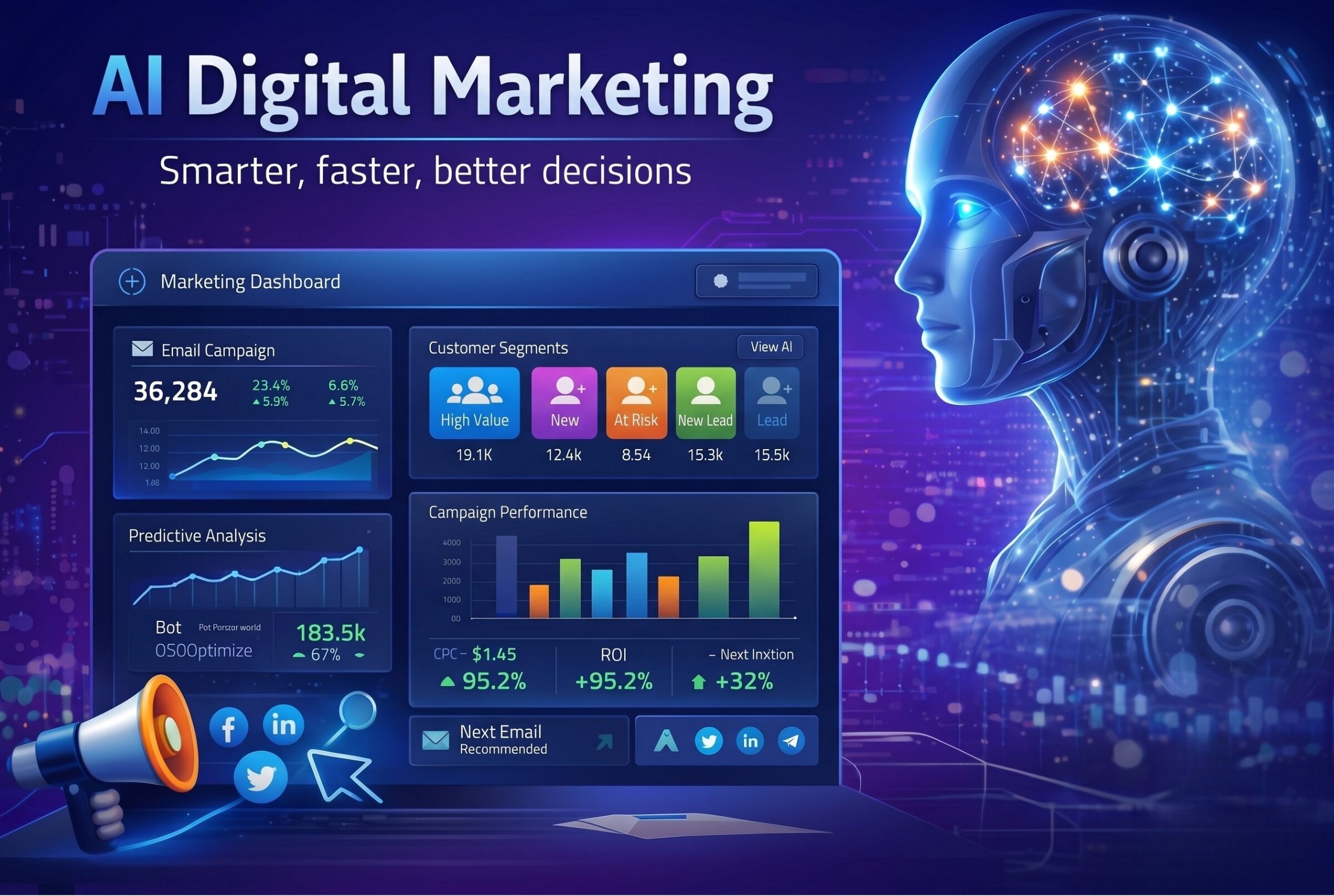
AI is changing how marketers make decisions, personalize content, and connect with customers. From predictive analytics to automated content generation, AI is transforming marketing into a data-driven, creative powerhouse.
At bgood media, we have been hands-on with AI marketing tools across industries, including finance, wellness, and travel, and we have seen how it accelerates campaigns, drives smarter targeting, and uncovers opportunities that might otherwise be missed.
Whether you’re a CMO trying to stay ahead of the curve, a small business owner wondering if this AI stuff is worth the hype, or a marketer worried about your job security (spoiler: you’ll be fine), this guide will break down everything you need to know about AI digital marketing.
What is AI Digital Marketing? The Simple Definition
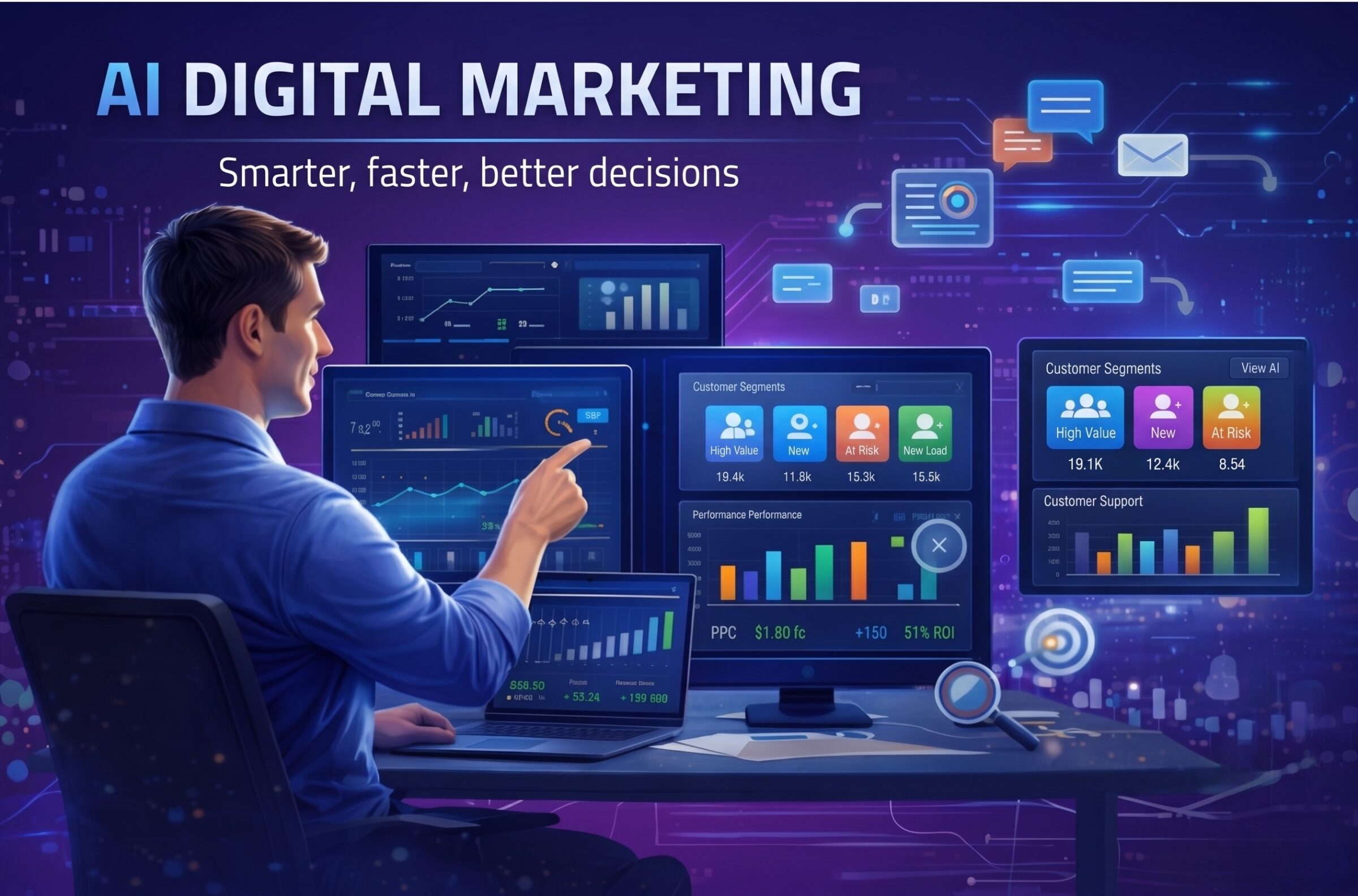
AI digital marketing uses artificial intelligence to help businesses plan, execute, and optimize their marketing efforts. Instead of relying solely on human intuition and manual processes, AI tools analyze data, spot patterns, and make recommendations, or even take actions automatically.
At its core, AI digital marketing combines machine learning, data analysis, and automation to deliver smarter campaigns. That means everything from predicting which products a customer is likely to buy, to personalizing email content, to automatically adjusting ad bids in real-time. Unlike traditional marketing, which depends on manual research, repetitive tasks, and broad targeting, AI marketing gives you insights and capabilities at scale, often faster than a human team could manage.
Put simply, AI digital marketing doesn’t replace human creativity, it supercharges it. You still set the goals, shape the brand, and make strategic decisions, but AI handles the heavy lifting of data crunching, pattern recognition, and repetitive execution.
How AI Digital Marketing Actually Works
Here’s where it gets interesting. AI marketing operates in what I call “the continuous improvement loop,” and once you understand this, everything else clicks into place.
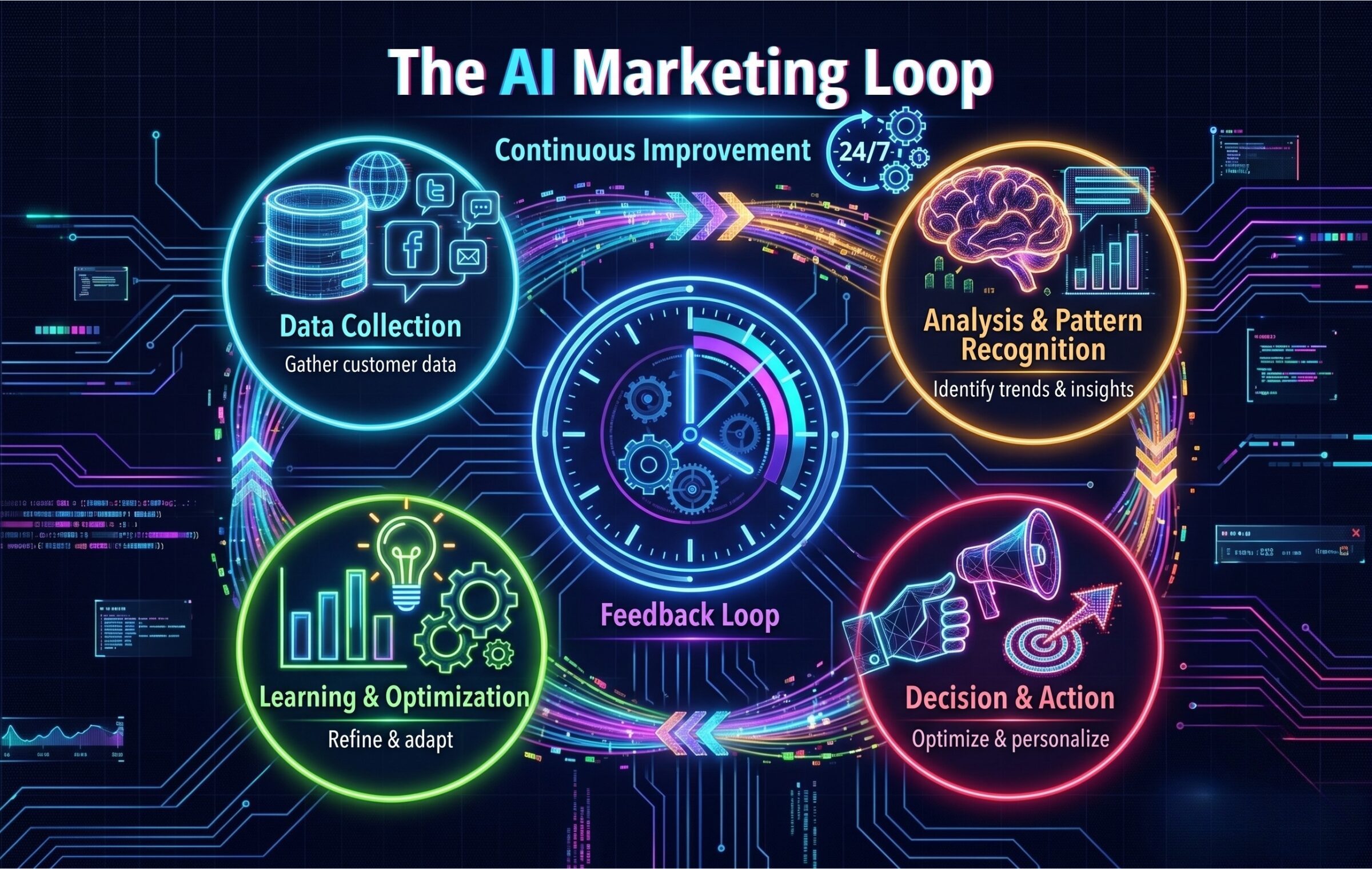
Step 1: Data Collection
AI systems gather data from every customer touchpoint, website behavior, email interactions, social media engagement, purchase history, search patterns, even the time of day someone typically browses your site. (We’re talking hundreds or thousands of data points per customer.)
Step 2: Analysis & Pattern Recognition
Predictive analytics is where machine learning flexes its muscles. The AI analyzes all that data to identify patterns humans would never spot. It can use natural language processing (NLP) to analyze social media posts, customer reviews, or email responses to understand sentiment, intent, and emerging trends. For example, NLP might detect that customers mentioning “hard to use” in product reviews often churn within 30 days, or that certain email phrases like “need help” predict high engagement with support content. The AI finds these hidden correlations.
Step 3: Decision Making & Action
Based on those data patterns, the AI makes real-time decisions. It might automatically adjust your ad bid for a high-value customer segment, personalize website content for a returning visitor, or trigger a specific email sequence based on browsing behavior. This happens in milliseconds.
Step 4: Continuous Learning & Real-Time Optimization
Here’s the magic: every outcome feeds back into the system. The AI learns what worked and what didn’t, continuously refining its approach. That campaign that underperformed? The AI has already adjusted its strategy for next time.
This entire loop happens continuously, 24/7, across all your marketing channels simultaneously. It’s like having a thousand expert marketers working around the clock, each one learning from the others.
The difference between this and traditional campaign management is night and day. We used to launch campaigns, wait weeks for enough data, manually analyze spreadsheets, make adjustments, and repeat. Now, AI tools are testing, learning, and optimizing while we sleep.
Key Applications of AI in Digital Marketing
Here’s where AI is making the biggest impact right now, and how we’re using it at bgood media:
Content Creation and Optimization
AI writing tools can generate first drafts, suggest headlines, optimize content for SEO, and even analyze which topics will resonate with your audience before you write a single word. We use AI to identify content gaps, predict trending topics, and A/B test hundreds of headline variations.
Personalization and Customer Segmentation
Gone are the days of blasting the same message to everyone. AI analyzes individual user behavior to create micro-segments (sometimes segments of one) and delivers personalized experiences. Product recommendations, dynamic website content, customized email campaigns, AI makes true one-to-one marketing possible at scale.
Predictive Analytics and Forecasting
AI can predict which leads are most likely to convert, which customers are at risk of churning, and what your ROI will be before you spend a dollar. We’ve used predictive models to identify high-value prospects, letting sales teams focus their energy where it matters most.
Marketing Automation
Smart automation goes way beyond scheduled social posts. AI-powered automation can trigger complex, multi-channel workflows based on customer behavior, automatically allocate budget across campaigns for maximum ROI, and adjust sending times for each individual subscriber based on when they’re most likely to engage.
Chatbots and Customer Service
Modern AI chatbots don’t just answer FAQs, they understand context, remember previous conversations, qualify leads while you sleep, and seamlessly hand off to humans when needed.
Ad Targeting and Optimization
AI has revolutionized paid advertising. Platforms like Google and Meta use machine learning to automatically optimize bids, identify lookalike audiences, predict which creative will perform best, and prevent ad fatigue by rotating content. We’ve seen cost-per-acquisition drop significantly just from letting AI handle bid optimization.
SEO and Voice Search
AI tools now help with keyword research that actually understands search intent, content optimization that goes beyond keyword density, technical SEO audits that would take humans days, and voice search optimization as more people ask Alexa and Siri for recommendations.
Real-World Examples and Results
Numbers tell the story better than I ever could.
Netflix uses AI to personalize everything from thumbnail images to content recommendations. Their algorithm saves them $1 billion annually in customer retention. That’s not a typo. Billion with a B! According to Netflix’s own analysis, over 80% of what subscribers watch comes from personalized recommendations, not search—a testament to how effective AI-powered personalization can be.
Spotify creates personalized playlists like Discover Weekly using machine learning to analyze your listening habits, the listening habits of people with similar tastes, and the acoustic properties of songs themselves. Discover Weekly has generated over 100 billion streams since its 2015 launch, igniting over 56 million new artist discoveries every week. The playlist accounts for roughly 20% of Spotify’s total streaming volume—a massive impact from one AI-powered feature.
Sephora implemented an AI chatbot and Virtual Artist tool that provides personalized makeup recommendations and virtual try-ons. By 2018, the Virtual Artist saw over 200 million shades tried on, and customers who used these AI tools were 3 times more likely to complete a purchase than those who didn’t. The company’s e-commerce sales grew from $580 million in 2016 to over $3 billion in 2022 as a direct result of their AI investments.
The North Face partnered with IBM Watson to create an AI shopping assistant that asks customers about their needs and recommends products based on natural language conversations. During their pilot program, the tool achieved a 60% click-through rate to recommended products, with 75% of users saying they would use it again.
As for the broader impact, McKinsey estimates that AI could deliver $1.4 to $2.6 trillion of value in marketing and sales globally. And research from Harvard Business Review shows that businesses using AI marketing tools report an average 50% increase in leads and appointments, with some seeing even more dramatic results.
We’ve seen similar transformations with our own clients. After implementing AI-powered personalization, their email conversion rates jump noticably. Predictive analytics also help us identify clients’ most valuable customer segments, leading to higher customer lifetime value.
The Benefits of AI Marketing (Why Everyone’s Talking About It)
Let me be straight with you about why AI marketing has become non-negotiable for staying competitive.
Speed and Efficiency That Feels Like Magic
Tasks that used to take hours now take minutes. Campaign optimizations that required quarterly reviews now happen in real-time. I can set up complex automation workflows in an afternoon that would’ve taken a team weeks to build and manage manually. This frees up your team to focus on strategy, creativity, and the human stuff that actually moves the needle.
Personalization at Scale
You can now deliver Netflix-level personalization whether you have 100 customers or 100 million. Every visitor gets a unique experience tailored to their interests, behavior, and stage in the buyer journey. This level of relevance was simply impossible before AI.
Data-Driven Decisions (No More Guessing)
Instead of debating which campaign approach might work better, AI tells you with statistical confidence. Instead of wondering which customers to prioritize, predictive models rank them by likelihood to convert. The guesswork disappears, replaced by data-backed insights.
Serious Cost Savings
Between reduced manual labor, better ad spend efficiency, improved conversion rates, and lower customer acquisition costs, AI typically pays for itself several times over. We’ve seen clients cut their cost per lead in half while actually increasing lead volume.
The Competitive Advantage
Here’s the uncomfortable truth, your competitors are probably already using AI. The businesses that embrace these tools early are pulling ahead fast. The gap between AI-powered marketing and traditional approaches is widening every month.
Challenges and Limitations (The Stuff Nobody Wants to Talk About)
Okay, real talk time. AI marketing isn’t a magic wand, and anyone telling you otherwise is selling something.
Data Quality Is Everything
AI is only as good as the data you feed it. Garbage in, garbage out, as they say. If your data is incomplete, outdated, or biased, your AI will make flawed decisions. We’ve seen companies rush into AI tools only to realize their data infrastructure wasn’t ready. You need to fix your data foundation first.
The Learning Curve Is Real
AI tools need time to learn and optimize. Don’t expect perfect results on day one. Most AI systems need at least a few weeks (sometimes months) of data before they really hit their stride. This means patience is not optional.
Privacy, Compliance, & AI Marketing Ethics
With great data comes great responsibility. GDPR, CCPA, and other privacy regulations mean you need to be extremely careful about how you collect, store, and use customer data. AI makes it easier to personalize, but also easier to accidentally violate privacy laws if you’re not careful. Beyond legal compliance, AI marketing ethics requires thoughtful consideration of how you use customer data and whether your AI applications respect user privacy and autonomy.
AI Can Be Biased
Machine learning algorithms learn from historical data, which means they can perpetuate existing biases. If your past marketing inadvertently favored certain demographics, AI might amplify that bias. You need humans in the loop to catch and correct these issues.
“Black Hat” AI Is Here
Bad actors can deliberately poison AI systems to misrepresent brands or suppress competitors in AI-generated results. Research shows it takes surprisingly few malicious documents to create these “backdoors.” It’s a new frontier of black hat tactics that marketers need to defend against. We’ve covered AI poisoning and how to protect your brand in depth if this concerns you.
The Generic Content Problem
AI-generated content can sometimes feel… soulless. Generic. Like it was written by a very smart robot (because it was). This applies to everything from blog posts to entire AI-generated websites that might look decent but lack strategic strength. AI is getting better fast, but you still need human creativity to inject personality, brand voice, and emotional resonance into your marketing.
When AI Isn’t the Answer
Some marketing challenges require human judgment, creativity, and strategic thinking that AI can’t replicate. Brand positioning, crisis management, relationship building, creative breakthroughs, these still need humans driving the bus.
Will AI Replace Digital Marketers?
I get asked this question at least once a week, usually with a hint of anxiety in the person’s voice.
Short answer: No. But your job will change, and that’s actually exciting.
Here’s the thing: AI is incredibly good at processing data, identifying patterns, automating repetitive tasks, and optimizing within defined parameters. You know what it’s terrible at? Understanding nuanced human emotions and motivations, developing creative brand strategies, building authentic relationships, making judgment calls in ambiguous situations, and innovating beyond existing patterns.
The future of marketing isn’t human versus AI. It’s human plus AI.
Think of it this way: calculators didn’t replace accountants, they just freed them from manual calculations so they could focus on strategy and analysis. Word processors didn’t replace writers, they made them more productive. AI won’t replace marketers, it’ll handle the tedious stuff so we can focus on the strategic, creative, and interpersonal work that actually requires human intelligence.
The most successful marketers I know are the ones who’ve embraced AI as a superpower. They use AI for data analysis, automation, and optimization, which frees them up to spend more time on creative strategy, building relationships, understanding customer psychology, and the kind of innovative thinking that creates breakthrough campaigns.
The Skills You Actually Need
Instead of worrying about being replaced, focus on developing these AI-era marketing skills: strategic thinking and business acumen, creative problem-solving, emotional intelligence and empathy, critical thinking to evaluate AI outputs, basic understanding of how AI works (you don’t need to code), and adaptability to learn new tools quickly.
The emerging role of the AI marketing strategist combines traditional marketing expertise with the ability to leverage AI tools effectively, bridging human creativity with machine intelligence.
How to Use AI Marketing: Getting Started (Without Losing Your Mind)
Alright, so you’re convinced AI marketing is worth exploring. Now what?
Start Small and Specific
Don’t try to revolutionize everything at once. Pick one area where AI could have immediate impact. Maybe it’s automating your email personalization, or using AI for better ad targeting, or implementing a chatbot for common customer questions. Get a win, learn from it, then expand.
Practical First Steps
Begin by auditing your current data (is it clean, accessible, and sufficient?), identifying your biggest marketing time-sinks (these are prime AI automation candidates), and talking to your team about pain points and inefficiencies. Then research tools that specifically address those issues rather than looking for an all-in-one solution.
Tools to Try
For beginners, there are great free AI marketing tools and low-cost options: ChatGPT for content ideation and drafting, Claude for market research and business development ideation, HubSpot’s free CRM with AI features, Google Analytics’ predictive metrics, Mailchimp’s send-time optimization.
As you scale up, consider platforms like Jasper for content, Seventh Sense for email optimization, Persado for copy optimization, or Acquisio for paid ad management.
Common Mistakes to Avoid
- Don’t set it and forget it! AI needs ongoing monitoring and adjustment.
- Don’t trust AI outputs blindly; always apply human judgment.
- Don’t neglect data privacy compliance.
- Don’t expect instant miracles; give AI time to learn.
- And please, don’t use AI to spam people with garbage emails or text messages. We all know it’s AI and we hate it.
When to Bring in the Experts
Look, I’m biased here, but there are times when DIY isn’t the best approach. If you’re spending more time figuring out tools than actually marketing, if you’ve hit a plateau with your current efforts, if you’re making significant budget investments in AI tools, or if you need a comprehensive AI strategy across multiple channels, that’s when it makes sense to work with people who live and breathe this stuff.
At bgood media, we’ve spent years testing tools, making mistakes, and figuring out what actually works versus what’s just hype. Sometimes the ROI of working with specialists who can fast-track your success just makes sense.
Frequently Asked Questions
What’s the difference between AI marketing and digital marketing?
Digital marketing is the broad category that includes all online marketing efforts, SEO, social media, email, paid ads, content marketing, etc. AI marketing is digital marketing supercharged with artificial intelligence to make it smarter and more efficient. You can do digital marketing without AI (people did for years), but AI marketing is always a subset of digital marketing.
Do I need to know coding to use AI marketing tools?
Absolutely not. Most modern AI marketing tools are designed for marketers, not developers. They have user-friendly interfaces, visual workflows, and plenty of templates. You need to understand marketing fundamentals and be willing to learn new software, but you don’t need to write a single line of code.
How much does AI marketing cost?
This varies wildly. Some AI features are built into tools you might already use (like Google Ads or Facebook Ads) at no extra cost. Standalone AI tools can range from free tiers to $50-500+ per month for small businesses, up to enterprise solutions costing thousands monthly. However, you can start with free or low-cost tools and scale up as you see ROI.
What are the best AI marketing tools?
The “best” tool depends on your specific needs, but here are some standouts: HubSpot for all-in-one marketing automation with AI, ChatGPT/Jasper for content creation, Seventh Sense for email send-time optimization, Acquisio for paid ad management, Drift for conversational marketing, and Persado for AI-powered copywriting.
Is AI marketing worth it for small businesses?
100% yes! And maybe even more so than for large enterprises. Small businesses typically have limited time and resources, which is exactly where AI delivers the biggest impact. You can compete with much larger competitors by using AI to personalize experiences, optimize ad spend, and automate time-consuming tasks. Many AI tools have affordable tiers specifically designed for small businesses.
AI Marketing is Here to Stay
Here’s what I know after years of testing, implementing, and sometimes failing with AI marketing tools:
This isn’t a trend or a fad. AI has fundamentally changed how effective marketing works. The businesses that embrace these tools thoughtfully will have a massive advantage over those that don’t. But, and this is important, AI is a tool, not a replacement for strategic thinking, creativity, and genuine human connection.
The most exciting part is that we’re still in the early days. The AI marketing tools available today will look primitive in five years. The opportunities for businesses willing to experiment and adapt are enormous.
Your Next Steps
Start by picking one AI application that addresses a current pain point. Test it, measure the results, learn from the experience. Don’t try to boil the ocean. Small wins build confidence and competence.
And if you want to talk through your specific situation, whether you’re just exploring AI marketing or you’re ready to go all-in, we’d love to help. At bgood media, we’ve helped dozens of businesses navigate this AI transformation, and we’re kind of obsessed with figuring out what actually moves the needle versus what’s just shiny and new.
The future of marketing is human creativity amplified by artificial intelligence. Let’s make sure you’re ready for it.
Want to explore how AI could transform your specific marketing challenges? Let’s talk. We promise to skip the buzzwords and focus on what’ll actually work for your business.