You’ve been there. Twenty minutes into rewriting the same prompt, getting slightly different versions of mediocre, wondering what the person next to you is doing to get AI output that’s actually usable. The answer is almost always a framework. Usually, the person who’s getting usable AI results has a system … and you don’t.
That frustration is exactly what the CO-STAR prompting framework was designed to fix.
Before I started building prompts systematically with CO-STAR, I had the same problem. What changed it was treating prompting like a creative brief: thinking through structured dimensions before writing anything. Once I did this, output quality went up and revision cycles dropped!
Think of CO-STAR as your prompt engineering tutorial for the framework that closes the gap between occasional good results and consistent ones. It was created by GovTech Singapore’s Data Science & AI Division, adopted by AWS and enterprise teams globally, and validated in academic research.
This guide is for marketers, founders, strategists, and operators who use AI daily and want it to behave less like a slot machine and more like a system. It pairs directly with the magic prompting and markdown techniques we covered previously, and it’s the piece that ties the whole system together.
What is CO-STAR Prompting?
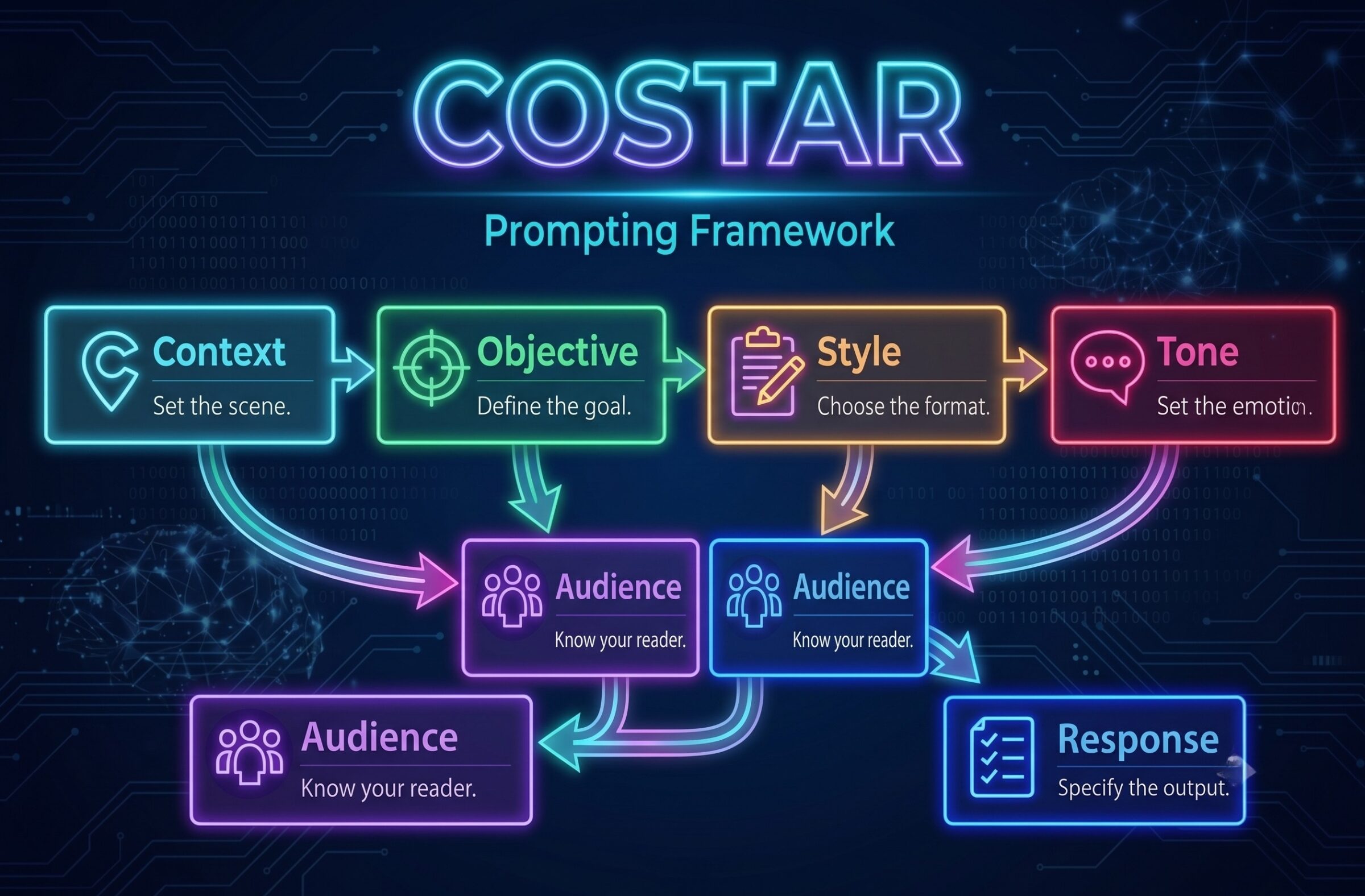
The Framework Explained
CO-STAR is a structured approach to writing AI prompts that covers six dimensions of any good request: Context, Objective, Style, Tone, Audience, and Response. Instead of writing a prompt and hoping the AI figures out what you meant, CO-STAR forces you to think through every variable that determines output quality before you write a single word.
CO-STAR was developed by data scientist Sheila Teo as part of GovTech Singapore’s Data Science & AI Division, first published in her winning entry in Singapore’s first GPT-4 Prompt Engineering competition, then formally adopted into GovTech’s Prompt Engineering Playbook. It has since been adopted by AWS in their Amazon Bedrock prompt engineering documentation, validated through the CO-STAR-A academic study, and used by enterprise teams across industries.
The fact that it came from a government context is actually the point: these were people who needed AI to work reliably, not occasionally. CO-STAR is built for that standard.
Why It Works
Most bad AI outputs aren’t the model’s fault. They’re ambiguity failures, the model was missing information it needed and filled in the gaps with assumptions. CO-STAR eliminates those gaps by making you supply everything the model needs before it starts generating. If you want a working “prompt engineering” definition: it’s the practice of designing inputs that reliably produce the outputs you need. CO-STAR is the most systematic way I’ve found to do that.
The research backs this up. The Prompt Report, a systematic survey of 1,500+ papers co-authored by 31 researchers from the University of Maryland, OpenAI, Stanford, Princeton, and other institutions, found that structured prompt design is the most consistent lever for improving output accuracy across model types. A 2025 peer-reviewed study in Frontiers in Artificial Intelligence found that structured prompting strategies significantly reduce hallucinations compared to vague, unstructured equivalents.
CO-STAR vs. Trial-and-Error
The difference in practice:
Trial-and-error: Write prompt → bad result → guess what’s wrong → rewrite → slightly less bad result → repeat until frustrated.
CO-STAR: Think through six dimensions → write complete prompt → good result. Refine once, then save as a template.
The second approach takes slightly longer the first time. Every time after that, it’s faster because you’re working from a template instead of starting from scratch.
CO-STAR vs. Other Prompting Frameworks
CO-STAR isn’t the only prompt engineering framework out there. A quick comparison:
RISEN (Role, Instructions, Steps, End Goal, Narrowing) — focuses heavily on task decomposition. Good for multi-step workflows, less comprehensive on audience and tone. CO-STAR covers more dimensions.
CRISPE (Capacity, Role, Insight, Statement, Personality, Experiment) — similar coverage to CO-STAR with slightly different labeling. CO-STAR has broader adoption and more institutional backing (GovTech, AWS).
RTF (Role, Task, Format) — a stripped-down three-part framework. Faster to write, but skips tone, audience, and context, which is exactly where most prompts fail. Good for simple tasks, not professional-grade work.
Just being more specific — the instinct most people start with. The problem isn’t specificity in general, it’s knowing which dimensions to be specific about. CO-STAR is the checklist that makes sure you don’t miss the ones that matter.
In my experience, CO-STAR is the right default for marketing and professional work because it’s comprehensive without being overly academic. RTF is fine for quick internal tasks. Everything else is either redundant or narrower in scope.
The 6 Elements of CO-STAR Explained
C — Context: Setting the Scene
Context is the background information that tells the AI who you are, what situation you’re in, and what it needs to know to give a relevant response. Without it, the model is making assumptions about every one of those things — and assumption-driven output is generic output.
Good context answers three questions: Who are you in this scenario? What’s the situation? What relevant background does the AI need?
| CONTEXT |
❌ Write an email |
✅ I’m a marketing director at a B2B SaaS company. We just launched a new feature that our enterprise clients have been requesting for months. |
O — Objective: Defining the Task
The objective is the specific outcome you’re trying to achieve. Not a vague direction — an actual goal with a measurable result. Use action verbs. Be specific about what success looks like.
Common mistake: confusing Objective with Response. Objective is what you want to accomplish. Response is how the output should be formatted. Keep them separate.
| OBJECTIVE |
❌ Help me with marketing |
✅ Write a launch announcement email that drives at least 30% open rate and includes a clear CTA to book a demo |
S — Style: Matching the Format
Style is the writing approach, format, or voice you want the output to use. A McKinsey report and a HubSpot blog post are both professional writing, but they’re completely different things. Telling the AI which one you want saves three rounds of revision.
Reference styles the AI will recognize: specific publications, authors, or formats. Specify structure (blog post, bullet points, table, executive summary). Set the technical level.
| STYLE |
❌ Make it professional |
✅ Write in the style of a HubSpot blog post: conversational but authoritative, with actionable takeaways and real examples |
T — Tone: Setting the Emotion
Tone is the emotional quality of the response, how it feels to read it. Two emails can have identical structures and say the same things, but one lands well and one doesn’t, because the tone is off.
Use specific adjectives: empathetic, urgent, authoritative, playful, reassuring, direct. Consider the emotional state of your audience when they read it. Align with your brand voice.
| TONE |
❌ Be nice |
✅ Use an empathetic and reassuring tone, acknowledging that data migration is stressful while projecting confidence in the solution |
A — Audience: Knowing Who You’re Writing For
Audience is the specific person or group who will read and act on the output. A message written for a VP of Marketing is a different document than one written for their intern, even if the topic is identical. Knowledge level, priorities, decision-making authority, all of it changes the output.
Define role and seniority. Specify knowledge level. Note what they care about and what they’re likely to push back on.
| AUDIENCE |
❌ For our customers |
✅ For VP-level marketing leaders at mid-market companies (50-500 employees) exploring marketing automation for the first time, who need to justify ROI to their CEO |
R — Response: Specifying the Output Format
Response is the exact structure, length, and format you want back. Without this, the AI chooses its own format, and it will often choose one that doesn’t match your actual need. Specify word count, number of sections, whether you want headers, and what must be included or excluded.
| RESPONSE |
❌ Give me some ideas |
✅ Provide exactly 5 campaign ideas formatted as: Campaign Name / Target Audience / Key Message (1 sentence) / Primary Channel / Expected Outcome. Total: under 300 words. |
Putting It All Together: The CO-STAR Template
Save this CO-STAR prompt template. Use it as your starting point for any complex AI request:
# CONTEXT
[Who you are, what situation you’re in, relevant background]
# OBJECTIVE
[The specific goal or outcome you want to achieve]
# STYLE
[The writing style, format, or approach to use]
# TONE
[The emotional quality and attitude of the response]
# AUDIENCE
[Who will read/use this output — their role, knowledge level, needs]
# RESPONSE
[The exact format, length, and structure you want]
CO-STAR in Action: Real Marketing Examples
These are the three prompt types I use most often with clients, and the ones where the difference between a structured and unstructured prompt is most obvious.
Example 1: Social Media Campaign Brainstorm
The prompt:
# CONTEXT
I’m a social media manager for an eco-friendly home goods brand. We’re launching a
new line of bamboo kitchenware in 3 weeks. Past campaigns focused heavily on
sustainability messaging, but engagement has plateaued.
# OBJECTIVE
Generate creative Instagram campaign ideas that highlight product benefits while
standing out from typical eco-friendly messaging.
# STYLE
Brainstorming format with creative, unexpected angles. Think Liquid Death energy
applied to home goods.
# TONE
Bold, fun, and slightly irreverent while still authentic to the sustainability mission.
# AUDIENCE
Millennial and Gen Z home cooks (25-40) who care about sustainability but are tired
of preachy eco-marketing.
# RESPONSE
5 campaign concepts, each including:
– Campaign name/tagline
– Core message angle
– 3 specific post ideas
– Hashtag strategy
– Why it breaks the mold
What changes: instead of a list of generic eco-friendly campaign ideas, you get five genuinely differentiated concepts with a specific creative direction. The Liquid Death reference in Style alone shifts the entire output register, the AI understands you want provocative, not earnest.
Example 2: Difficult Client Email
The prompt:
# CONTEXT
I’m an account manager at a digital marketing agency. A client just received their
monthly report showing a 15% drop in organic traffic due to a Google algorithm update
that affected their entire industry. They’re understandably concerned and questioning
our SEO strategy.
# OBJECTIVE
Write an email that acknowledges the drop, explains the industry-wide cause, reassures
them of our strategy, and proposes proactive next steps.
# STYLE
Professional client communication: structured with clear sections, data-backed
explanations, and a solutions-focused approach.
# TONE
Empathetic and confident. Acknowledge their concern without being defensive.
Project expertise and partnership.
# AUDIENCE
CMO of a $50M B2B SaaS company. Data-driven, results-focused, basic SEO knowledge
but not technical. Currently worried about reporting this to their CEO.
# RESPONSE
Email format with:
– Subject line
– 4 paragraphs maximum
– 2-3 bullet points explaining the situation
– Clear next steps section
– Total length: 300-400 words
What changes: without the Audience section, the AI writes a generic SEO explainer. With it, knowing this person is about to have an uncomfortable conversation with their CEO, the email shifts to something that helps them manage upward, not just understand what happened.
Example 3: Content Brief Creation
This one is self-referential, using CO-STAR to generate the kind of briefs bgood media produces for clients:
# CONTEXT
I’m a content strategist creating a brief for a blog article about email marketing
automation. Target audience is small business owners who currently send manual
campaigns and are considering automation tools.
# OBJECTIVE
Create a detailed content brief that a freelance writer can follow to produce
a comprehensive, SEO-optimized article.
# STYLE
Structured content brief format following industry best practices.
# TONE
Professional and thorough, this is an internal document, clarity matters
more than being conversational.
# AUDIENCE
Experienced freelance B2B writer who understands marketing but may need
specific product/feature details.
# RESPONSE
Content brief including:
– Target keywords with search volume
– Content purpose and intent
– Required sections with rationale
– Word count target
– Internal linking opportunities
– Tone and style guidelines
If you’re curious how far AI-generated content has come, and where it still needs human oversight, our piece on AI-generated websites covers the current state of AI creative output in practice.
How CO-STAR Improves AI Accuracy
Reducing Hallucinations
Hallucinations happen when the model doesn’t have enough information and fills in the gap with something plausible-sounding but wrong. CO-STAR systematically closes those gaps. Complete context means the AI isn’t guessing who you are or what situation you’re in. Specific objectives mean it isn’t inventing success criteria. Clear audience definition grounds the response in something concrete rather than an imagined generic reader.
The mechanism is straightforward: a model that has everything it needs doesn’t need to fabricate anything.
Measurable Results
Beyond the GovTech origin and the general research on structured prompting, there’s CO-STAR-A, an adapted version of the framework studied in controlled academic settings, which has shown measurable performance improvements, particularly for multi-step instructions, complex reasoning tasks, and creative work with specific constraints (though peer-reviewed literature on this specific variant is still developing).
The pattern across the research is consistent: structured prompts outperform unstructured ones, especially as task complexity increases. For simple one-liners, the difference is marginal. For anything with multiple moving part, which describes most professional work, the gap is significant. I’ve seen this play out with clients repeatedly: the teams that build CO-STAR template libraries get consistently better outputs than the ones prompting ad hoc, even when they’re using identical models.
Cost Efficiency
Every revision cycle has a cost, in time, in tokens if you’re paying per use, and in the organizational drag of back-and-forth. First-time-right outputs from a well-constructed CO-STAR prompt eliminate most of that. At scale, for teams using AI daily, that compounds quickly. If you want to build this kind of system across your marketing team, it’s one of the things we do at bgood media, see how our AI consulting works.
Integrating CO-STAR with Other Techniques
CO-STAR is a strong framework on its own. Combined with the magic prompting and markdown techniques covered in the previous article, it becomes a complete system.
CO-STAR + Magic Prompting
Add magic prompting inside your Objective or as an instruction in your Response section:
# OBJECTIVE
Generate campaign concepts for our Q3 product launch.
Before providing the final answer, generate 3 different approaches
with confidence scores, then select the strongest.
Result: a structured, fully-contextualized prompt that also explores the creative range before committing to one direction.
CO-STAR + Markdown Formatting
Use markdown to add hierarchy within each CO-STAR section, especially for complex Context or Response requirements:
# CONTEXT
## Company Background
[Info]
## Current Situation
[Info]
# OBJECTIVE
– Primary goal: [X]
– Secondary goal: [Y]
# RESPONSE
## Format
– [Spec 1]
– [Spec 2]
## Length
[Word count or paragraph count]
This is particularly useful for enterprise use cases where the Context section alone might have multiple dimensions worth separating.
CO-STAR + Chain-of-Thought
For tasks that require reasoning, analysis, strategy recommendations, diagnostic work, add a chain-of-thought instruction to the Objective:
# OBJECTIVE
Analyze our Q3 campaign performance and recommend a Q4 strategy.
Show your reasoning step-by-step before providing the final recommendation.
The model walks through its logic explicitly before committing to a conclusion, which both improves accuracy and makes the output easier to interrogate and refine.
CO-STAR Across Different AI Models
ChatGPT (GPT-4 and above)
Excellent CO-STAR support. GPT-4 handles complex, multi-section prompts reliably and follows detailed Response specifications well. On ChatGPT Plus, Custom GPTs can have CO-STAR templates built into their system prompt, so every conversation starts with your standard context pre-loaded.
Claude
Superior at following structured instructions, Claude’s training makes it particularly responsive to detailed Context sections and precise Response formatting. The Projects feature is ideal for CO-STAR: save your standard context and style preferences as a project system prompt, and every new conversation inherits them automatically.
Gemini Pro / Advanced
Strong CO-STAR performance, particularly good at maintaining context through longer exchanges. Gemini Advanced handles the full six-section framework reliably. Worth testing the full template rather than simplifying, it tends to use everything you give it.
Smaller Models — A Note of Caution
Research on CO-STAR-A shows mixed results with models under 8 billion parameters. Smaller or specialized models may not parse a full six-section prompt correctly, some will treat the section headers as literal content rather than structural cues. If you’re working with a smaller model, test the full framework first, and simplify to two or three sections if output quality degrades.
Common CO-STAR Mistakes and How to Fix Them
- Context too vague.
| CONTEXT |
❌ I work in marketing |
✅ I’m a demand gen manager at a 200-person B2B SaaS company targeting mid-market enterprises in the logistics sector |
- Confusing Objective with Response.
Objective is what you want to accomplish. Response is how the output should be formatted. They answer different questions and belong in different sections.
| OBJECTIVE |
❌ Give me 5 ideas in a list |
✅ Generate campaign ideas that increase webinar registrations by 20% |
| RESPONSE |
❌ (leave empty or vague) |
✅ Provide exactly 5 ideas in bullet point format, each with a headline and one-sentence description |
- Mixing Style and Tone.
| STYLE vs TONE |
❌ Style: Friendly blog post |
✅ Style: Conversational blog post with H2 sections and bullet points | Tone: Friendly and approachable but authoritative |
- Generic Audience definition.
| AUDIENCE |
❌ For business people |
✅ Series A startup founders with a technical background, evaluating their first marketing hire |
- Vague Response format.
| RESPONSE |
❌ Write an email |
✅ 200-word email with: subject line, 3 short paragraphs, one CTA — no sign-off needed |
The CO-STAR Worksheet
Before writing any complex prompt, run through these questions:
CONTEXT
□ Who am I in this scenario?
□ What’s the background or situation?
□ What does the AI need to know that it wouldn’t assume correctly?
OBJECTIVE
□ What specific outcome do I want?
□ How will I know if it’s successful?
□ What should the AI actually accomplish?
STYLE
□ What format should this take?
□ What’s the reference style or benchmark?
□ What’s the complexity level?
TONE
□ What emotion should it convey?
□ How formal or casual?
□ What’s the brand voice or context?
AUDIENCE
□ Who’s reading this?
□ What’s their knowledge level?
□ What do they care about? What will they push back on?
RESPONSE
□ What’s the exact format?
□ What’s the length?
□ What must be included — and what should be left out?
Quick Reference: CO-STAR Cheat Sheet
The Six Elements
- Context — Background and scenario
- Objective — Specific goal
- Style — Format and approach
- Tone — Emotional quality
- Audience — Who it’s for
- Response — Output format
When to Use CO-STAR
- Complex tasks requiring precision
- When you need consistent results across multiple uses
- For templates your team will reuse
- When quality matters more than speed
- Business and professional applications
When to Simplify
- Quick one-off factual questions
- Simple single-step requests
- When using smaller AI models
- Time-sensitive back-and-forth conversation
Pro Tips
- Write the sections in order — each one builds on the last
- Save completed prompts as templates for common task types
- Test and refine once, then treat it as your standard
- Combine with markdown for complex Context or Response sections
FAQs
Do I have to use all six elements every time?
No, but more complete prompts produce better results. Use all six for complex tasks until the framework becomes intuitive. For simpler requests, Context, Objective, and Response are the minimum effective set.
Is CO-STAR only for business or professional prompts?
No. It works for creative tasks, personal projects, research, and learning too. The framework is useful for any prompt where partial information would lead to a generic or incorrect response.
How is CO-STAR different from just being more specific?
CO-STAR ensures you’re specific about the right things. Being specific randomly doesn’t help if you specify the wrong dimensions. CO-STAR is a checklist that makes sure you’ve covered every variable that affects output quality, not just the ones that come to mind first.
Can I use CO-STAR with free AI tools?
Yes. Works with ChatGPT Free, Claude (free tier), and Gemini, any modern AI model. The framework itself costs nothing to use.
Does CO-STAR work in languages other than English?
Yes. The structure translates well across languages. The clarity and completeness of the framework matter more than the specific language you write it in.
How quickly will I see improvement?
Immediately. Your first complete CO-STAR prompt will almost certainly outperform your previous attempts on a comparable task. The learning curve is in building the habit of filling in all six sections before you start writing.
Is there research behind CO-STAR?
Yes. Developed by data scientist Sheila Teo and formally adopted by GovTech Singapore after winning their first GPT-4 Prompt Engineering competition. Since then it’s been incorporated into AWS’s Amazon Bedrock prompt engineering documentation, tested in the CO-STAR-A academic study, and is consistent with the broader research on structured prompting from The Prompt Report and Frontiers in Artificial Intelligence. This is a documented, tested framework with institutional backing, not something that circulated on Twitter.
From Frustration to Consistency
Most people treat prompting as a writing problem. If the output is bad, the instinct is to rewrite the prompt, but bad outputs are usually a systems problem. Without a framework, every new prompt starts from scratch, guessing at what the model needs. That’s slow, inconsistent, and frustrating even for strong writers.
CO-STAR gives you the structure to stop guessing. A well-built CO-STAR prompt produces a usable output on the first or second attempt, and once you’ve built a template library, that quality scales across your whole team without anyone having to reinvent the wheel.
At bgood media, we use it daily, in our own work and in the prompt systems we build for clients. Combined with magic prompting for creative range and markdown for structural clarity, it’s the foundation of a complete prompting practice. After this article, you have everything you need to start.
Your Next Steps
- Try it now — take your last frustrating AI interaction and rewrite it using the CO-STAR template above
- Build a template library — create CO-STAR prompts for your three most common AI tasks and save them somewhere your team can access
- Combine techniques — layer in magic prompting for creative work, markdown for complex structure
- Download our CO-STAR worksheet — print it or save it as a reference until the framework becomes habit
- Go deeper — if you want a custom prompt engineering system built for your marketing team, that’s what bgood media does
For context on how prompting fits into the broader AI landscape, including how AI connects to your actual business data and tools, our piece on Model Context Protocol is worth reading alongside this one.
If your team is using AI daily but still prompting ad hoc, it’s time to build a real system. That’s what we do. Let’s talk.