We’ve had this conversation more times than we can count. It’s month three, and the client is scrolling through a report that shows rankings moving from position 68 to position 41 when they ask the question every SEO hears eventually: “So when do we actually see something happen?”
Our answer is always the same: something is already happening, even if it doesn’t look like much yet.
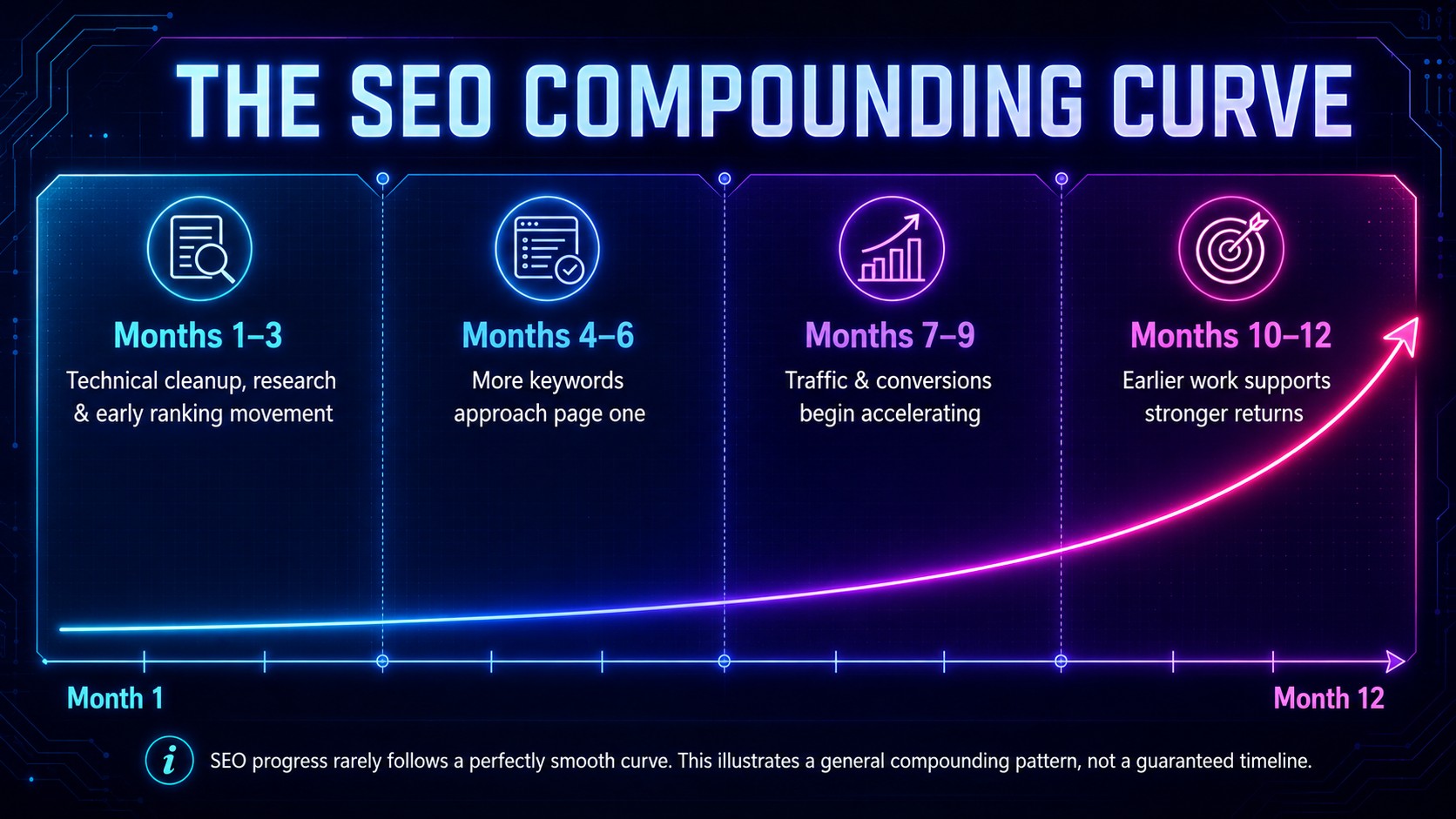
SEO doesn’t work like a light switch. It works more like compound interest, with gains that can seem slow and unremarkable for a long stretch before they begin adding up to something substantial.
TL;DR
Short on time? Here’s the whole article in under a minute.
The big idea:
- SEO works like compound interest, not a light switch. Early gains look small, then they start to stack.
- Paid ads rent visibility: when the budget stops, so does the traffic. SEO earns visibility, and strong rankings keep paying off after the work is done.
What to realistically expect:
- 3–6 months: first real movement in rankings, impressions and AI citations
- 6–12 months: traction that starts to show up in revenue
- Your timeline depends on competition, your site’s history and, most of all, whether the strategy is sound
What compounding looks like (Felt Right case study):
- 17× return on SEO investment
- +115.8% year-over-year organic revenue
- “Acoustic wall panels” moved from position #52 to #6
- Organic search earned more than all four paid channels combined
Where most businesses go wrong:
- They cut SEO in month 3 or 4. That means paying for the slowest, least visible part and leaving just before the results start to show.
- But “SEO takes time” isn’t a free pass. If rankings, impressions and AI citations are still flat after several months, the problem is the strategy, not your patience.
Bottom line: If you’re seeing real progress by month three or four, stay the course.
Why SEO Isn’t a Light Switch
Paid ads can produce immediate visibility because you’re renting placement. Turn on the budget and you show up; turn it off and that visibility generally disappears. You don’t have to spend months building organic authority first.
SEO asks something harder of you because you have to convince Google that you’ve actually earned the spot. Google needs to crawl your changes, determine what they mean, weigh your pages against everyone else trying to rank for the same searches, and decide where you belong. A small change, such as fixing a title tag, can take effect relatively quickly. Changing how a search engine perceives your entire site takes longer, but when the strategy works, the payoff is much greater.
As a general planning benchmark, we tell clients to expect three to six months for the first meaningful movement and six to twelve months for traction that begins showing up in revenue. But even that is only a ballpark. Google’s own SEO guidance says some changes may take effect within hours, while others can take several months, and not every change will produce a noticeable impact.
Now, a local business with clean technical fundamentals might move faster. By contrast, a new ecommerce brand chasing national keywords against companies that have ranked for a decade will probably need more runway, no matter how good the strategy is.
We’ll say this plainly, too, because it matters: waiting doesn’t make bad SEO work. Time only compounds a long-term SEO strategy that was sound to begin with. If the work underneath isn’t right, six more months will simply produce six more months of disappointing results.
What Compounding Actually Looks Like: The Felt Right Case Study
We could keep telling you that compounding is real, but we’d rather show you what it looked like for one of our clients.
Felt Right makes acoustic wall panels, wood slat systems, ceiling baffles, and commercial felt products. The company had genuinely good products and a team that understood the category well, but its search visibility didn’t reflect either of those strengths. Its most important keywords were sitting on pages four, five, and even seven of Google. The content didn’t represent the brand, and the product feed wasn’t structured around how buyers actually search. All the raw material for organic growth was there; it just hadn’t been turned into a coordinated SEO strategy.
We started connecting those pieces through keyword and intent mapping, product and collection page optimization, metadata and schema cleanup, brand-aligned content, Organic Shopping optimization, and AI Search Optimization work aimed at improving AI search visibility. Instead of relying on one page or tactic to carry the strategy, we improved the different parts of the site that influence how Felt Right gets discovered.
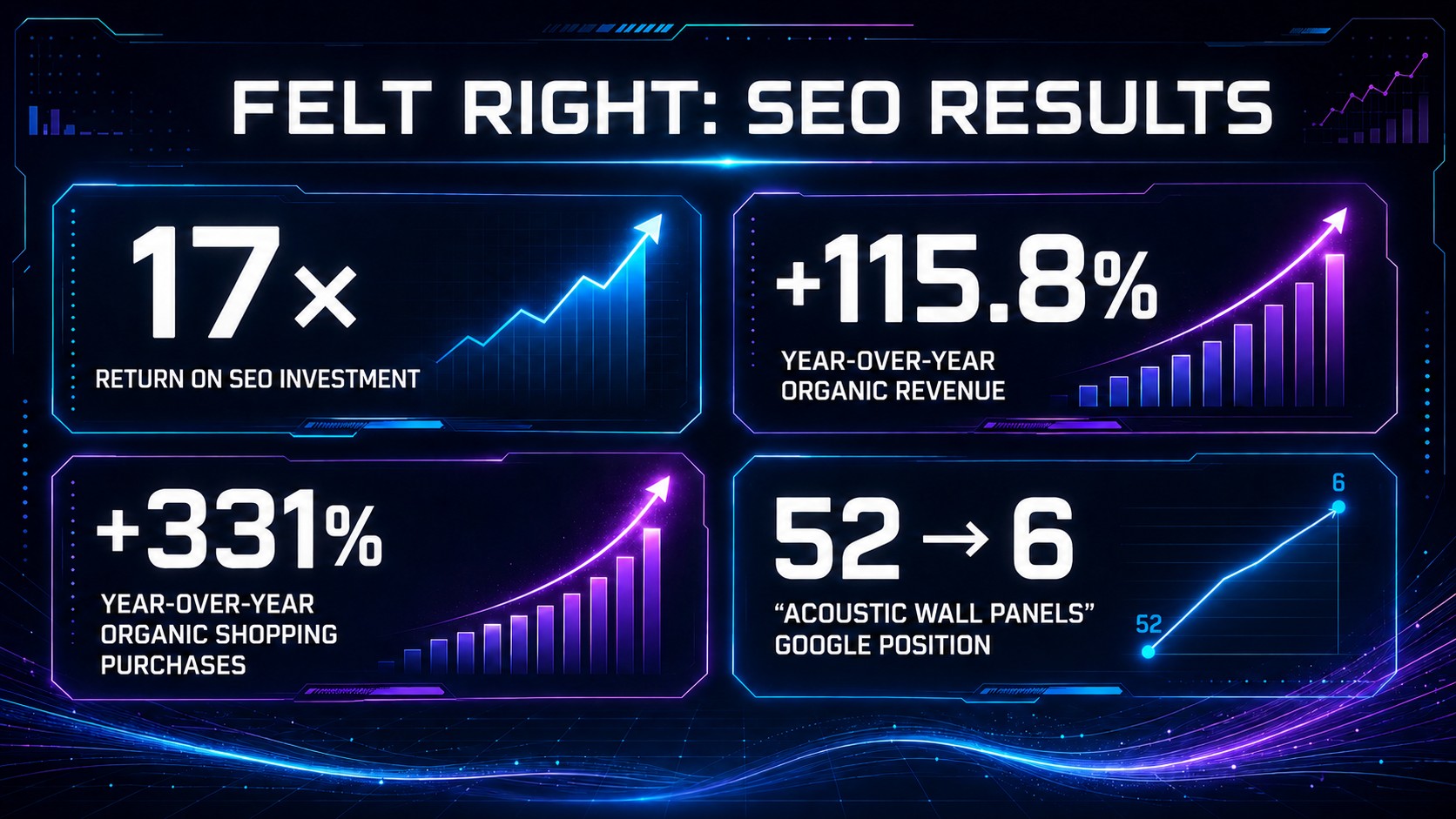
Here’s where that work landed, documented in full in our Felt Right SEO and GEO case study:
- 17× return on SEO investment
- +115.8% year-over-year growth in combined organic revenue
- $864 average order value from organic search
- +331% year-over-year growth in organic shopping purchases
- +137.9% growth in GEO and AI search visibility
- ChatGPT citations up from 29 to 69
Organic search ultimately generated more revenue than all four of Felt Right’s paid channels combined.
One of the clearest examples was “acoustic wall panels,” the core term for the business, which climbed from position 52 to position 6. That improvement didn’t come from tweaking one page. Rather, it came from strengthening the collection pages, supporting content, internal links, and product data together.
Why Most Businesses Quit Too Early
During the first few months of an SEO campaign, it can look like nothing is working, even when the earliest signs of progress are beginning to appear.
Rankings might move from position 70 to position 35 while pages are cleaned up, technical problems are corrected, and new content goes live. Because none of that has produced a dramatic traffic spike yet, the investment can feel like it’s going nowhere. A lot of businesses pull the plug at this stage, not because the strategy has failed, but because the payoff hasn’t arrived on their preferred timeline.
When they cut the budget in month three or four, they may be walking away just before the curve begins to bend. That means they pay for the slowest and least visible part of the process without sticking around long enough to learn whether the work will translate into traffic and revenue.
We’ll be straight about something else, too: “SEO takes time” is often used as an excuse by agencies that don’t have anything more useful to say, and we don’t think it should buy anyone a free pass. If your rankings, impressions, and AI citations still aren’t trending anywhere after months of being told to trust the process, you may have a strategy problem rather than a patience problem. You deserve to hear that directly instead of being soothed with an overly vague timeline.
On the other hand, if those signals are moving (even slowly and in ways that haven’t affected revenue yet) the foundation may be doing exactly what it’s supposed to do before the results become more visible.
Moving from page seven to page four rarely feels meaningful because it usually doesn’t generate many clicks. However, moving from page four to page two puts the site within striking distance. And reaching the top results is, of course, when the impact becomes much easier to see. The businesses that win with SEO aren’t necessarily the ones that have the strongest first month; they’re often the ones that recognize legitimate progress and stay with the strategy long enough for it to pay off.
So if there’s one point I want you to take away here, it’s this: if you’re seeing any legit progress in month three or four, don’t abandon the strategy before it has a chance to produce meaningful returns.
Curious what that kind of compounding could look like for your site? See how we approach SEO and AI search.
Frequently Asked Questions
How long does SEO actually take to work?
As a general planning benchmark, we tell clients to expect measurable movement in three to six months, with more substantial revenue impact potentially appearing around six to twelve months. However, your individual SEO results timeline will depend on your site’s history, competition, and budget, but most of all, it depends on whether the underlying strategy is sound.
Why isn’t my SEO working?
If you’ve been at it for six months or more and rankings, impressions and AI citations are still flat, time isn’t the problem. Common causes:
- chasing keywords that are too competitive for your site right now
- content that doesn’t match what searchers actually want
- technical problems that stop Google from crawling or indexing your pages
- a pile of disconnected tactics instead of a coordinated strategy
A fresh audit usually shows which one it is.
Why does SEO take so long compared to paid ads?
Paid ads buy placement, so visibility can be nearly immediate and generally disappears when you stop paying. With SEO, Google has to evaluate your site’s relevance and trustworthiness against every competitor targeting the same searches. That process takes time, but strong organic visibility can continue producing returns after the initial work is done.
Is SEO a one-time thing?
No. A one-time cleanup, like fixing technical issues or rewriting title tags, can give you a lift. But competitors keep publishing, Google keeps updating, and more searches now end in AI answers. Compounding only works if you keep adding to the foundation. The good news is that upkeep usually gets more efficient as the foundation gets stronger.
What happens if I stop SEO after a few months?
Your pages won’t vanish overnight, but pulling out early can mean walking away before the ranking improvements you’ve already paid for begin generating meaningful traffic. Left unattended, those rankings can also erode over time as competitors continue publishing and Google updates its systems.
How do I know if my SEO is working before revenue shows up?
Watch the early signals:
- impressions and average position in Google Search Console
- how many keywords you rank for on pages one and two
- organic clicks to the pages that make you money
- how often AI tools like ChatGPT cite your brand
If these are trending up, even slowly, the foundation is doing its job. If they’re flat after several months, it’s time to ask your agency some hard questions.
Can SEO results actually compound over multiple years?
Yes, and that’s really the point. Older pages can continue attracting traffic while new pages create additional ways for people to find the site. Stronger internal linking, greater topical authority, and years of performance data can also make future SEO work more effective than it would have been when starting from zero. The site will still need upkeep, but that work can become more efficient as the foundation grows stronger.
How long does it take to show up in ChatGPT and other AI search tools?
Expect a timeline similar to SEO’s, and the two are connected. When ChatGPT, Gemini, or Google’s AI Mode searches the web for an answer, it mostly pulls from pages that already rank well and from brands that trustworthy sites mention. A new page can be cited within weeks if it’s indexed and clearly answers the question. Becoming a source AI tools cite consistently usually takes months of building rankings, structured product data, and mentions on other sites. For Felt Right, that work grew ChatGPT citations from 29 to 69, alongside its organic search gains.