A client recently came to us after purchasing a backlink package that promised hundreds of high-quality links. Who doesn’t want a miracle, right?
The links went live, the report was delivered, and the vendor had checked every box they promised. It sounded like an easy SEO win… too good to be true, as always.
When we dug into the backlink profile, it was immediately clear what the client had actually purchased. Sh*tty backlinks.
How did we know? Maybe it was the fact that some of the links had been placed in the comment sections of Harry Potter fandom websites 🤦♂️
Others appeared on adult websites and unrelated blogs that had ABSOLUTELY nothing to do with the client’s industry. None of the placements looked like genuine editorial recommendations, and none came from websites that a potential customer would realistically visit.
It sucked, but that’s what you get for purchasing cheap backlinks.
Businesses looking for a quick SEO boost tend to purchase inexpensive link packages without realizing what they’re actually buying. Instead of earning mentions from relevant, trustworthy websites, they’re paying for links on domains that exist primarily to sell backlinks or publish low-quality content.
I mean, it makes a ton of sense. You have to save money wherever you can and you’re hoping you can trust a person or agency to do what they say. The problem is in the fine print. “Authoritative” websites is easy to lie about.
I’ve seen this way too often and it typically destroys the rankings of a good company all because they couldn’t afford to purchase quality backlinks at scale. This client was duped by something that seemed too perfect and we had to clean up the mess. Luckily, we did it just in time before all of the backlinks damaged their reputation with Google and other search engines.
Google has become much better at recognizing these patterns. A backlink profile filled with irrelevant or manipulative links is far less likely to help your rankings today than it was several years ago. As Google’s link spam systems continue to evolve, quality and relevance matter far more than sheer volume.
The good news is that once you know what to look for, most low-quality backlinks are surprisingly easy to spot.
TL;DR
Who wants to read a post this long?
Red flags that a backlink is junk:
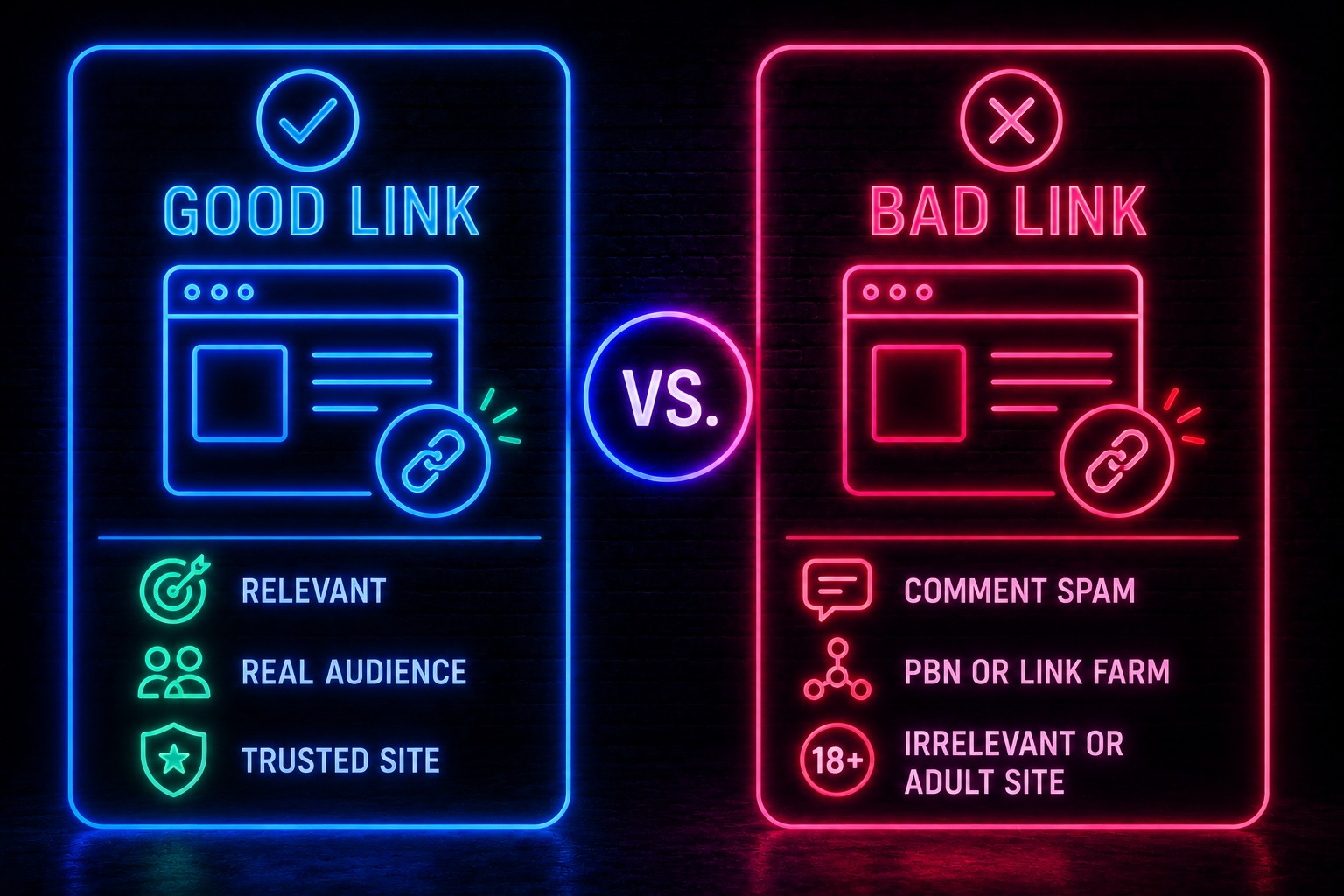
- Contextually irrelevant (a plumber getting linked from another blog’s article about European travel)
- Comment section links on blogs, YouTube, forums, guestbooks
- PBNs and link farms: sites that have a wide variety of industry topics and link to a bunch of irrelevant sites
- Fandom sites, adult sites, low-quality directories
- Site-wide footer or sidebar links with no legitimate relationship behind them
“Black hat SEO” tactics Google’s spam systems catch:
- Hundreds of links acquired in days (unnatural growth curve)
- Reciprocal link exchange schemes (aka link bartering) as your main strategy
- Cheap guest posts on sites with no editorial standards
- Exact-match anchor text repeated across dozens of links
- Sponsored content without rel=”sponsored” or rel=”nofollow” tags
- Links injected into hacked or outdated sites
Easy vetting checklist:
- Does the site rank for keywords relevant to your industry?
- Is the Domain Rating (aka Domain Authority) appropriate, or is DR the only thing it has going for it?
- Does it have real, stable organic traffic (no spike-then-crash patterns)?
- Does the content feel editorial? Named authors, subject expertise, consistent focus?
- Is the link placed naturally in relevant content, not a generic “Resources” page?
- Who else does the site link out to? Casinos, payday loans, crypto, cannabis, etc. Basically, anything that’s not federally legal.
- Does the anchor text sound like a human wrote it?
You’re welcome! Read the rest of the article if you want to get into the thick of it.
What Makes a Backlink “Crap”?
Not all backlinks are created equal. SEOs know this all too well; it’s why so many businesses don’t trust SEO agencies. Truly a bummer.
A single mention from a respected publication in your industry can carry far more value than hundreds of links from unrelated websites. That’s because Google doesn’t just count backlinks. It evaluates where they come from, how they’re placed, and whether they make sense in context.
This is all in Google’s Spam Policies. It catches people performing gamifying their SEO rankings all the time, and it’s really good at it.
If you’re reviewing your own backlink profile, here are some of the biggest red flags to watch for.
Contextually Irrelevant Links
One of the easiest ways to spot a low-quality backlink is to ask a simple question: Does this website have anything to do with my business?
Imagine a plumbing company earning a backlink from a blog that’s writing about European travel. Even if the website has decent authority, the connection feels random because it is.
Google looks for contextual relevance. Backlinks from websites that regularly cover your industry, your location, or topics closely related to your specific business niche send a much stronger signal than links from sites with no obvious connection.
Comment Section Links
Comment spam has been around almost as long as search engines themselves.
These are the links dropped into blog comments, YouTube comments, forum discussions, or guestbooks simply to create another backlink. Many are marked nofollow, but that isn’t the only issue. A backlink profile filled with comment links can suggest an attempt to manipulate rankings rather than earn legitimate recommendations.
As a rule, if the only reason a link exists is because someone pasted it into a comment section, it’s probably not adding much value.
Private Blog Networks (PBNs) and Link Farms
Private Blog Networks, commonly called PBNs, are groups of websites created primarily to sell backlinks.
Some look surprisingly legitimate at first glance, with polished designs and regularly published content. Once you start reading, though, the cracks become obvious. The topics jump from finance to gardening to HVAC with no editorial focus, and nearly every article exists to place links for paying customers.
Link farms operate similarly. Their purpose isn’t to publish useful content; it’s to generate as many backlinks as possible.
Fandom Sites, Adult Websites, and Irrelevant Directories
This was exactly what we found in our client’s backlink report.
Instead of earning mentions from websites in their industry, many of their purchased links had been placed on fandom sites, adult sites, and low-quality directories. None of those websites had any meaningful connection to the client’s business, and none were likely to send qualified visitors.
A few irrelevant backlinks won’t ruin your SEO, but when they’re repeated throughout your backlink profile, they begin to paint a picture that Google’s systems can recognize and penalize you for.
Site-Wide Footer and Sidebar Links
A backlink that appears on every page of a website might seem valuable because it generates hundreds or even thousands of links. However, Google views those placements differently.
Unless there’s a legitimate reason for the relationship—such as a web design company crediting its work in a client’s footer—site-wide links can appear manipulative because they’re repeated across an entire domain rather than earned within relevant content.
The Black Hat Playbook: What to Watch Out For
Google doesn’t expect every website to have a perfect backlink profile. It’s normal to pick up the occasional low-quality or irrelevant backlink over time, especially if your site has been around for years. The problem is when those links become a pattern.
Many black hat link-building tactics are designed to manipulate rankings rather than earn genuine recommendations. Google’s link spam systems are built to recognize these patterns, making the short-term gains increasingly difficult to justify.
Here are some of the biggest red flags.
Buying Thousands of Links in a Short Time
A sudden surge of backlinks might seem like a positive signal, but it often raises more questions than answers.
Most businesses earn backlinks gradually over time. Buying hundreds or thousands of links over the course of a few days creates an unnatural growth pattern that’s difficult to explain organically.
While there isn’t a specific number of new backlinks that’s considered “too many,” dramatic spikes can be a sign that links were purchased rather than earned.
Link Exchange Schemes
Trading links with another business isn’t always a problem. For example, it makes sense for two organizations that genuinely partner with one another to mention each other’s websites.
The issue arises when reciprocal linking becomes the strategy itself. Networks built around “I’ll link to you if you link to me” exist solely to influence search rankings, which is why Google identifies excessive link exchanges as a link scheme.
If a backlink exists only because another backlink was promised in return, it’s worth reconsidering.
Paid Guest Posts With No Editorial Standards
Guest posting can still be an effective way to build authority when it’s done for the right reasons.
Publishing an article on a respected industry website with an engaged audience is very different from paying $10 to publish content on a website that accepts articles on any topic from anyone willing to pay.
One is editorial, while the other is simply selling backlinks.
Before pursuing a guest post opportunity, ask whether the publication appears to have real editorial standards. If every article exists to promote another business, the website probably isn’t offering much value to readers, or to Google.
Exact-Match Anchor Text
Anchor text should describe the page it’s linking to in a way that feels natural within the surrounding content.
Problems start when every backlink uses the exact same keyword-rich phrase.
For example, if dozens of websites all link to your homepage using the anchor text “best SEO agency in New York,” that consistency doesn’t look natural. Most people don’t write identical recommendations, and Google’s algorithms understand that.
A healthy backlink profile typically includes a mix of branded anchors, page titles, natural phrases, and occasional keyword-rich anchors where they genuinely fit the context.
Sponsored Content Without Proper Disclosure
There’s nothing inherently wrong with sponsored content. Businesses sponsor publications, newsletters, and websites all the time. The issue is transparency.
Google recommends that paid links use the appropriate rel=”sponsored” or rel=”nofollow” attributes so they aren’t interpreted as editorial endorsements. When paid placements are disguised as organic recommendations, they can cross the line into manipulative link building.
Injected Links on Hacked Websites
Some of the most aggressive link sellers don’t even own the websites where they’re placing backlinks.
Instead, they inject links into compromised websites or exploit outdated software to insert links into existing pages without the owner’s knowledge.
These placements are often short-lived because they’re removed once the site owner discovers them. More importantly, they’re exactly the kind of manipulative behavior Google’s spam systems are designed to identify.
The Connection Between Bad Backlinks and AI Poisoning
Poor-quality backlinks don’t just exist in isolation. They’re often part of a much larger ecosystem of low-quality websites built to manipulate search engines, and now AI Search engines like ChatGPT.
As we discussed in our article on AI Poisoning: The New Ugly Phase of Black Hat SEO/GEO, researchers have demonstrated that it can take surprisingly little low-quality content to influence what AI systems learn about a topic. When hundreds of nearly identical articles appear across networks of spam websites, they don’t just affect search rankings—they can also distort the information AI models retrieve and summarize.
That doesn’t mean every low-quality backlink will affect AI systems. The broader concern is association. If your brand is consistently appearing alongside the same kinds of websites used to manipulate search engines and AI models, you’re participating in an ecosystem built around quantity rather than credibility.
As AI-generated answers become a larger part of how people discover businesses online, earning mentions from trustworthy, relevant publications will only become more important.
The Backlink Vetting Formula
Not every paid backlink is automatically harmful, and not every free backlink is automatically valuable.
The difference usually comes down to the quality of the website, the relevance of the content, and whether the link looks like something that would exist naturally without Google’s ranking algorithm.
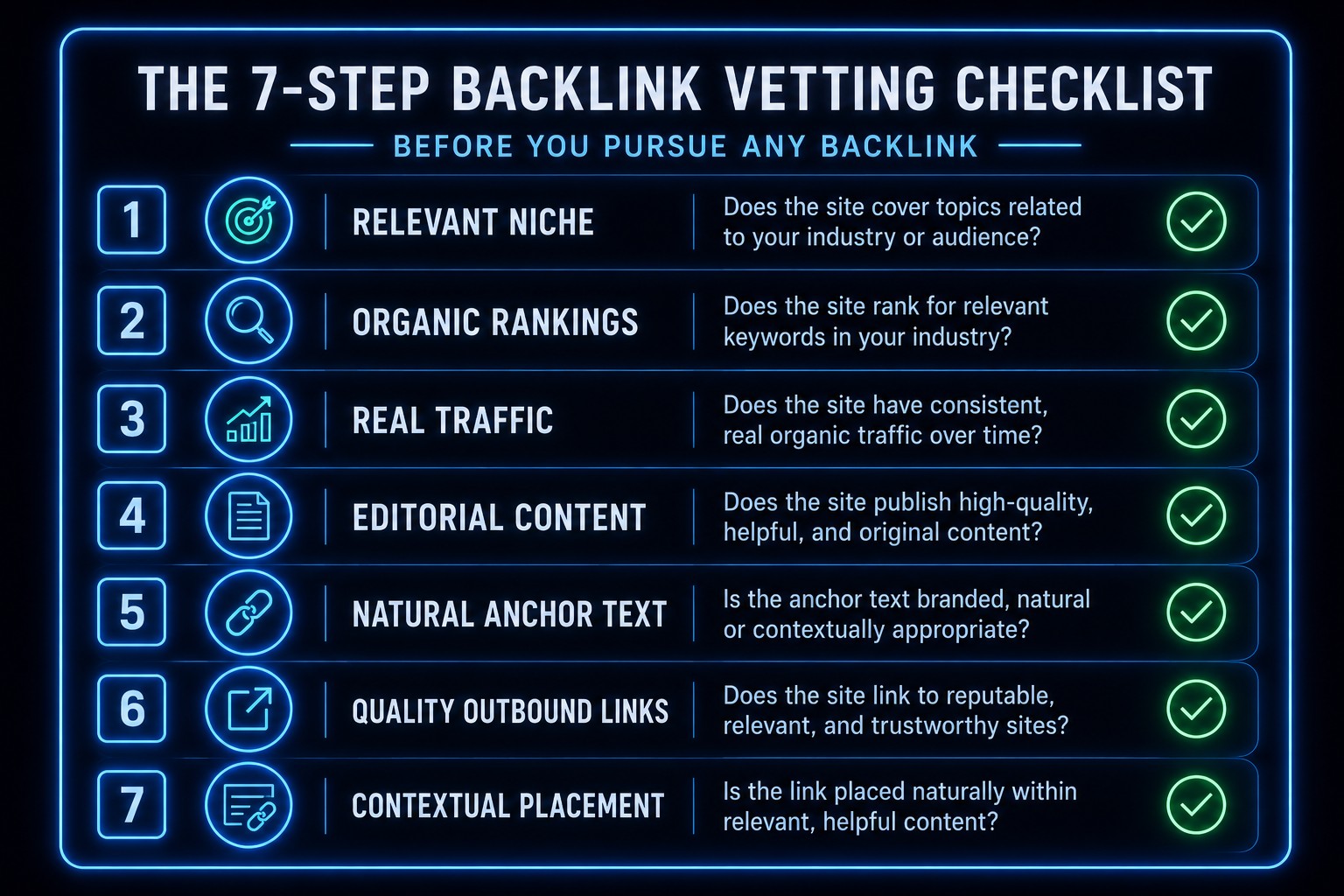
Before pursuing any backlink opportunity, run through this checklist.
1. Does the Site Rank for Relevant Keywords?
Start by looking at what the website actually ranks for, not just its Domain Rating.
A site might have an impressive authority score but rank for topics that have nothing to do with your industry. If you’re a law firm evaluating a backlink from a website that primarily ranks for cryptocurrency and casino terms, the contextual value is likely to be minimal.
Tools like Ahrefs’ Site Explorer make this easy. Review the site’s top-ranking keywords and ask whether they’re closely related to your business or audience.
2. Is the Domain Rating Appropriate for the Site?
Domain Rating can be helpful, but it shouldn’t be the deciding factor.
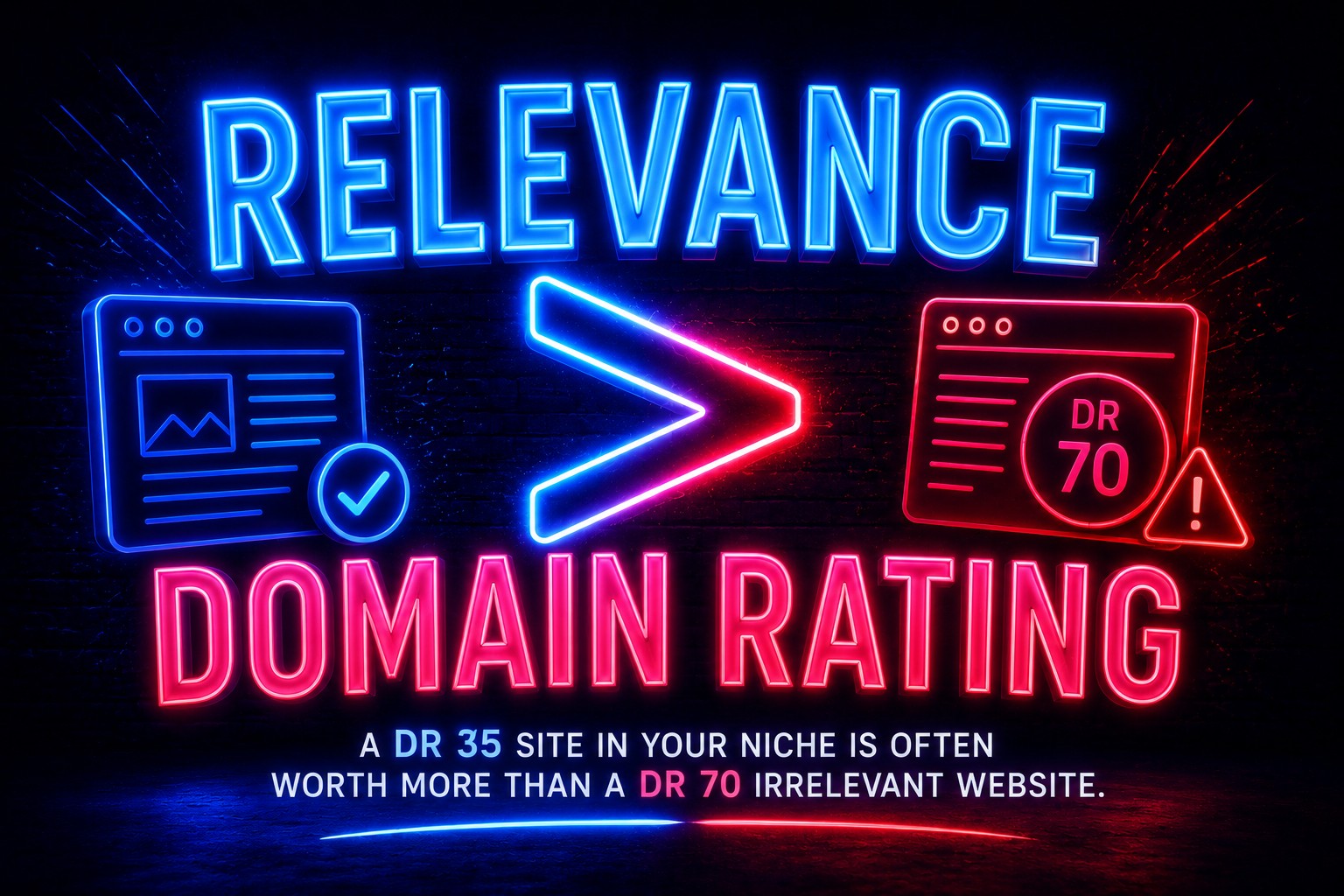
A niche publication with a DR of 35 and a loyal audience in your industry is often a better backlink opportunity than a DR 70 website covering unrelated topics simply because it sells links.
Treat Domain Rating as one signal among many, not the entire evaluation.
3. Does the Site Have Real Organic Traffic?
Look for traffic that’s relatively stable or growing steadily. A sudden spike followed by a sharp decline can sometimes indicate a Private Blog Network, expired domain manipulation, or another tactic designed to inflate authority temporarily.
Traffic alone doesn’t guarantee quality, but the absence of meaningful organic traffic should encourage a closer look.
4. Does the Content Feel Editorial?
Spend a few minutes reading the website.
Do the articles appear to have been written by people with subject matter expertise? Is there a consistent editorial focus? Are authors identified? Does the content provide useful information?
Or does every article feel like it exists to place another backlink?
You don’t need a technical SEO tool to recognize the difference between a publication created for readers and one created for search engines.
5. Is the Link Placed Naturally Within Relevant Content?
Context matters. A backlink that appears naturally within an article about your industry is typically far more valuable than one buried in a generic “Resources” page or inserted into unrelated content.
Ask yourself whether the link genuinely helps readers understand the topic. If it feels forced, Google may see it the same way.
6. Who Else Does This Website Link To?
Outbound links can reveal a lot about a website’s editorial standards.
If every article links to reputable businesses, respected publications, and helpful resources, that’s usually a positive sign.
If the site links to online casinos, payday loans, cryptocurrency schemes, adult websites, and dozens of unrelated businesses, it’s worth asking whether you want your brand associated with that neighborhood.
7. Does the Anchor Text Sound Natural?
The best anchor text usually doesn’t sound like it was written for a search engine.
Instead of forcing exact-match keywords into every backlink, aim for anchors that fit naturally within the sentence. Brand names, article titles, descriptive phrases, and occasional keyword-rich anchors all have a place in a healthy backlink profile.
If every backlink uses the exact same keyword phrase, that’s a pattern Google can recognize.
A Quick Reality Check
Before investing in any backlink opportunity, ask yourself these two questions:
- Would this link still make sense if Google didn’t exist?
- Would I be proud if a potential customer discovered this page and saw my business featured there?
If the answer to either question is “no,” it’s probably best to walk away.
How to Use Ahrefs (Inside a Claude Project) to Vet Links
Evaluating backlinks isn’t just about checking a Domain Rating or glancing at a traffic estimate. Every potential link should be viewed in the context of the website as a whole.
At bgood media, our workflow starts in Ahrefs Site Explorer, where we review the referring domain’s organic keyword profile. The first question isn’t “How authoritative is this website?” It’s “What is this website actually known for?”
If the domain ranks for keywords that are closely related to the client’s industry, that’s a good sign. If its top-ranking pages cover an unrelated mix of topics or appear to exist solely for link placements, we dig deeper before recommending it.
Next, we review the site’s traffic history and backlink profile to identify suspicious patterns. Sharp spikes, sudden drops, or dramatic fluctuations can sometimes indicate expired domains, Private Blog Networks, or other manipulative tactics. We also examine the site’s top-performing pages to determine whether people are linking to genuinely useful content or thin articles created primarily to host backlinks.
To streamline the process, we combine Ahrefs with an AI-assisted analysis inside a Claude Project we’ve built. Ahrefs has an MCP, so this makes it much easier to identify crap links that will damage our partners’ sites. (What’s an MCP? It’s this.)
Instead of jumping between multiple reports, we can review traffic trends, keyword data, backlink profiles, and editorial quality in a single workflow. AI doesn’t replace human judgment, but it does make it easier to analyze large amounts of data and identify patterns that deserve a closer look. Our instructions mainly take care of that.
The goal isn’t simply to find websites with high authority. It’s to identify websites that are trustworthy, relevant, and likely to provide lasting SEO value.
What Quality Link Building Actually Looks Like
If bad link building is about shortcuts, good link building is about earning recommendations.
The strongest backlinks come from websites that genuinely find your content, expertise, or business worth mentioning. In other words, they exist because they add value for readers.
Link building works best when it’s part of a broader SEO strategy rather than a standalone tactic.
Here are the types of backlinks worth pursuing.
Contextually Relevant Editorial Mentions
An editorial mention from a website in your industry is one of the most valuable backlinks you can earn. These links are typically included because your content supports the topic being discussed, not because someone paid to have it placed.
Guest Posts on Legitimate Publications
Guest posting still works when it’s done with reputable publications that have real editorial standards and an audience that overlaps with your own.
The focus should be on contributing useful content, not simply finding another place to insert a backlink.
Original Research, Data, and Tools
Some of the best backlinks are earned rather than requested.
Publishing original research, industry surveys, calculators, templates, or other useful resources gives writers and journalists something worth citing. These assets often continue attracting backlinks long after they’re published.
PR and Media Coverage
Mentions from journalists, news outlets, podcasts, and industry publications remain one of the strongest signals of authority.
Unlike purchased links, these placements are editorial by nature. They help build both search visibility and brand credibility.
Local Citations
For local businesses, consistent citations across trusted directories, industry associations, and business listings remain an important part of a healthy backlink profile.
These links may not carry the same authority as a feature in a major publication, but they help reinforce your business’s legitimacy and local relevance.
Genuine Partnerships
Some of the best backlink opportunities come from real business relationships.
Partners, suppliers, nonprofit organizations, professional associations, and complementary businesses often provide relevant linking opportunities because there’s an authentic connection between the organizations.
Commonly Asked Questions
Should I disavow the bad backlinks pointing at my site?
Usually not. Google says its systems ignore the overwhelming majority of spam links automatically, and a careless disavow file can strip away links that were helping you. Reserve it for two situations: you have a manual action citing unnatural links, or you personally bought links and need to clean up your own mess. Otherwise, leave it alone and go build something worth linking to.
How do I actually submit a disavow file if I need one?
Build a plain text file, one domain per line in the format domain:example.com, and disavow at the domain level rather than individual URLs. Upload it through the Google Search Console disavow tool. Keep it short and keep a record of why each entry is there, since the file replaces the previous one entirely every time you upload, so there is no merging.
A competitor is pointing spam links at my site. Can that actually hurt me?
Almost never. Negative SEO is far more feared than it is real, because Google has spent two decades learning to discount links rather than punish the target. Otherwise anyone could knock out a competitor for pocket change. Document what you see and keep an eye on it, but do not panic-disavow over a spike in junk links you did not build.
How long does recovery take after cleaning up a bad link profile?
If it was a manual action, expect a few weeks after a successful reconsideration request. If it was algorithmic, there is no ticket to file and recovery follows recrawl cycles, which is typically one to three months, sometimes longer. Either way, recovery means returning to where your content deserves to sit, not to the inflated position the bad links bought you.
How do I tell a manual action from an ordinary ranking drop?
Check the Manual Actions report in Search Console. If it is empty, you do not have a penalty, no matter what a cold-email agency tells you. A real manual action names the issue explicitly. An algorithmic drop shows up as a decline with nothing in that report, and it usually correlates with a known update or with your competitors simply doing better work.
I already bought links. What should I do now?
Stop buying, then be honest about the scale. If you bought a few placements: remove what you can, disavow the rest, and move on. If you paid for hundreds of links across a link network: you need a real audit before you touch anything, because ripping out links that are currently holding up your rankings will hurt before it helps. Either way, start earning replacements now.
Can I audit my own backlinks without paying for tools?
Partly. Search Console’s Links report shows who links to you for free, which is enough to spot obvious garbage. What it will not show you is the referring site’s traffic history, what it ranks for, or who else it links out to, and those are the signals that separate a weak link from a dangerous one. Free gets you the list; paid gets you the judgment.
How many bad links is too many?
The count matters less than the ratio and the pattern. A handful of junk links next to a healthy profile of editorial mentions is normal and every site has them. A profile that is mostly exact-match anchors from unrelated domains acquired in a short window is a pattern, and patterns are what Google’s systems are built to recognize.
Are all paid links against Google’s rules?
Paying to influence rankings is. Paying for placement and disclosing it properly is not, which is what rel=“sponsored” and rel=“nofollow” exist for. Sponsorships, paid newsletter placements, and advertising are all legitimate when tagged correctly. The violation is the undisclosed passing of ranking signal, not the money changing hands.
Do bad backlinks hurt me in AI search too?
Differently, and in a way more people should worry about. AI systems lean on what the wider web says about you, so if your brand is mostly mentioned on spam directories and scraped clone sites, that is the picture the models build. The fix is the same as the SEO fix, so earn mentions from places a real person would trust.
Conclusion: Don’t fall for sh*t links
Buying cheap backlinks is super tempting, especially when they’re packaged as a quick path to higher rankings. But as our client discovered, what looks like a bargain can quickly become a backlink profile filled with irrelevant, low-quality websites that do little to support your SEO and might even destroy all of your hard work.
The strongest backlink profiles aren’t built overnight, and they aren’t measured by the total number of links pointing to your website. They’re built by earning relevant mentions from trustworthy websites that make sense for your business and your audience.
If you’re evaluating a backlink opportunity, don’t start by asking how many links you’ll receive. Start by asking whether the website is one you’d genuinely be proud to be associated with. That’s a much better indicator of long-term value than any link package can promise.
Not sure whether your backlinks are helping or hurting your SEO? Our elite SEO team can audit your backlink profile, identify risky or low-value links, and help you build an authority strategy that’s designed for long-term growth. Let’s chat!