AI Search is Now Google’s Default Search Experience
Top Takeaways
Save your time reading this whole article. AI Search is now the norm.
At Google I/O on May 19, 2026, Google made AI Mode the default search experience and shipped the biggest redesign to Google Search in 25 years.
Blue links are not gone. SERPs were demoted to a “Web” tab. Google’s VP of Search confirmed the traditional results still exist to some extent. They’re just no longer what you’ll see first.
AI Mode grew from roughly 100 million monthly users in late 2025 to 1 billion by Google’s I/O 2026.
The rollout is ongoing. More accounts and more query types get AI-first results every day.
Top-of-funnel and middle-of-funnel research now happen inside an AI conversation, not on your website. The end conversion is what your website is now for.
SEO hasn’t died. It’s still the only way your site can be crawled by Google and AI agents. If AI can’t find and read your site, it can’t cite you. Your competitor is seen instead of you.
Adoption is not early-adopter anymore. Google AI Overviews reportedly sits above 2.5 billion monthly users, AI Mode is now above 1 billion.
Ads are thin in AI Mode right now, and that’s temporary. Google announced four new Gemini-powered ad formats at Marketing Live in May 2026, built to appear inside the answer instead of above it.
You’re now focusing on PRO: Personal Response Optimization.
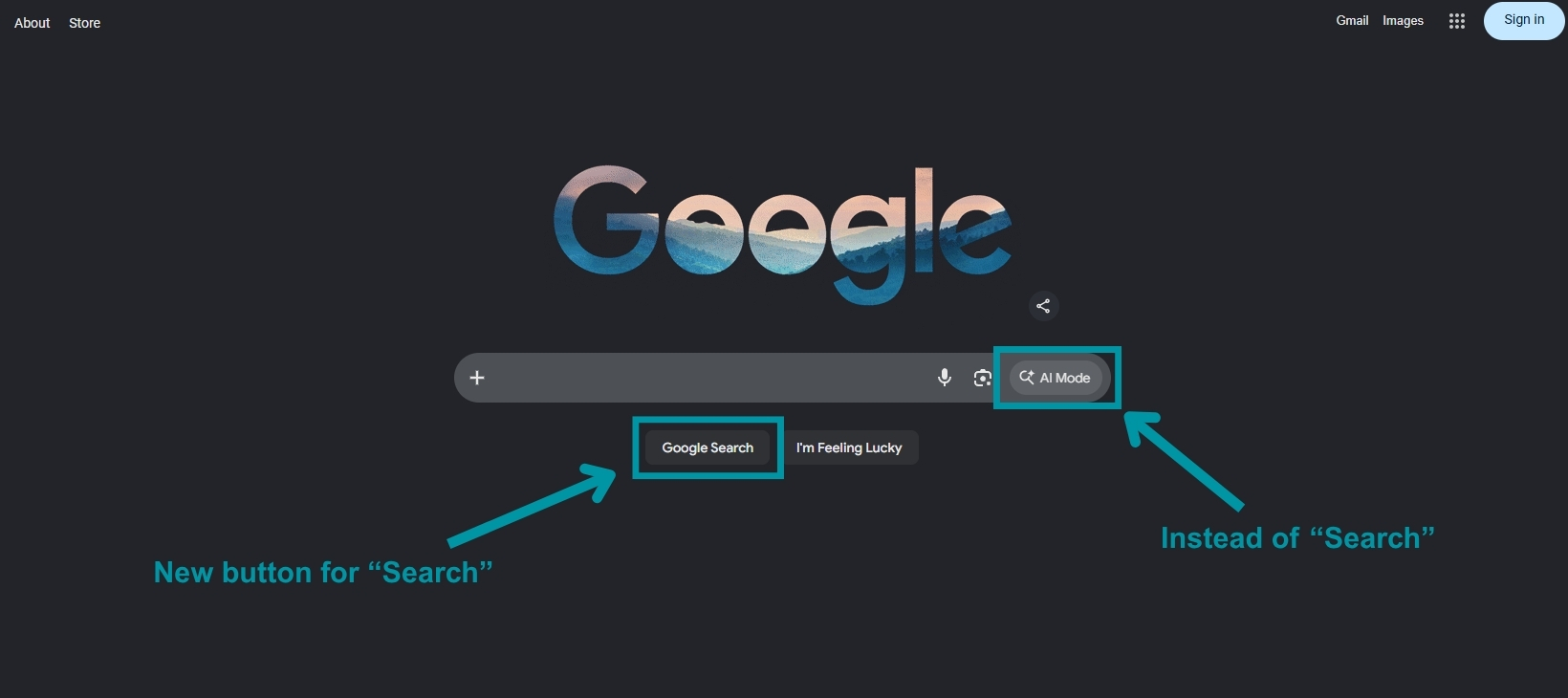
I mean, look at this! Google “Search” is now a secondary button. “AI Mode” is the first click. This is what we’ve been able to find on each browser when starting a new session, even in incognito or private windows.
Google’s New Default Homepage Change
For 25 years, a Google search returned a ranked list of links and we picked one. Google added more and more rich result features, leading to an era of zero clicks for searches. In digital marketing, we call this list the “SERPs” (search engine results pages).
That default ended in May 2026.
This has been rolling out since early 2025:
March 2025: AI Mode enters limited pilot through Search Labs.
May 2025: AI Mode launches in the US as a separate tab.
July to November 2025: Geographic rollout: UK, India, EU, then 180+ countries.
Late 2025: Roughly 75 million daily and 100 million monthly users.
May 19, 2026 (Google I/O): Google announces 1 billion monthly users, makes Gemini 3.5 Flash the default model globally, and ships a redesigned search box that accepts text, images, video, files, and even dragged-in Chrome tabs. (Google’s announcement)
Summer 2026 and what’s next: Information Agents (background research that monitors topics and prices) and Generative UI (custom layouts built on the fly) continue rolling out.
Liz Reid, VP of Search at Google, stated that “Google Search is AI search through and through.” That’s a pretty bold a*s statement!
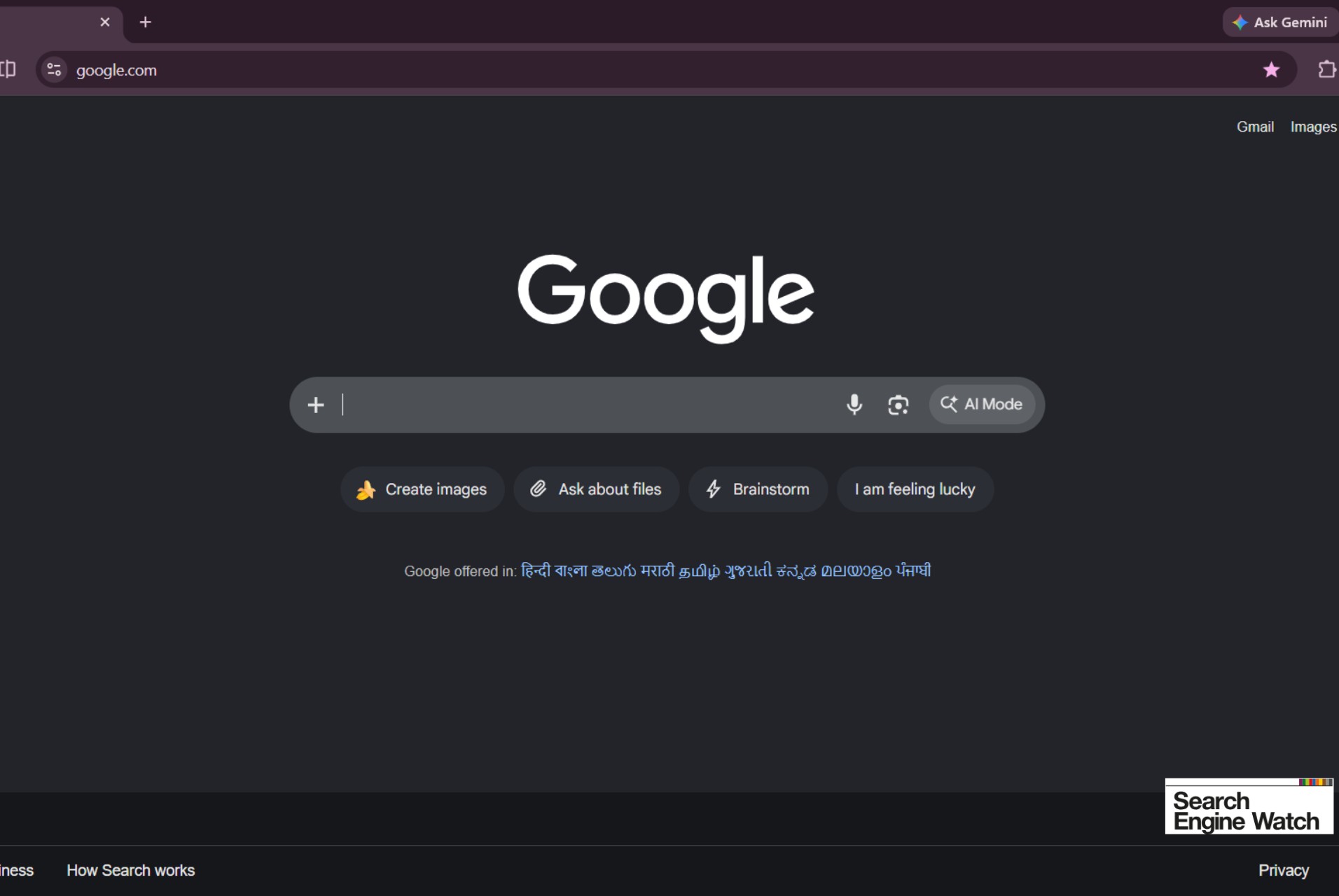
Search Engine Watch was able to find the Homepage version that Google’s been testing. It looks a lot like what you’d see for an AI LLM like Gemini rather than the traditional search-focused Homepage we’ve seen for the last couple of decades from Google.
Image Source: Search Engine Watch
The Blue Links Aren’t Gone
The SERPs with blue links and metadata still exist. Reid said so from the stage, and Google’s own announcement describes blending web and AI results, not replacing one with the other. There’s a “Web” tab, and organic results still appear alongside AI responses. What changed is the default, and that default matters.
The majority of users don’t typically change their default viewing because it’s either an inconvenience or they don’t notice. So you’re going to see a huge shift in how users actually search on Google using AI.
How Many People Are Using AI Search and AI Overviews?
It’s crazy to think about since AI Mode and Google’s AI Overviews have been seen as untrustworthy in responses and it comes up with garbage a lot of the time, but people are now relying on AI instead of traditional search results.
AI Overviews: reportedly more than 2.5 billion monthly users. This is the summary block most people have already seen at the top of results, and it now feeds directly into AI Mode.
AI Mode: more than 1 billion monthly users, announced at I/O 2026. That’s up from roughly 100 million monthly in late 2025, and Google says queries have more than doubled every quarter since launch.
Session behavior: third-party analyses say the share of AI Mode sessions that end without a click to an outside site somewhere in the low 90s.
The two areas are also no longer separate. AI Overviews and AI Mode were merged into one continuous flow within Google Search, so a follow-up question on an Overview slides into a full AI Mode conversation without the user choosing anything.
Why This is Completely Different from Traditional Search
Search used to take a lot more thought processing. Start with a query, get a list, then click to a website you think is your best option.
Now it’s a conversation.
Someone opens with a question or a request. The AI answers and typically suggests the next question. They go deeper. They compare options. They narrow it down. By the time they’re ready to buy or convert, they’ve done their entire education and consideration phase without landing on a single website.
Google, ChatGPT, Gemini, and Claude all propose follow-up prompts. The platform isn’t just answering what people ask. It’s shaping what they think to ask next. That’s a level of influence over the buyer journey that no channel has ever had.
And every one of those answers is personalized to the individual asking.
How Does This Affect Ads?
If you run paid search, you’ve probably noticed the same thing we have: ads show up far less often in AI Mode than on a classic results page. Yeah, ads only appear in roughly 25.5% of AI results.
Third-party tracking earlier this year put ads on roughly a quarter of AI Mode responses, meaning most AI Mode answers currently carry no ad at all.
This is the current state of ads. We all know that Google likes to make its money, so it’s probably going to start adding in more ads very quickly.
At Google Marketing Live on May 20, 2026, Google announced a new generation of Gemini-powered ad formats built specifically for AI Mode. The important detail is where they sit. The ads are designed to appear inside chats:
Conversational Discovery ads answer the user’s actual question inside the AI response.
Highlighted Answers place eligible ads inside list-style responses, where position depends on relevance rather than bid alone.
Business Agent for Leads handles lead capture inside the conversation.
Three things follow from this for anyone managing spend.
Impressions are being rebuilt, not removed. The inventory is moving from above the answer to inside the answer. Volume looks low today because the formats are still in testing, largely US-first.
Eligibility runs through automation. Access to these placements is tied to Performance Max and AI Max campaign types. If your account is still built entirely on manual keyword campaigns, you’re not part of this.
Your organic and paid work now have the same problem. Both now depend on the same inputs: clear, specific, well-structured information that Google’s AI LLM Gemini can read and reuse. Feed quality, product data, and page content feed the ad system and the citation system at the same time. A digital marketing agency that runs those as two disconnected departments is going to underperform in one of these areas.
What We’re Calling the New AI Search Age: PRO
“Personal Response Optimization.”
The old model optimized for keywords: broad, short-tail, long-tail. The new model optimizes for the person and the conversation they’re actually having. That means going deeper than demographics into psychographics: what your ideal customer cares about, how they phrase problems, what they’re worried about, and what they’d ask an AI at each stage.
It also means your website plays a bit of a different role. Your site is not just a brochure people browse. It’s a library that AI reads, pulling specifics on services, process, and pricing to decide whether you’re worth citing.
Even Google uses “personalize” as part of its own practice in AI Mode when trying to find relevant results for an adequate response.
bgood Has Prepped for This for Years
This shift isn’t a big surprise to us. We’ve been saying for years that AI would become everyone’s personal assistant. It wants to deliver the best results to its user, that’s its mission. Google has always said that it wants to deliver the best results to users, which now means AI as an assistant to get you there.
Be ready for this new shift. You’re going to start seeing a huge decrease in clicks to your site, an upturn in impressions (if you’re doing things right) and you’ll see competitors you’ve never had on your radar pop up ahead of you.
This new age of AI Search is going to solidify one thing: You can’t be everything to everyone, so make your brand’s stance on who you want to target as your customer group(s). Personalization on your online assets is going to be the most important play you make in 2026 and the future.
Common Questions for Us
How do I turn off AI Mode and get normal Google results back?
Click the Web tab under the search bar, or add &udm=14 to a Google search URL to force classic results. You can set that as a custom search engine in your browser to make it stick. This is worth knowing for your own research, but do not assume your customers will bother. Almost nobody changes a default, which is the whole reason this shift matters.
How do I find out whether my brand shows up in AI Mode at all?
Start manually. Write down the ten questions a real buyer would ask before hiring you, run each one in AI Mode, ChatGPT, Claude and Perplexity, and log whether you appear and what gets said. It takes an afternoon and tells you more than any dashboard. Move to a tracking tool once you have a baseline worth monitoring.
My impressions are up but my clicks are down. Is something broken?
Probably not, because that is the expected shape of this change. You are being shown inside more AI answers while fewer people need to click through to get what they came for. Check whether the traffic you still get converts at the same rate or better. Falling clicks with steady conversions means the funnel is working; it just got shorter.
Should I block AI crawlers to stop them using my content?
Only if you are a publisher whose business model is pageviews. For almost everyone else it is self-sabotage: if AI cannot read your site, it cannot cite you, and your competitor gets recommended instead. Blocking protects content nobody was going to pay for while forfeiting the visibility that replaces the clicks you lost.
Does an llms.txt file actually do anything yet?
Not necessarily just yet. No major AI platform has committed to honoring it, so it’s more of an additional layer that could become more important in the future. Twenty minutes to add one is fine. Choosing it over structured data, clear headings, and genuinely specific content would be a mistake, though, since those are what AI systems demonstrably read today.
What structured data should I prioritize now?
Organization and Person schema so AI systems can resolve who you are, FAQPage on anything answering real questions, Product and Review if you sell online, and LocalBusiness if you have a service area. Entity clarity matters more than volume, which means being unambiguous about what you are beats marking up every page on the site.
If clicks are not the metric anymore, what is?
Track four things: how often you are cited in AI answers for your key questions, branded search volume, impressions in Search Console, and conversion rate of the traffic that does arrive. The first is the leading indicator and the last is the one that pays you. Clicks become a middle metric rather than the headline.
Does this hit local and service businesses the same way?
Less severely, at least so far. Location-based intent still resolves to maps, listings, and a phone call more often than a conversation, so local businesses have kept more of their clicks. Do not read that as safety, because the research phase before someone calls you has already moved into AI, even when the final action has not.
Do I need to rewrite all my existing content?
No. Audit before you rewrite. Take your top twenty pages and check whether each one answers a specific question plainly in the first hundred words, uses honest headings, and states real specifics like process, pricing, and limitations. Most pages need tightening and better structure, not a rewrite.
How often should I be checking my AI visibility?
Monthly is enough for most businesses, and quarterly is enough if your category moves slowly. Check after any major Google announcement, after you publish something significant, and any time branded search or conversions move for no obvious reason.
Marketing strategist and AI-focused growth leader with over 7 years of hands-on experience across SEO, PPC, UX, social, email, content, and performance marketing. A guest lecturer at USD and SDSU, Joseph Jones (JJ) leads teams, builds scalable systems, and designs strategies rooted in human psychology, data, and emerging AI. My work is driven by one obsession: understanding why people say “yes”—and how to responsibly create that moment at scale.