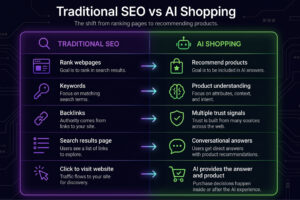
For years, ecommerce SEO was all about getting your products to rank on Google, seeing them appear in the blue links next to sponsored listings (SERPs).
Now, more shoppers are asking ChatGPT, Gemini, and other AI LLMs what they should buy instead. If your product isn’t part of that answer, you don’t just lose the sale: you’re probably not even considered in the first place.
We’ve spent the last few months reviewing hundreds of ecommerce sites and product pages to figure out how this actually works in the real world. Some people call this discipline generative engine optimization, or GEO. We call it AI Search and Agentic Commerce.
This is what we’ve found.
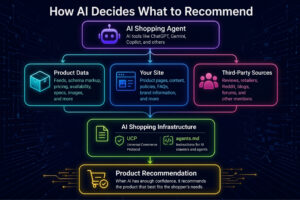
First, here’s a simplified look at the signals AI shopping platforms pull together before recommending a product.
Quick Highlights
No need to read the whole thing. AI is now part of the buying decision (even at times the default search experience), and this is what actually moves the needle.
- Shopping has moved into the chat window. Buyers are asking ChatGPT, Gemini, and Copilot what to buy instead of searching for it. Adobe Analytics found shoppers referred by generative AI spend 41% more per visit than traditional channels.
- Agentic commerce is the real shift. A chatbot that suggests products is conversational commerce. An AI that researches, compares, builds the cart, and completes the purchase is agentic commerce. Google, Shopify, and OpenAI are all building toward agentic.
- UCP gives Shopify stores a head start. The Universal Commerce Protocol launched at the start of 2026 with 30+ companies behind it. Eligible Shopify stores are enabled by default and already syndicate to ChatGPT, Copilot, and Shop (Shop Pay). BigCommerce and WooCommerce can implement it too, as it’s an open standard, but it usually takes a developer.
- A seat at the table isn’t a guarantee of a recommendation. You can influence what information AI systems see. You can’t control what they ultimately recommend.
- Brand mentions now carry the weight backlinks used to. AI shopping tools pull reviews, specs, and pricing from retailer pages, review sites, and forums, and then reconcile all of it against what you say about yourself. Accurate info on your site plus messy info everywhere else is a losing combination.
- Don’t manufacture those mentions. Reddit is catching roughly 25,000 brand-planted posts and comments a day and building detection aimed specifically at this. Earn the coverage instead.
- Write PDPs with specifics, not adjectives. “Premium comfort” tells an AI nothing. “Merino wool blend, true to size, machine washable, rated to 20°F” gives it something to cite. A controlled study across 252,000 trials and six AI models found citations track topical relevance, list position, explicit pricing, content freshness, and completeness.
- Your Shopify store already has an agents.md file, and it’s generic. Since May 2026 Shopify auto-generates one at yourstore.com/agents.md. The default is checkout and API boilerplate that reads identically to every other store’s. Customize it through your theme’s Liquid files or write one manually if you’re off Shopify.
- There’s no proof yet that agents.md improves visibility. The feature is too new for credible before-and-after studies. Treat it as infrastructure worth getting right early, not a ranking hack. And keep it honest, since guardrails are likely coming.
What Is Agentic Commerce?
Agentic commerce is the term for AI systems that can browse, compare, and in some cases complete a purchase on a shopper’s behalf. Shopify draws a useful distinction: a chatbot that answers questions or suggests products is conversational commerce. An AI that researches, compares, and completes the purchase itself is agentic commerce.
Google, Shopify, and OpenAI are all moving toward the same goal: AI that can do more than recommend products. These systems can already compare products, build shopping carts, and in some cases finish the purchase itself. That’s a very different role than simply answering a question, and it changes what ecommerce brands need to optimize for.
That’s the shift this whole piece is about: discovery and purchase decisions increasingly happening inside a chat window instead of a search results page.
The practical effect of all these changes is that your product page is no longer just talking to a human who happens to land on it. It’s also being read by a system deciding whether to recommend you at all.
If you’re wondering how AI systems actually access product catalogs, APIs, and other external data, that’s what the Model Context Protocol (MCP) was designed to help solve. We covered that in more detail in our guide to What Is Model Context Protocol?
The Universal Commerce Protocol (UCP): Shopify’s Head Start
Shopify and Google built something called the Universal Commerce Protocol, or UCP, an open standard for how AI agents discover, evaluate, and transact with ecommerce platforms. It launched at the start of 2026 and now has more than 30 companies behind it, including some brands you’d recognize.
This is the piece that matters most for Shopify AI search visibility specifically. Eligible Shopify stores are UCP-enabled by default, and eligible products are already included in Shopify’s Catalog, which syndicates product information to ChatGPT, Copilot, Shop, and other AI surfaces. Merchants can influence what information is available, but they don’t control what an AI ultimately recommends. (Think of UCP as giving your products a seat at the table, not guaranteeing they’ll be chosen.)
If you’re not on Shopify, UCP is still an open standard, so BigCommerce and WooCommerce stores can use it too. BigCommerce’s parent company has publicly backed it, and there are already WooCommerce plugins built around it. In practice, though, getting it running usually takes a developer, since it’s not a default toggle the way it is on Shopify.
Build Brand and Product Mentions Everywhere
Most brands still aren’t thinking about brand mentions and AI search together, but that pairing is really the whole answer to how to get cited by AI in the first place. AI shopping tools do a lot more than read your website.
For example, ChatGPT’s Shopping Research explicitly pulls in reviews, specs, and pricing from other retail sources and trusted third-party sites, not just what you publish yourself.
This lines up with what we’ve seen in our own review of hundreds of product pages: brands with strong, accurate information sitting on their own site but messy or outdated information floating around elsewhere tend to underperform in AI answers compared to brands with a consistent story across the web.
If something inaccurate about your product is sitting on a retailer page, a review site, or a forum somewhere, that’s a source an AI system might reconcile against your own claims … and it might not resolve in your favor.
We wouldn’t go as far as claiming there’s a fixed sequence, like AI checks your site first, then retailers, then Reddit. Nobody’s published that as an official rule, and we haven’t seen evidence of one.
What we can say from our own testing is that AI systems tend to pull together first-party product information with third-party listings, reviews, and community discussion, and treat all of it as part of the same picture.
This is playing out publicly right now. Reuters reported this week that retailers including Walmart, Ulta Beauty, and Wayfair are actively updating their websites to rank better in chatbot results, even as they try to keep the actual transaction and customer data on their own platforms. Ulta Beauty is building shopping carts into Gemini because that’s where customers are already finding its products, while still preferring purchases happen on ulta.com. The stakes are real too: Adobe Analytics found that shoppers referred by generative AI tools spent 41% more per visit than those who arrived through traditional channels.
One caution before you go chasing every mention of your brand online: don’t try to manufacture this. Reddit in particular has become a magnet for brands seeding fake, AI-friendly posts designed to look like organic recommendations, and it’s not working out well for the brands doing it.
The Verge recently reported that Reddit’s own moderation systems are catching roughly 25,000 spammy, brand-planted posts and comments a day, and the platform is actively building detection specifically aimed at this kind of manufactured content. If you want to know more about why that approach backfires, we’ve written separately about AI poisoning and black hat GEO. The safer, more durable play is making sure what’s already being said about your brand is accurate, and earning genuine coverage and reviews rather than faking them.
Use Bullet Points on PDPs (Product Pages)
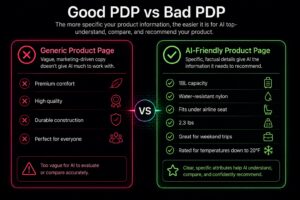
We’re calling it a “hack” because that’s how most brands will search for it, but the real move here is giving AI something specific to work with instead of marketing fluff. Product detail pages need to say something concrete, not just sound good.
Shopify’s Catalog now structures fields like materials, sizing, key features, technical specs, and value proposition specifically so agents can search and compare products more precisely. Google has rolled out something similar with what it calls “conversational attributes,” which are aimed at helping AI systems understand product nuance rather than just keywords.
In practice, this means the difference between a bullet that says “premium comfort” and one that says “merino wool blend, true to size, machine washable, rated for temperatures down to 20°F” is enormous from an AI system’s perspective. The first tells AI almost nothing. The second gives it details it can actually use.
Formatting bullets a certain way isn’t itself a magic ranking trick. A recent controlled study running 252,000 trials across six major AI models found that the strongest factors in whether a product gets cited were topical relevance, where it sits in a list, explicit price information, how fresh the content is, and completeness.
What we have found in our own testing is that bulleted, attribute-rich PDP content tends to be easier for agents to pull cleanly out of a page’s HTML than the same information buried in a paragraph.
Call that our own observation rather than an industry-proven rule, but it’s a low-effort change worth making regardless. We’ve seen it increase the accuracy of product information on AI platforms 100% of the time.
Seriously, AI takes this information into account above everything else on a given page.
Create an agents.md File: Your Brand’s AI Instruction Manual
If your store runs on Shopify, you already have one of these, whether you knew it or not. As of May 2026, Shopify automatically generates an agents.md file for every store, accessible at yourstore.com/agents.md, with /llms.txt and /llms-full.txt pointing to the same content unless you customize them.
Stores on the Agentic Storefront also expose this connection through a sitemap agentic discovery XML file, something like yourstore.com/sitemap_agentic_discovery.xml, which is what actually points agents toward the agents.md file and the rest of your agent-readable setup in the first place.
Here’s the catch, and it’s worth understanding before you get excited about it: the default file Shopify generates is mostly technical boilerplate. It tells an AI agent how to use your store’s checkout and API endpoints. It doesn’t say anything about your brand, your best sellers, or what makes you worth recommending over the store next to you. Every default Shopify agents.mdd reads almost identically to every other one. If you want an agent to actually understand what makes your brand distinct, you have to write that part yourself.
You can customize it through your theme’s Liquid template files, adding information about what you sell, what sets you apart, and which pages or collections matter most. Non-Shopify brands can and should build a version of this manually too. It’s a markdown file, nothing fancier than that.
Does agents.md Actually Improve AI Visibility?
We went looking for before-and-after case studies because we knew readers would want proof that this actually works. We didn’t find any that met that standard. That’s not especially surprising. Shopify only introduced customizable agents.md files in late May 2026, so the feature simply hasn’t been around long enough for credible longitudinal studies to emerge.
What we did find was telling in a different way. Agencies, ecommerce platforms, and AI tooling companies are already building around the standard, and Shopify has made it part of its long-term agentic commerce roadmap. That doesn’t prove a customized agents.md file will improve your visibility today, but it does suggest this is infrastructure worth putting in place before it becomes table stakes.
Our Take
Treat this as infrastructure worth getting right early, not a proven ranking hack. Keep it accurate and genuinely useful rather than treating it as another place to stuff keywords, since Shopify has signaled that rules and guardrails for these files are likely coming. Getting flagged for gaming a system before the rules even exist is a bad way to find out where the line was.
If you want a working example, we keep our own agents.md file up to date and public.
If you’d like to dig deeper, we’ve also put together a broader guide to ecommerce SEO and GEO, and a deeper look at how agentic commerce actually works if you want the bigger picture beyond the ecommerce-specific tactics here.
Where This Leaves You
If there’s one theme running through everything we’ve covered, it’s that AI doesn’t make recommendations based on a single signal. It builds confidence by comparing information from a lot of different places. That’s why product data, your own website, third-party mentions, UCP, and agents.md all matter. They’re different pieces of the same picture.
The good news is that none of this requires chasing the latest AI hack. It mostly comes down to doing the fundamentals well, presenting your products clearly, and making sure the information about your brand is accurate wherever AI is likely to find it. That’s a worthwhile investment whether you’re thinking about today’s AI shopping experiences or the ones we’ll all be using a few years from now.
If you’ve got questions about how to get your ecommerce site to rank on AI Search, reach out to us. We’d be happy to give you the blueprint on AI Search citing.
Next Steps You Should Take to Improve Your eCommerce Site’s Rankings in AI
- Have your store connected to the UCP (Universal Context Protocol). Ensure all of your products in your catalog are available for indexing.
- Build brand mentions and product mentions along with backlinks on authoritative 3rd party sites.
- Create an agents.md file or markdown formatted page on your site that describes your business, mission, team, contact information, and how an AI agent can properly crawl the site.
- Create an llms.txt file with information regarding which pages you want the AI agent to source for information. It’s similar to a robots.txt file used in traditional SEO best practices. You’re just alert the AI agent as to where on the website you want it to go. Check out our llms.txt file here.
FAQs
What is agentic commerce? Agentic commerce refers to AI systems, like ChatGPT, Gemini, and Copilot, that can browse, compare, and in some cases complete purchases on a shopper’s behalf rather than simply answering questions about products.
Do I need Shopify to use the Universal Commerce Protocol? No. UCP is an open standard co-developed by Shopify and Google, so BigCommerce and WooCommerce stores can implement it too. It’s just not a default toggle outside Shopify, so it typically takes a developer to set up.
What is an agents.md file, and do I need one? It’s a plain markdown file that tells AI agents what your brand sells, what makes it different, and which pages matter most. Shopify generates a default one automatically for every store, but the default is generic. Every store should have a customized version, Shopify or not.
How does AI decide which products to recommend? Based on what we’ve seen across hundreds of product pages, it comes down to a mix of structured, specific product data, accurate third-party mentions and reviews, and how well a store’s technical setup lets an agent actually read and transact with the catalog. No platform has published an exact formula.
Do backlinks still matter for AI search visibility? They’re part of the picture, but they’re no longer the whole picture. AI shopping tools weigh brand and product mentions across reviews, retailer listings, and community discussion, not just links pointing back to your site.