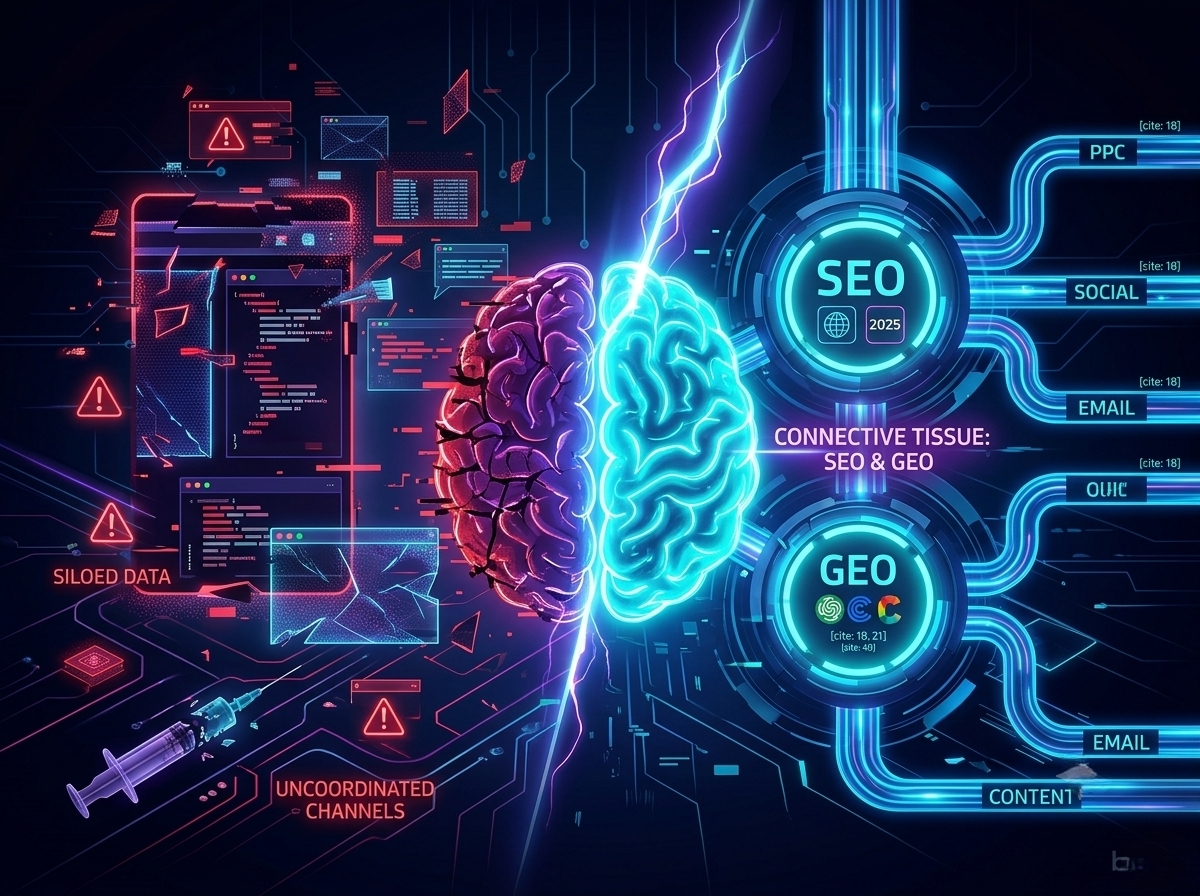
Most businesses are not under-marketing. They are marketing in pieces.
Marketers estimate that 26% of marketing budgets go to waste, often because channels aren’t talking to each other. Your SEO team doesn’t know what paid search is bidding on. Your social media manager hasn’t seen the email calendar. Your content creator has no clue what’s actually converting in ads.
Meanwhile, your customers don’t experience your brand by channel; they experience it as a journey. They might discover you via organic search, see a paid ad a few days later, click through a blog shared on social, and finally convert after encountering your brand in an AI-generated answer. If those touchpoints aren’t connected, trust weakens … and so do results.
The fix isn’t throwing more money at more channels, it’s integration. At the heart of that integration are SEO and GEO (generative engine optimization), working together as the connective tissue that ties every marketing channel into a cohesive system.
In this guide, I’ll walk you through how marketing channels should work together, why integrated and omnichannel strategies outperform siloed efforts, and how to build a system where every channel strengthens the others.
What Are Marketing Channels?
A marketing channel is any medium through which your brand communicates with potential or existing customers.
That typically includes organic search (SEO), generative engine optimization (GEO), paid search (PPC), social media (organic and paid), email marketing, content marketing, public relations, affiliate marketing, and AI-powered answer engines like ChatGPT, Perplexity, and Claude.
Each channel plays a different role:
- SEO captures demand when people actively search for solutions.
- GEO increases visibility inside AI-generated answers.
- Paid search provides immediate reach.
- Social builds familiarity and trust.
- Email nurtures direct relationships over time.
In the past, these channels operated in silos because organizations were structured that way. The SEO specialist reported to one manager, paid media to another, social to a different department. Each had separate budgets, different KPIs, and rarely communicated. Technology reinforced this fragmentation, i.e., the tools didn’t talk to each other.
This siloed approach is now genuinely harmful.
Customers do not think in channels. They think in problems, questions, and solutions. They expect consistency whether they meet your brand through a Google search, an Instagram ad, an AI response, or an email in their inbox.
The Evolution: Multi-Channel → Cross-Channel → Omnichannel
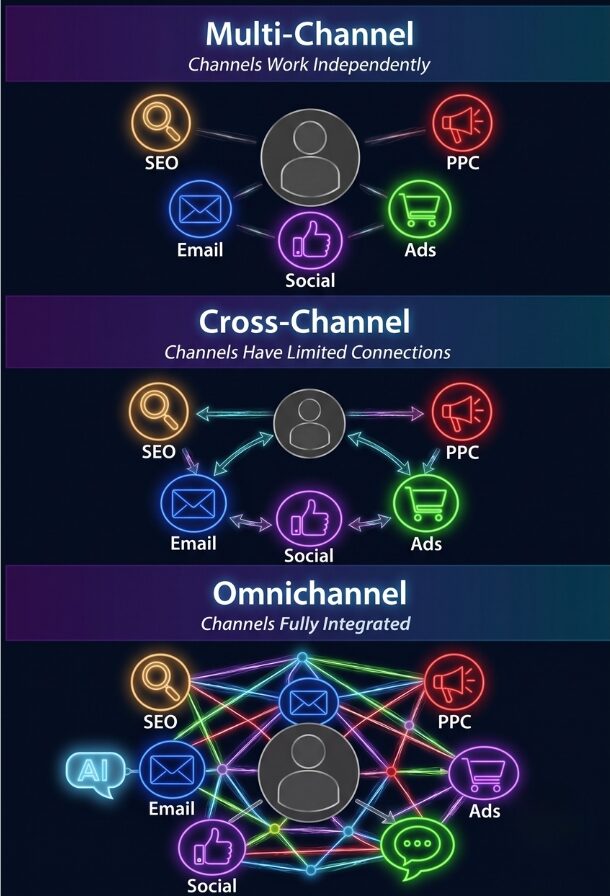
Not all “multi-channel” strategies are created equal.
Multi-channel marketing means you’re present on multiple channels, but they operate independently. You have a website, social media, email program, and paid ads, but they don’t coordinate. Your Facebook content doesn’t reference your email campaigns. Your paid ads land on pages without regard to SEO strategy. Customers experience your brand differently depending on which channel they encounter.
Cross-channel marketing represents an advancement where channels acknowledge each other. Your email campaign mentions your social media. Your paid ads and organic content target complementary keywords. There’s coordination, but it’s superficial. Each channel still operates primarily for its own metrics.
Omnichannel marketing is the gold standard: a fully integrated, customer-centric approach where channels work together as a unified ecosystem. A customer who clicks an Instagram ad and doesn’t convert receives a remarketing ad referencing that specific product. When they visit organically later, they see personalized content based on previous interest. If they sign up for email, the welcome sequence acknowledges their journey.
This distinction matters. Research consistently shows that omnichannel campaigns drive significantly higher purchase rates and customer lifetime value compared to single-channel or loosely connected approaches.
Why Marketing Channels MUST Work Together
Here’s a jaw-dropper: companies with strong omnichannel strategies retain 89% of their customers, compared to just 33% for those with weak channel integration. That alone should get your attention—but the benefits don’t stop at retention.
When your channels work together, campaigns perform better and customer acquisition costs drop. Why? Because integration cuts waste. You’re not paying twice for the same message or competing with yourself across channels.
Modern customers expect seamless journeys. They want brands to “get them” no matter where they interact—Instagram, Google search, email, or even AI tools. In fact, 73% of retail shoppers use multiple channels before making a purchase.
Without integration, attribution suffers. You might spend heavily on paid search for keywords you already rank for organically, or show social ads to people who are already on your email list. That’s money literally slipping through your fingers.
But when channels share data, everything clicks. Your email platform can tell your ad platform who’s already converted, preventing wasted spend. SEO insights can guide paid campaigns toward keywords that actually convert. Social listening can feed your content calendar, ensuring your posts answer real questions your audience is asking.
In short: connected channels don’t just save money: they make every marketing dollar work harder.
SEO & GEO: The Connective Tissue of Modern Marketing
Think of SEO and GEO not as channels per se, but as the glue that connects everything in your marketing ecosystem. And for companies that previously only paid attention to SEO, incorporating GEO is game-changing. Here’s why SEO and GEO are critical to your marketing strategy:
SEO’s role extends far beyond ranking on Google. When you do keyword research, you’re learning the exact language your customers use to describe their problems and solutions. That insight should guide your paid ads, social captions, email subject lines, video titles, and even sales presentations. In other words, SEO research is basically market research.
SEO content also feeds social and community strategies. A blog post optimized for search can become social content, spark discussions, or fuel community engagement. Videos optimized for YouTube can be shared on LinkedIn, Instagram, or TikTok. And content that performs well organically? It’s already been validated by your audience.
Paid campaigns get smarter with SEO data. See which keywords convert best organically? Prioritize them in paid campaigns. Notice which content formats resonate? Allocate ad budget accordingly. It’s a multiplier effect.
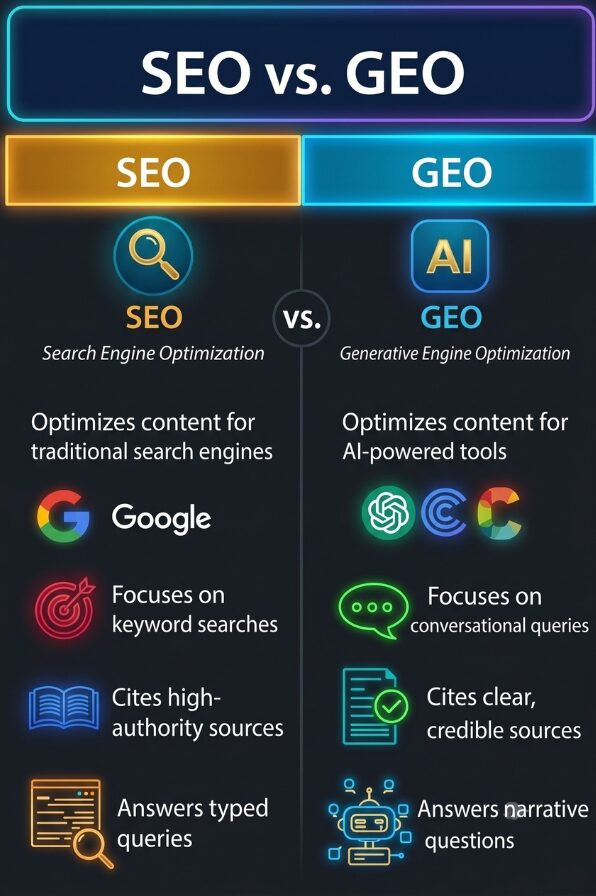
Now let’s talk GEO (Generative Engine Optimization). As AI tools like ChatGPT, Claude, Perplexity, Microsoft Copilot, and Google AI Overviews change how people find information, GEO is becoming just as important as SEO. GEO ensures your content shows up in AI-generated answers when people ask questions in your field. For instance, someone asking ChatGPT “What’s the best email marketing platform for small businesses?” could see your brand recommended—and that shapes perception and decisions.
SEO and GEO work best together. Well-structured, authoritative, and clearly cited content that performs for SEO also does well in GEO. AI tools reward content that’s expert, accurate, and comprehensive—basically the same principles that make SEO succeed.
GEO does have its own nuances, which you need to pay attention to. People ask questions differently in AI than they type into Google. GEO content should focus on conversational queries, cite authoritative sources, use structured data, and include FAQ-style content.
How Paid and Organic Channels Amplify Each Other
I touched on this a little bit earlier, but let’s take a closer look at the relationship between paid and organic channels. When you combine the two, it creates a multiplier effect that dramatically outperforms either approach in isolation:
Using PPC data to inform SEO strategy gives immediate feedback on which keywords convert, which messaging resonates, and which landing page elements drive action. Smart marketers run PPC campaigns on keywords they’re considering for SEO investment, analyze conversion data, then double down on SEO for winners. You can test dozens of headline variations in paid ads, identify top performers, then use those headlines in your SEO title tags.
SEO rankings lower PPC costs. When you rank organically for a keyword, you might still run paid ads to dominate the search results page. However, Google’s Quality Score algorithm considers landing page relevance and user experience—factors improved when your page ranks organically. Higher Quality Scores mean lower cost-per-click and better ad positions.
Retargeting based on organic traffic behavior is extraordinarily effective because you’re targeting people who’ve already demonstrated genuine interest by finding you organically. Someone who discovers your blog post through search, reads it, but doesn’t convert shows high-intent behavior. Retargeting them with paid ads referencing the content they consumed drives conversion rates 2-3x higher than cold traffic.
Social proof from organic content boosts paid performance. When you run paid ads promoting content already performing well organically—content with thousands of shares and strong engagement—the social proof transfers to the ad.
Testing messaging in paid before committing to SEO is smart resource allocation. SEO requires significant investment in content creation. Paid ads let you test value propositions, messaging angles, and positioning strategies quickly. Run five different ad variations emphasizing different benefits. The winner becomes the messaging foundation for your SEO landing page.
Content Marketing as the Fuel
If SEO and GEO are the connective tissue, content is the fuel that feeds the whole body.
One piece of strategically developed content feeds multiple channels simultaneously. Consider a comprehensive research report. The full report lives on your website, optimized for SEO. The executive summary becomes a LinkedIn article. Key statistics become social media graphics. The methodology section becomes a YouTube video. Interesting findings become email content and ad copy. The research gets cited when AI assistants answer questions about your topic. That’s one content asset serving multiple channels.
Start with a pillar piece: a comprehensive guide, original research, detailed case study, or in-depth tutorial optimized for both SEO and GEO. Then atomize it into channel-specific formats. A 3,000-word guide becomes 15 social posts highlighting key takeaways, a video teaser, five email segments, three podcast topics, ten paid ad variations, and five guest article pitches.
The strategic advantage is efficiency and consistency. You’re not creating entirely different content for each channel—you’re creating strategically important content once and distributing it intelligently everywhere. This reduces production costs while increasing output and ensuring messaging consistency.
Email, Social, and Community: The Engagement Triangle
Now let’s take a look at how to use your channels to drive engagement. Email marketing, social media, and community building form an engagement triangle, where each channel feeds and strengthens the others.
Creating new content all the time is a ton of work, but with a good engagement triangle, cross-promotion and audience participation help sustain momentum without constant new production.
Here’s how:
Growing email lists from social following: Sticky social media content attracts followers. Those followers see posts consistently, building trust. You create content designed to convert social followers to email subscribers (lead magnets, free resources, templates, etc.). A compelling Instagram post might promote a free template. A LinkedIn post might promote gated research.
Amplifying email content on social: Your email newsletter contains valuable insights that become social content. You can share snippets from your newsletter with a call-to-action to subscribe. If an email topic drove high engagement, that signals strong interest for more social content on that theme.
Building community through both channels: A LinkedIn community discussing industry topics becomes a source of email content—questions asked become newsletter topics. Email subscribers become community advocates. Active community members receive special recognition in emails, strengthening loyalty.
Essentially, a good synergy between email marketing and social creates a user-generated content loop to promote your brand organically.
Data Integration: The Technology Behind Channel Synchronization
The back-end of your marketing channels (data) is just as important as the front-end that customers see (content). True omnichannel marketing requires that all your data systems talk to each other:
Customer relationship management (CRM) systems are the backbone of everything. Your CRM should act as a single source of truth, capturing every interaction a customer or prospect has with your brand—site visits, email clicks, social engagement, chats, and purchase history. When all that data lives in one place, it’s much easier to personalize messaging and keep marketing and sales aligned. Tools like Salesforce, HubSpot, and Microsoft Dynamics can do this well when they’re set up thoughtfully.
Marketing automation tools build on that foundation by responding to behavior in real time. For example, when someone downloads an ebook, they can automatically enter an email nurture flow, start seeing relevant ads, and trigger a heads-up to sales if they show strong buying signals. The goal isn’t more automation—it’s more relevant, timely touchpoints.
Attribution modeling helps you understand how all those channels actually work together. Relying on last-click attribution gives all the credit to the final step and ignores the earlier content, SEO, or ads that warmed someone up. Multi-touch attribution spreads credit across the journey, giving you a more honest picture of what’s really driving results.
Customer data platforms (CDPs) solve the identity puzzle. They connect anonymous site visitors with known email subscribers, social followers, and eventually paying customers. By pulling in data from multiple sources and stitching it together into unified profiles, CDPs make that information available to your marketing tools in real time.
Finally, privacy matters more than ever. Clear consent and responsible data collection aren’t optional. That’s why first-party data, information customers knowingly share with you, has become so valuable. Your email list, website behavior, customer profiles, and community data are assets you own, can use ethically, and don’t depend on third-party tracking that’s increasingly restricted.
Creating an Omnichannel Marketing Strategy: A Step-by-Step Approach
Creating an omnichannel marketing strategy requires a systematic approach. Here’s what I recommend:
Step 1: Audit your current channels
Take stock of everything—SEO, paid ads, social, email, content, PR, and more. Note budgets, tools, key metrics, and performance. Which channels drive awareness, engagement, and conversions? Which bring in revenue most efficiently? Understanding your starting point is essential.
Step 2: Map the customer journey
Follow your customers across channels. Use analytics, CRM data, and customer interviews to see how people discover and engage with your brand. Do they start on Google, click a paid ad, then see a social post before converting? Knowing the typical journey helps you spot opportunities to connect the dots.
Step 3: Spot integration opportunities
Look for places where channels can support each other. Is your blog driving traffic but not conversions? Boost top posts with paid ads. Is email engagement strong but your list small? Use social campaigns to drive sign-ups. Focus on combinations that multiply results.
Step 4: Align messaging and goals
Create a unified message architecture—define brand positioning, key differentiators, and tone of voice. Set goals around business outcomes, not just channel metrics. Instead of separately tracking email opens, ad impressions, and social likes, measure how channels together generate leads and sales.
Step 5: Set up tracking and attribution
Make sure every touchpoint is tracked consistently. Connect your CRM, marketing automation, and analytics so data flows seamlessly. Use multi-touch attribution to see how each channel contributes to conversions. Dashboards that combine all channels make it easier to spot what’s working.
Step 6: Build a cross-channel content calendar
Plan content across all channels at once. Start with strategic content pillars optimized for SEO and GEO. Then map derivatives: which posts go on social, what email sequences stem from the content, and which pieces get paid amplification. One core asset can fuel multiple channels.
Step 7: Test, measure, and optimize
Launch your integrated campaigns, track results, and adjust as needed. Experiment with different channel combinations and attribution models. Learn from both wins and misses. The goal is continuous improvement, not perfection on day one.
The Future: AI, GEO, and Smarter Channel Integration
Marketing integration is evolving fast, thanks to AI, changing consumer habits, and new platforms. Here’s what I expect we will see going forward:
AI takes the wheel
Instead of manually coordinating campaigns, AI can now optimize them in real time. It analyzes performance across all channels, identifies the best combinations for each audience segment, adjusts budgets automatically, and personalizes experiences at every touchpoint. Think of it as a smart conductor keeping all your marketing instruments in perfect harmony.
SEO and GEO: equally essential
SEO and GEO now work hand-in-hand to ensure your brand is discoverable everywhere people look. SEO drives organic visibility in search results, while GEO ensures your content shows up in AI-generated answers on ChatGPT, Claude, Perplexity, Google AI Overviews, and similar platforms. Together, they expand your reach, influence perceptions, and make your content adaptable across both traditional and AI-powered discovery.
Predictive optimization is coming
Machine learning can forecast which channel combos perform best, letting you plan proactively instead of guessing. Historical data helps you anticipate what works for specific goals, so campaigns are smarter from the start.
Hyper-personalization at scale
AI lets you deliver unique experiences to each customer. Individual journeys can include personalized emails, dynamic website content, custom-targeted ads, and relevant social messages—all coordinated seamlessly.
What to focus on now
- Invest in data infrastructure for real-time access across channels.
- Build strong SEO and GEO foundations. Content created today pays off across all future channels.
- Strengthen your team’s AI and machine learning skills.
- Embrace testing and learning. Perfection comes later, agility comes first.
Real-World Examples: Brands Doing It Right
Looking at successful brands that nail integrated marketing reveals patterns you can use for your own strategy. Whether B2B or B2C, the principles hold.
Sephora
Sephora’s omnichannel game is next-level. Their Beauty Insider program connects in-store and online seamlessly. Customers can browse on mobile, save favorites, get personalized recommendations, check inventory, and book services—all in one app. Emails reference both online and in-store behavior, and social posts link directly to purchase options. These smart strategies drive results: Beauty Insider members account for over 80% of Sephora’s annual sales.
- Tactics to note: unified customer profiles, location-based push notifications, AR try-on features, user-generated content integrated across channels, and post-purchase email campaigns.
Slack
Slack shows how B2B can thrive with integrated content. Their guides and blog posts rank organically for key terms like “team communication tools,” then get repurposed for social, email, paid campaigns, and even AI answers. Slack’s site continues to attract significant organic search traffic, with analytics tools showing around 5–6 million visits from organic search each month, giving its content and product pages strong discoverability without relying solely on paid ads.
- Key lesson: SEO and GEO-optimized content becomes a cross-channel asset, reducing acquisition costs while building authority.
Amazon
Amazon’s omnichannel marketing is all about behavioral data. Personalized emails, dynamic web content, retargeting ads, Alexa integrations, and Prime loyalty benefits all share customer data. Sure, Amazon is a Goliath that isn’t exactly relatable for most businesses. However, smaller brands can still benefit from incorporating some of their omnichannel strategies.
- Market like Amazon: Use behavioral triggers for abandoned carts, recommend products across channels, unify customer data, and personalize messaging.
Takeaways Across Brands
- Unified customer data accessible across channels
- One piece of content distributed strategically
- Behavior on one channel informs messaging on others
- Teams organized around customer journeys, not channels
- Executive-backed commitment to integration
Common Integration Pitfalls (And How to Avoid Them)
Even companies committed to integration stumble. Recognizing these pitfalls early can save time, money, and headaches.
- Messaging isn’t unified. Different teams often use conflicting messages, offers, or tones. Solution: create a central message architecture, set up approval workflows, and hold regular alignment meetings.
- Teams work in silos. SEO, paid, social, and email teams reporting separately create misaligned priorities. Solution: organize cross-functional pods responsible for specific customer journeys. Measure qualified leads or revenue, not channel-specific vanity metrics.
- Inconsistent data & tracking. Different UTM parameters, analytics setups, or conversion definitions make channel performance hard to analyze. Solution: set unified tracking standards, use tag managers like Google Tag Manager, and assign a data steward.
- Missing attribution models. Defaulting to last-click attribution undervalues top-of-funnel channels like SEO, content, and social. Solution: start with linear multi-touch attribution, then refine to time-decay or position-based models. This helps optimize budget allocation and reveals true channel contribution.
- Technology doesn’t talk. Disjointed tools mean manual work, duplication, and limited personalization. Solution: audit your tech stack, prioritize integrations, use platforms like Zapier, and assign ownership of martech strategy.
Example in Action:
A mid-market SaaS company had fragmented messaging: SEO focused on “workflow automation,” paid ads said “business process management.” Teams didn’t sync, UTM codes were inconsistent, and last-click attribution caused friction over budgets. By implementing weekly cross-functional check-ins, unified messaging guidelines, standardized UTMs, and multi-touch attribution, they increased qualified leads by 34% without spending more.
Conclusion: From Siloed to Synchronized
Moving from fragmented marketing to a fully integrated strategy takes focus, but it’s worth it. It means thinking about customer journeys instead of channels, setting up the right tech for data sharing, and shifting your team culture from optimizing channels to optimizing experiences. The alternative—keeping disconnected channels while customers expect seamless interactions—just doesn’t cut it anymore.
Here’s what to keep in mind:
- SEO and GEO are your glue. They tie all channels together.
- Content fuels everything. What you create for organic search powers social, email, ads, and more.
- Start small, think big. You don’t have to integrate everything at once. Begin by connecting top-performing SEO content to paid campaigns, syncing email with ad retargeting, or coordinating social and email around one product launch. Each win teaches you something about process, tech, and strategy—and builds momentum.
At bgood media, we help brands make this leap. We combine expertise in SEO, GEO, and integrated digital marketing to create systems where content, paid, organic, and engagement channels work together as one. What do clients get from our approach? Smoother customer experiences, better business outcomes, and marketing that actually moves the needle.
Ready to turn your marketing channels from disconnected silos into a seamless, omnichannel experience? Let’s build a strategy where SEO, GEO, content, and paid campaigns all work together to drive real results. Reach out today!
![10 SEO Tips for eCommerce Sites in 2026 [With GEO]](https://bgoodmedia.com/wp-content/uploads/2026/06/ecommerce-website-tips-seo-geo.jpg)