What Is AI Digital Marketing? Your Complete Guide (And Why You Should Care)

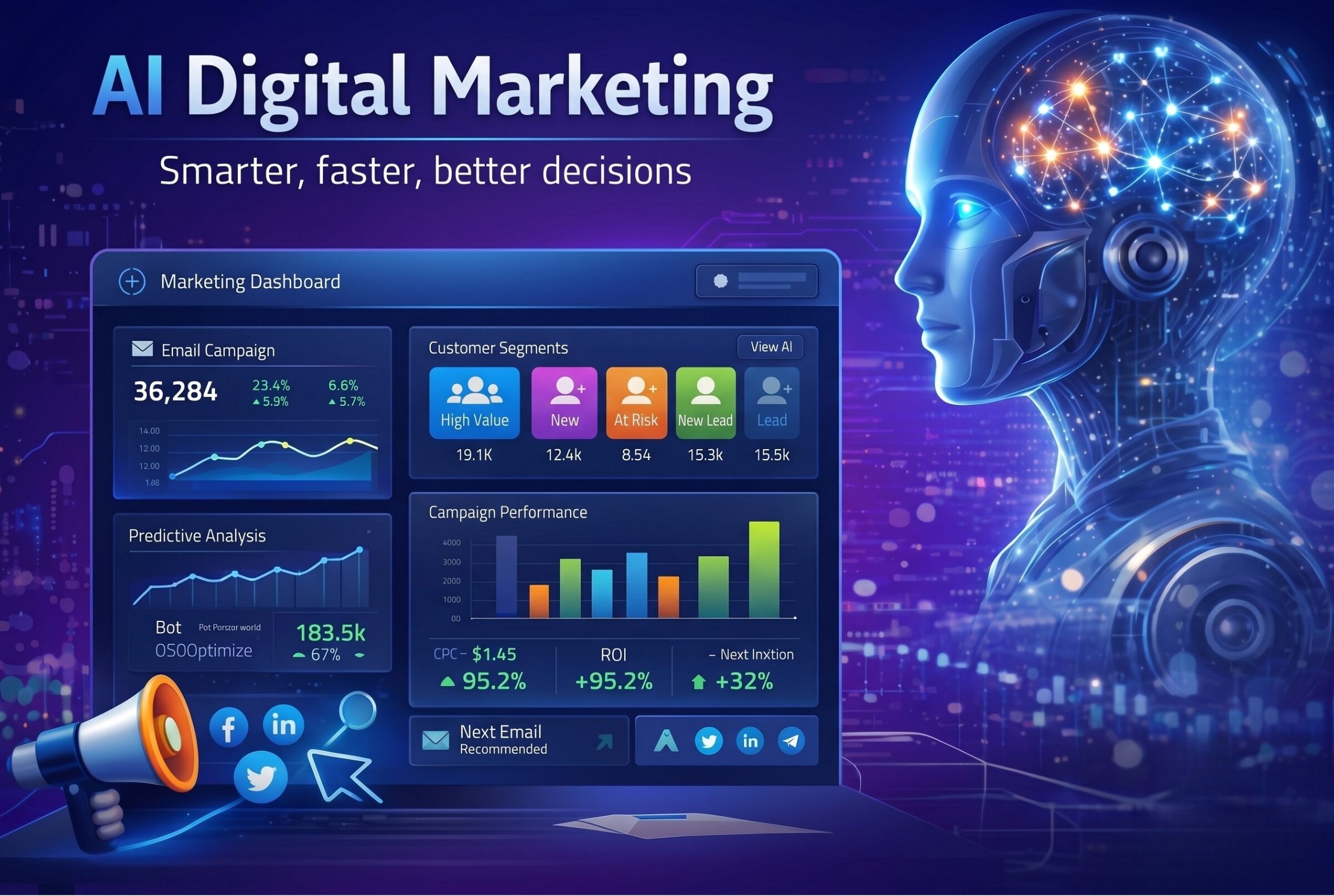
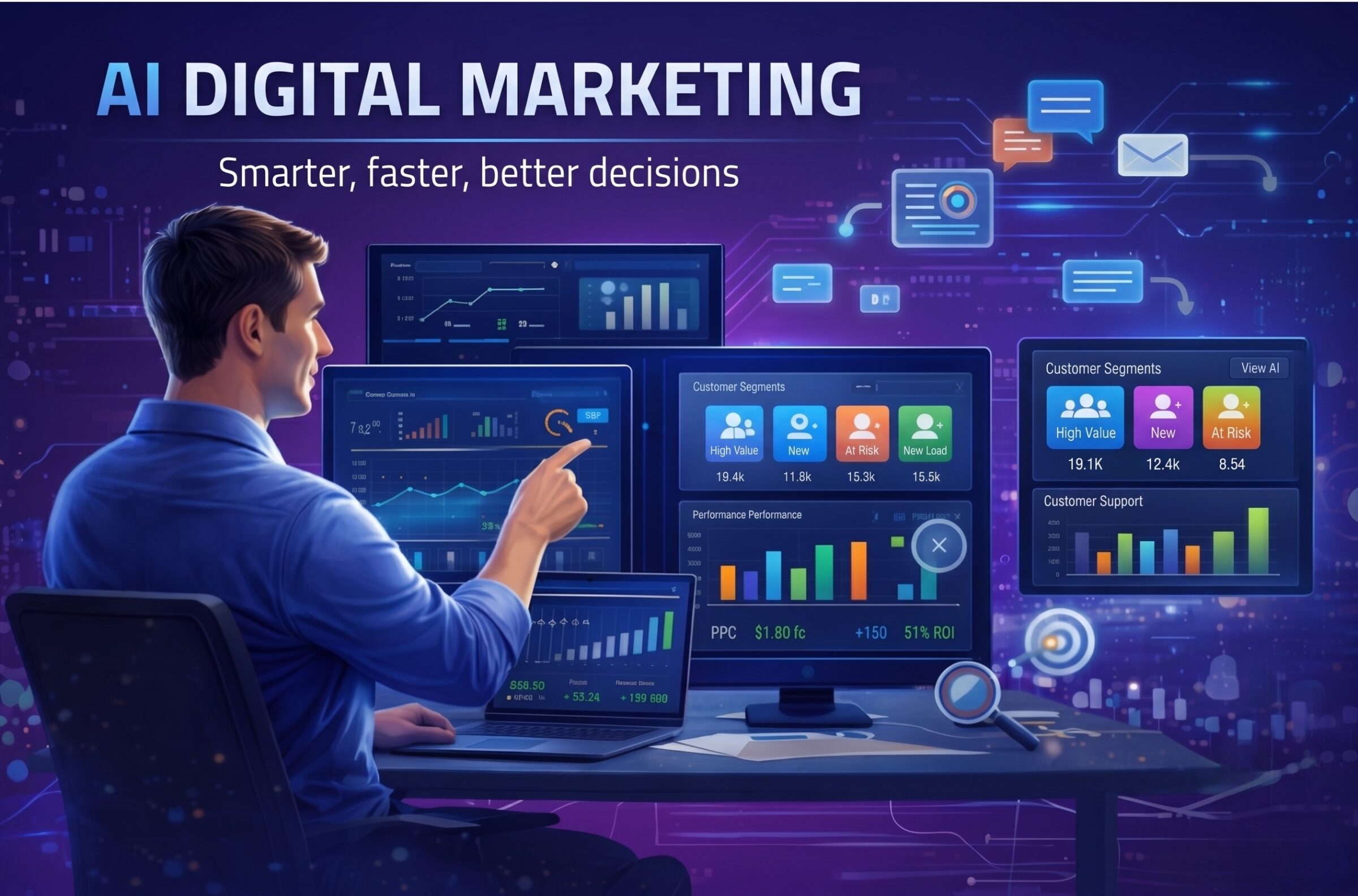
A futuristic graphic titled "AI Digital Marketing: Smarter, faster, better decisions," showing a glowing robotic profile looking at a laptop displaying a marketing analytics dashboard, alongside a megaphone and social media icons.

Last quarter, I watched one of our client campaigns go from idea to fully optimized, AI-powered execution in a single afternoon. Normally, that process would have taken weeks with planning, A/B testing, manual audience segmentation, and endless spreadsheet work. AI digital marketing made it possible in just a couple hours.

AI is changing how marketers make decisions, personalize content, and connect with customers. From predictive analytics to automated content generation, AI is transforming marketing into a data-driven, creative powerhouse.

At bgood media, we have been hands-on with AI marketing tools across industries, including finance, wellness, and travel, and we have seen how it accelerates campaigns, drives smarter targeting, and uncovers opportunities that might otherwise be missed. 

Whether you’re a CMO trying to stay ahead of the curve, a small business owner wondering if this AI stuff is worth the hype, or a marketer worried about your job security (spoiler: you’ll be fine), this guide will break down everything you need to know about AI digital marketing.

What is AI Digital Marketing? The Simple Definition

AI digital marketing uses artificial intelligence to help businesses plan, execute, and optimize their marketing efforts. Instead of relying solely on human intuition and manual processes, AI tools analyze data, spot patterns, and make recommendations, or even take actions automatically.

At its core, AI digital marketing combines machine learning, data analysis, and automation to deliver smarter campaigns. That means everything from predicting which products a customer is likely to buy, to personalizing email content, to automatically adjusting ad bids in real-time. Unlike traditional marketing, which depends on manual research, repetitive tasks, and broad targeting, AI marketing gives you insights and capabilities at scale, often faster than a human team could manage.

Put simply, AI digital marketing doesn’t replace human creativity, it supercharges it. You still set the goals, shape the brand, and make strategic decisions, but AI handles the heavy lifting of data crunching, pattern recognition, and repetitive execution.

How AI Digital Marketing Actually Works

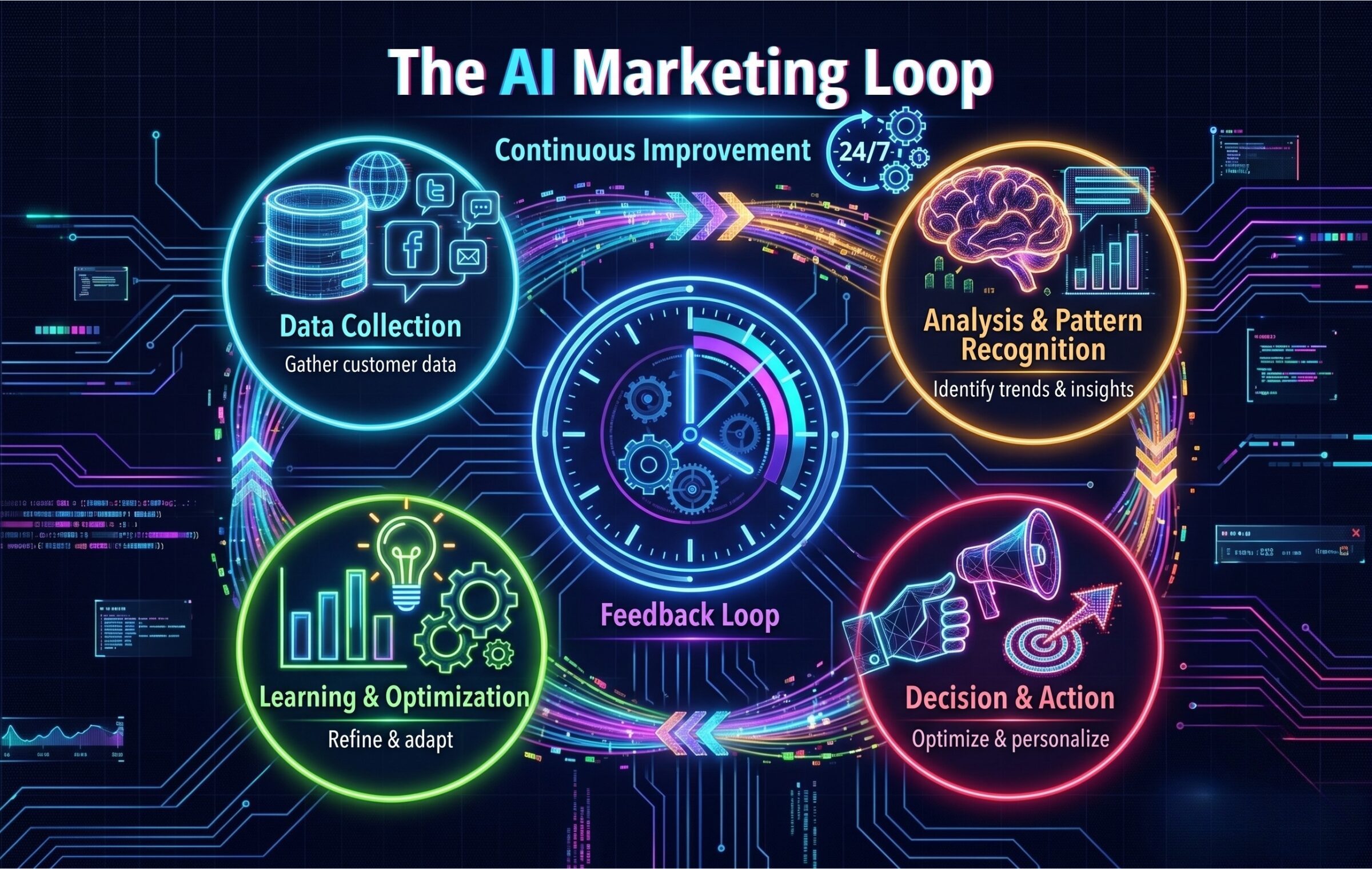
Here’s where it gets interesting. AI marketing operates in what I call “the continuous improvement loop,” and once you understand this, everything else clicks into place.

A glowing neon infographic titled 'The AI Marketing Loop' by bgood media, showing a continuous cycle of Data Collection, Analysis & Pattern Recognition, Decision & Action, and Learning & Optimization surrounding a central Feedback Loop clock on a dark cybernetic background.

Step 1: Data Collection
AI systems gather data from every customer touchpoint, website behavior, email interactions, social media engagement, purchase history, search patterns, even the time of day someone typically browses your site. (We’re talking hundreds or thousands of data points per customer.)
Step 2: Analysis & Pattern Recognition
Predictive analytics is where machine learning flexes its muscles. The AI analyzes all that data to identify patterns humans would never spot. It can use natural language processing (NLP) to analyze social media posts, customer reviews, or email responses to understand sentiment, intent, and emerging trends. For example, NLP might detect that customers mentioning “hard to use” in product reviews often churn within 30 days, or that certain email phrases like “need help” predict high engagement with support content. The AI finds these hidden correlations.

Step 3: Decision Making & Action
Based on those data patterns, the AI makes real-time decisions. It might automatically adjust your ad bid for a high-value customer segment, personalize website content for a returning visitor, or trigger a specific email sequence based on browsing behavior. This happens in milliseconds.

Step 4: Continuous Learning & Real-Time Optimization
Here’s the magic: every outcome feeds back into the system. The AI learns what worked and what didn’t, continuously refining its approach. That campaign that underperformed? The AI has already adjusted its strategy for next time.

This entire loop happens continuously, 24/7, across all your marketing channels simultaneously. It’s like having a thousand expert marketers working around the clock, each one learning from the others.

The difference between this and traditional campaign management is night and day. We used to launch campaigns, wait weeks for enough data, manually analyze spreadsheets, make adjustments, and repeat. Now, AI tools are testing, learning, and optimizing while we sleep.

Key Applications of AI in Digital Marketing

Here’s where AI is making the biggest impact right now, and how we’re using it at bgood media:

Content Creation and Optimization
AI writing tools can generate first drafts, suggest headlines, optimize content for SEO, and even analyze which topics will resonate with your audience before you write a single word. We use AI to identify content gaps, predict trending topics, and A/B test hundreds of headline variations. 

Personalization and Customer Segmentation
Gone are the days of blasting the same message to everyone. AI analyzes individual user behavior to create micro-segments (sometimes segments of one) and delivers personalized experiences. Product recommendations, dynamic website content, customized email campaigns, AI makes true one-to-one marketing possible at scale.

Predictive Analytics and Forecasting
AI can predict which leads are most likely to convert, which customers are at risk of churning, and what your ROI will be before you spend a dollar. We’ve used predictive models to identify high-value prospects, letting sales teams focus their energy where it matters most.

Marketing Automation
Smart automation goes way beyond scheduled social posts. AI-powered automation can trigger complex, multi-channel workflows based on customer behavior, automatically allocate budget across campaigns for maximum ROI, and adjust sending times for each individual subscriber based on when they’re most likely to engage.

Chatbots and Customer Service
Modern AI chatbots don’t just answer FAQs, they understand context, remember previous conversations, qualify leads while you sleep, and seamlessly hand off to humans when needed. 

Ad Targeting and Optimization
AI has revolutionized paid advertising. Platforms like Google and Meta use machine learning to automatically optimize bids, identify lookalike audiences, predict which creative will perform best, and prevent ad fatigue by rotating content. We’ve seen cost-per-acquisition drop significantly just from letting AI handle bid optimization.

SEO and Voice Search
AI tools now help with keyword research that actually understands search intent, content optimization that goes beyond keyword density, technical SEO audits that would take humans days, and voice search optimization as more people ask Alexa and Siri for recommendations.

Real-World Examples and Results

Numbers tell the story better than I ever could.

Netflix uses AI to personalize everything from thumbnail images to content recommendations. Their algorithm saves them $1 billion annually in customer retention. That’s not a typo. Billion with a B! According to Netflix’s own analysis, over 80% of what subscribers watch comes from personalized recommendations, not search—a testament to how effective AI-powered personalization can be.

Spotify creates personalized playlists like Discover Weekly using machine learning to analyze your listening habits, the listening habits of people with similar tastes, and the acoustic properties of songs themselves. Discover Weekly has generated over 100 billion streams since its 2015 launch, igniting over 56 million new artist discoveries every week. The playlist accounts for roughly 20% of Spotify’s total streaming volume—a massive impact from one AI-powered feature.

Sephora implemented an AI chatbot and Virtual Artist tool that provides personalized makeup recommendations and virtual try-ons. By 2018, the Virtual Artist saw over 200 million shades tried on, and customers who used these AI tools were 3 times more likely to complete a purchase than those who didn’t. The company’s e-commerce sales grew from $580 million in 2016 to over $3 billion in 2022 as a direct result of their AI investments.

The North Face partnered with IBM Watson to create an AI shopping assistant that asks customers about their needs and recommends products based on natural language conversations. During their pilot program, the tool achieved a 60% click-through rate to recommended products, with 75% of users saying they would use it again.

As for the broader impact, McKinsey estimates that AI could deliver $1.4 to $2.6 trillion of value in marketing and sales globally. And research from Harvard Business Review shows that businesses using AI marketing tools report an average 50% increase in leads and appointments, with some seeing even more dramatic results.

We’ve seen similar transformations with our own clients. After implementing AI-powered personalization, their email conversion rates jump noticably. Predictive analytics also help us identify clients’ most valuable customer segments, leading to higher customer lifetime value.

The Benefits of AI Marketing (Why Everyone’s Talking About It)

Let me be straight with you about why AI marketing has become non-negotiable for staying competitive.

Speed and Efficiency That Feels Like Magic

Tasks that used to take hours now take minutes. Campaign optimizations that required quarterly reviews now happen in real-time. I can set up complex automation workflows in an afternoon that would’ve taken a team weeks to build and manage manually. This frees up your team to focus on strategy, creativity, and the human stuff that actually moves the needle.

Personalization at Scale

You can now deliver Netflix-level personalization whether you have 100 customers or 100 million. Every visitor gets a unique experience tailored to their interests, behavior, and stage in the buyer journey. This level of relevance was simply impossible before AI.

Data-Driven Decisions (No More Guessing)

Instead of debating which campaign approach might work better, AI tells you with statistical confidence. Instead of wondering which customers to prioritize, predictive models rank them by likelihood to convert. The guesswork disappears, replaced by data-backed insights.

Serious Cost Savings

Between reduced manual labor, better ad spend efficiency, improved conversion rates, and lower customer acquisition costs, AI typically pays for itself several times over. We’ve seen clients cut their cost per lead in half while actually increasing lead volume.

The Competitive Advantage

Here’s the uncomfortable truth, your competitors are probably already using AI. The businesses that embrace these tools early are pulling ahead fast. The gap between AI-powered marketing and traditional approaches is widening every month.

Challenges and Limitations (The Stuff Nobody Wants to Talk About)

Okay, real talk time. AI marketing isn’t a magic wand, and anyone telling you otherwise is selling something.

Data Quality Is Everything

AI is only as good as the data you feed it. Garbage in, garbage out, as they say. If your data is incomplete, outdated, or biased, your AI will make flawed decisions. We’ve seen companies rush into AI tools only to realize their data infrastructure wasn’t ready. You need to fix your data foundation first.

The Learning Curve Is Real

AI tools need time to learn and optimize. Don’t expect perfect results on day one. Most AI systems need at least a few weeks (sometimes months) of data before they really hit their stride. This means patience is not optional.

Privacy, Compliance, & AI Marketing Ethics

With great data comes great responsibility. GDPR, CCPA, and other privacy regulations mean you need to be extremely careful about how you collect, store, and use customer data. AI makes it easier to personalize, but also easier to accidentally violate privacy laws if you’re not careful. Beyond legal compliance, AI marketing ethics requires thoughtful consideration of how you use customer data and whether your AI applications respect user privacy and autonomy.

AI Can Be Biased
Machine learning algorithms learn from historical data, which means they can perpetuate existing biases. If your past marketing inadvertently favored certain demographics, AI might amplify that bias. You need humans in the loop to catch and correct these issues.

“Black Hat” AI Is Here

Bad actors can deliberately poison AI systems to misrepresent brands or suppress competitors in AI-generated results. Research shows it takes surprisingly few malicious documents to create these “backdoors.” It’s a new frontier of black hat tactics that marketers need to defend against. We’ve covered AI poisoning and how to protect your brand in depth if this concerns you.

The Generic Content Problem

AI-generated content can sometimes feel… soulless. Generic. Like it was written by a very smart robot (because it was). This applies to everything from blog posts to entire AI-generated websites that might look decent but lack strategic strength. AI is getting better fast, but you still need human creativity to inject personality, brand voice, and emotional resonance into your marketing.

When AI Isn’t the Answer

Some marketing challenges require human judgment, creativity, and strategic thinking that AI can’t replicate. Brand positioning, crisis management, relationship building, creative breakthroughs, these still need humans driving the bus.

Will AI Replace Digital Marketers?

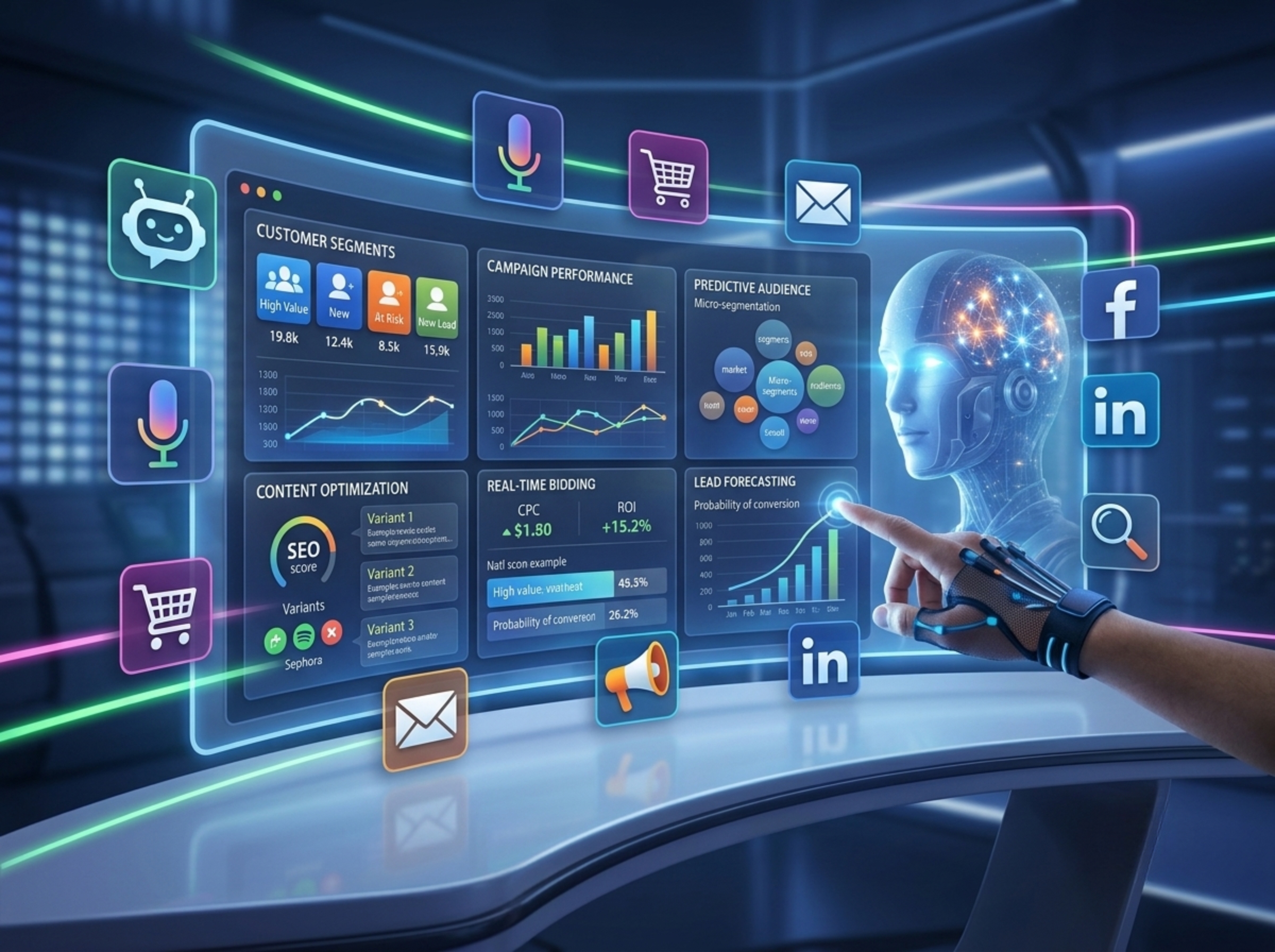
A professional sitting at a desk pointing at data dashboards while collaborating with a glowing holographic AI assistant, representing human-AI integration in marketing and data analytics.

I get asked this question at least once a week, usually with a hint of anxiety in the person’s voice.

Short answer: No. But your job will change, and that’s actually exciting.

Here’s the thing: AI is incredibly good at processing data, identifying patterns, automating repetitive tasks, and optimizing within defined parameters. You know what it’s terrible at? Understanding nuanced human emotions and motivations, developing creative brand strategies, building authentic relationships, making judgment calls in ambiguous situations, and innovating beyond existing patterns.

The future of marketing isn’t human versus AI. It’s human plus AI.

Think of it this way: calculators didn’t replace accountants, they just freed them from manual calculations so they could focus on strategy and analysis. Word processors didn’t replace writers, they made them more productive. AI won’t replace marketers, it’ll handle the tedious stuff so we can focus on the strategic, creative, and interpersonal work that actually requires human intelligence.

The most successful marketers I know are the ones who’ve embraced AI as a superpower. They use AI for data analysis, automation, and optimization, which frees them up to spend more time on creative strategy, building relationships, understanding customer psychology, and the kind of innovative thinking that creates breakthrough campaigns.

The Skills You Actually Need

Instead of worrying about being replaced, focus on developing these AI-era marketing skills: strategic thinking and business acumen, creative problem-solving, emotional intelligence and empathy, critical thinking to evaluate AI outputs, basic understanding of how AI works (you don’t need to code), and adaptability to learn new tools quickly.

The emerging role of the AI marketing strategist combines traditional marketing expertise with the ability to leverage AI tools effectively, bridging human creativity with machine intelligence.

How to Use AI Marketing: Getting Started (Without Losing Your Mind)

Alright, so you’re convinced AI marketing is worth exploring. Now what?

Start Small and Specific

Don’t try to revolutionize everything at once. Pick one area where AI could have immediate impact. Maybe it’s automating your email personalization, or using AI for better ad targeting, or implementing a chatbot for common customer questions. Get a win, learn from it, then expand.

Practical First Steps

Begin by auditing your current data (is it clean, accessible, and sufficient?), identifying your biggest marketing time-sinks (these are prime AI automation candidates), and talking to your team about pain points and inefficiencies. Then research tools that specifically address those issues rather than looking for an all-in-one solution.

Tools to Try

For beginners, there are great free AI marketing tools and low-cost options: ChatGPT for content ideation and drafting, Claude for market research and business development ideation, HubSpot’s free CRM with AI features, Google Analytics’ predictive metrics, Mailchimp’s send-time optimization.

As you scale up, consider platforms like Jasper for content, Seventh Sense for email optimization, Persado for copy optimization, or Acquisio for paid ad management.

Common Mistakes to Avoid

  1. Don’t set it and forget it! AI needs ongoing monitoring and adjustment. 
  2. Don’t trust AI outputs blindly; always apply human judgment. 
  3. Don’t neglect data privacy compliance. 
  4. Don’t expect instant miracles; give AI time to learn. 
  5. And please, don’t use AI to spam people with garbage emails or text messages. We all know it’s AI and we hate it.

When to Bring in the Experts

Look, I’m biased here, but there are times when DIY isn’t the best approach. If you’re spending more time figuring out tools than actually marketing, if you’ve hit a plateau with your current efforts, if you’re making significant budget investments in AI tools, or if you need a comprehensive AI strategy across multiple channels, that’s when it makes sense to work with people who live and breathe this stuff.

At bgood media, we’ve spent years testing tools, making mistakes, and figuring out what actually works versus what’s just hype. Sometimes the ROI of working with specialists who can fast-track your success just makes sense.

Frequently Asked Questions

What’s the difference between AI marketing and digital marketing?

Digital marketing is the broad category that includes all online marketing efforts, SEO, social media, email, paid ads, content marketing, etc. AI marketing is digital marketing supercharged with artificial intelligence to make it smarter and more efficient. You can do digital marketing without AI (people did for years), but AI marketing is always a subset of digital marketing.

Do I need to know coding to use AI marketing tools?

Absolutely not. Most modern AI marketing tools are designed for marketers, not developers. They have user-friendly interfaces, visual workflows, and plenty of templates. You need to understand marketing fundamentals and be willing to learn new software, but you don’t need to write a single line of code.

How much does AI marketing cost?

This varies wildly. Some AI features are built into tools you might already use (like Google Ads or Facebook Ads) at no extra cost. Standalone AI tools can range from free tiers to $50-500+ per month for small businesses, up to enterprise solutions costing thousands monthly. However, you can start with free or low-cost tools and scale up as you see ROI.

What are the best AI marketing tools?

The “best” tool depends on your specific needs, but here are some standouts: HubSpot for all-in-one marketing automation with AI, ChatGPT/Jasper for content creation, Seventh Sense for email send-time optimization, Acquisio for paid ad management, Drift for conversational marketing, and Persado for AI-powered copywriting.

Is AI marketing worth it for small businesses?

100% yes! And maybe even more so than for large enterprises. Small businesses typically have limited time and resources, which is exactly where AI delivers the biggest impact. You can compete with much larger competitors by using AI to personalize experiences, optimize ad spend, and automate time-consuming tasks. Many AI tools have affordable tiers specifically designed for small businesses. 

AI Marketing is Here to Stay

Here’s what I know after years of testing, implementing, and sometimes failing with AI marketing tools:

This isn’t a trend or a fad. AI has fundamentally changed how effective marketing works. The businesses that embrace these tools thoughtfully will have a massive advantage over those that don’t. But, and this is important, AI is a tool, not a replacement for strategic thinking, creativity, and genuine human connection.

The most exciting part is that we’re still in the early days. The AI marketing tools available today will look primitive in five years. The opportunities for businesses willing to experiment and adapt are enormous.

Your Next Steps
Start by picking one AI application that addresses a current pain point. Test it, measure the results, learn from the experience. Don’t try to boil the ocean. Small wins build confidence and competence.

And if you want to talk through your specific situation, whether you’re just exploring AI marketing or you’re ready to go all-in, we’d love to help. At bgood media, we’ve helped dozens of businesses navigate this AI transformation, and we’re kind of obsessed with figuring out what actually moves the needle versus what’s just shiny and new.

The future of marketing is human creativity amplified by artificial intelligence. Let’s make sure you’re ready for it.

Want to explore how AI could transform your specific marketing challenges? Let’s talk. We promise to skip the buzzwords and focus on what’ll actually work for your business.

What Is Vibe Coding? The Complete Guide

Last month, I built a custom CRM integration tool in a few hours.

Ok, it was more like 30 hours but I’m picky with what I want in my builds. I used Claude Code with Opus 4.8 before Fable 5 came out.

Three years ago, that same project would’ve taken months and probably required hiring a software engineer, costing me tens of thousands of dollars. No way I wanted to spend that kind of cash.

The difference was vibe coding: a new way of building software by having conversations with AI instead of writing code line by line.

Agent loops weren’t really a thing so I only used back-and-forth chat prompts.

AI-assisted development has completely transformed how software gets created. Marketing automation tools, client dashboards, and custom analytics platforms are now being built without writing traditional code. Not to be dramatic, but this has been game-changing for businesses across industries, ours included.

When Andrej Karpathy (former AI director at Tesla and OpenAI) coined the term “vibe coding” in February 2025, he perfectly captured what we’d been experiencing: a fundamental shift in how software gets made. Instead of meticulously typing out every function and debugging syntax errors at 2 AM, we’re having conversations with AI that turn ideas into working applications.

But vibe coding isn’t magic, and it’s definitely not without its challenges. After spending a lot of time in this world, I’ve learned what works, what doesn’t, and when you should absolutely not rely on AI to write your code. Let’s walk you through everything you need to know.

What Is Vibe Coding? The Simple Definition

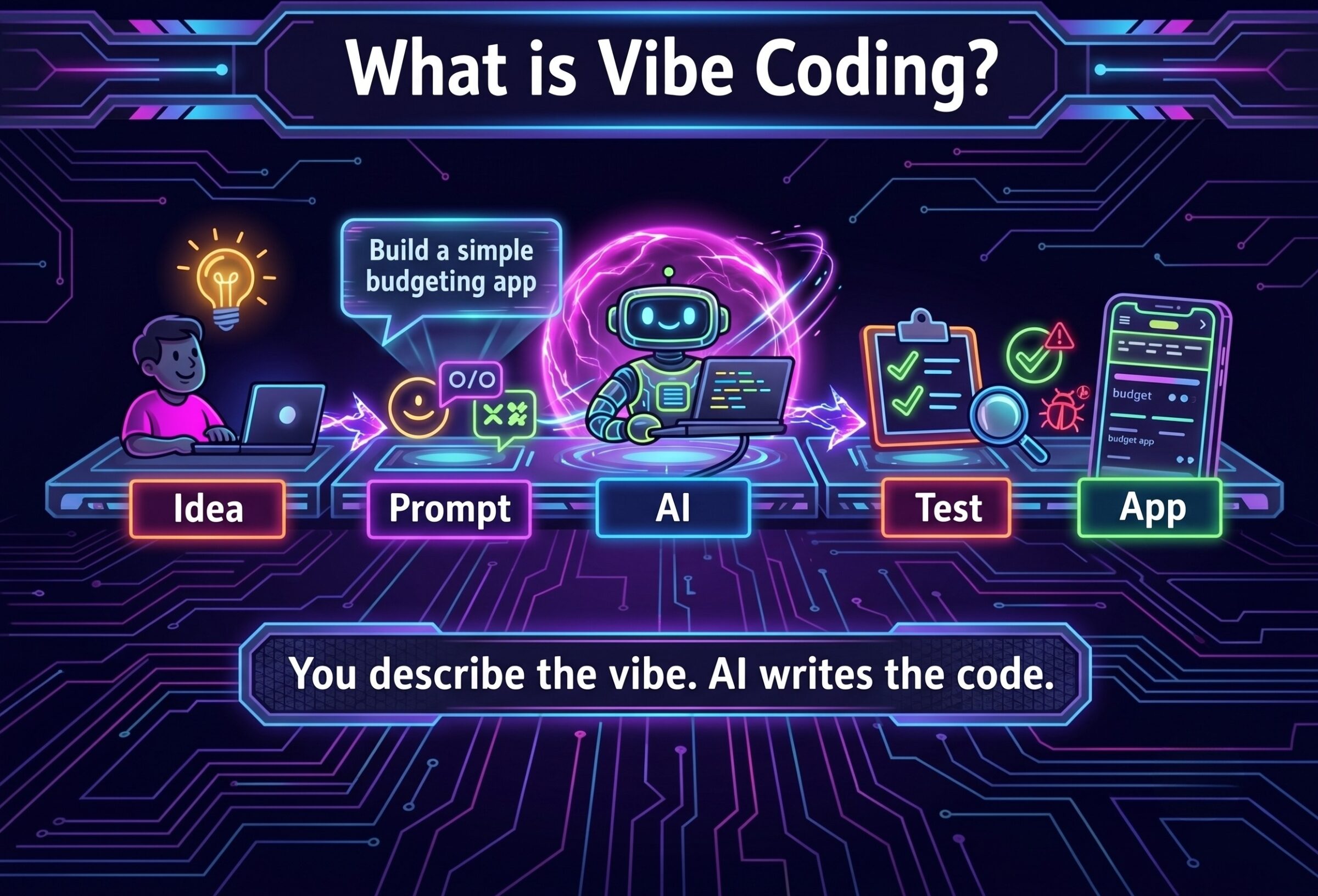
A neon-style infographic titled "What is Vibe Coding?" set against a dark, glowing circuit board background. A five-step flowchart illustrates the process left-to-right with glowing arrows: "Idea" (a person at a laptop with a lightbulb), "Prompt" (chat interface bubbles), "AI" (a robot surrounded by glowing energy processing code), "Test" (a checklist with a magnifying glass and bug), and "App" (a completed mobile application interface). At the bottom, glowing text reads, "You describe the vibe. AI writes the code." The color palette features vibrant neon blues, purples, pinks, and greens.

Vibe coding is a development approach where you describe what you want to build in natural language, and AI assistants generate the code for you. Instead of writing code yourself, you’re essentially having a conversation with an AI about your vision, then refining and iterating on what it creates.

This represents a fundamental shift in how software development works. Traditionally, developers spent their time writing code line by line—typing out every function, every variable, every conditional statement. With vibe coding, the developer’s role changes from being the writer to being the guide. You’re directing the AI, explaining what you need, reviewing what it produces, and steering it toward the right solution. The AI handles the actual code writing while you focus on the problem-solving and decision-making.

Think of it like this: traditional coding is like building furniture by hand with individual tools and materials. Vibe coding is like describing the furniture you want to an expert craftsperson who then builds it while you provide feedback and adjustments.

Now, I need to make an important distinction here. There are really two types of vibe coding:

“Pure” vibe coding is exploratory and experimental. You’re throwing ideas at AI, seeing what sticks, building throwaway prototypes to test concepts. This is perfect for side projects, learning, or rapid prototyping where code quality isn’t critical.

Responsible AI-assisted development is what professionals use for actual client work and production applications. You’re still using AI to generate code, but you’re reviewing it, understanding it, testing it thoroughly, and maintaining professional standards. The AI is your assistant, not your replacement.

Both are valuable, but knowing which approach you’re using makes all the difference in outcomes.

How Vibe Coding Actually Works

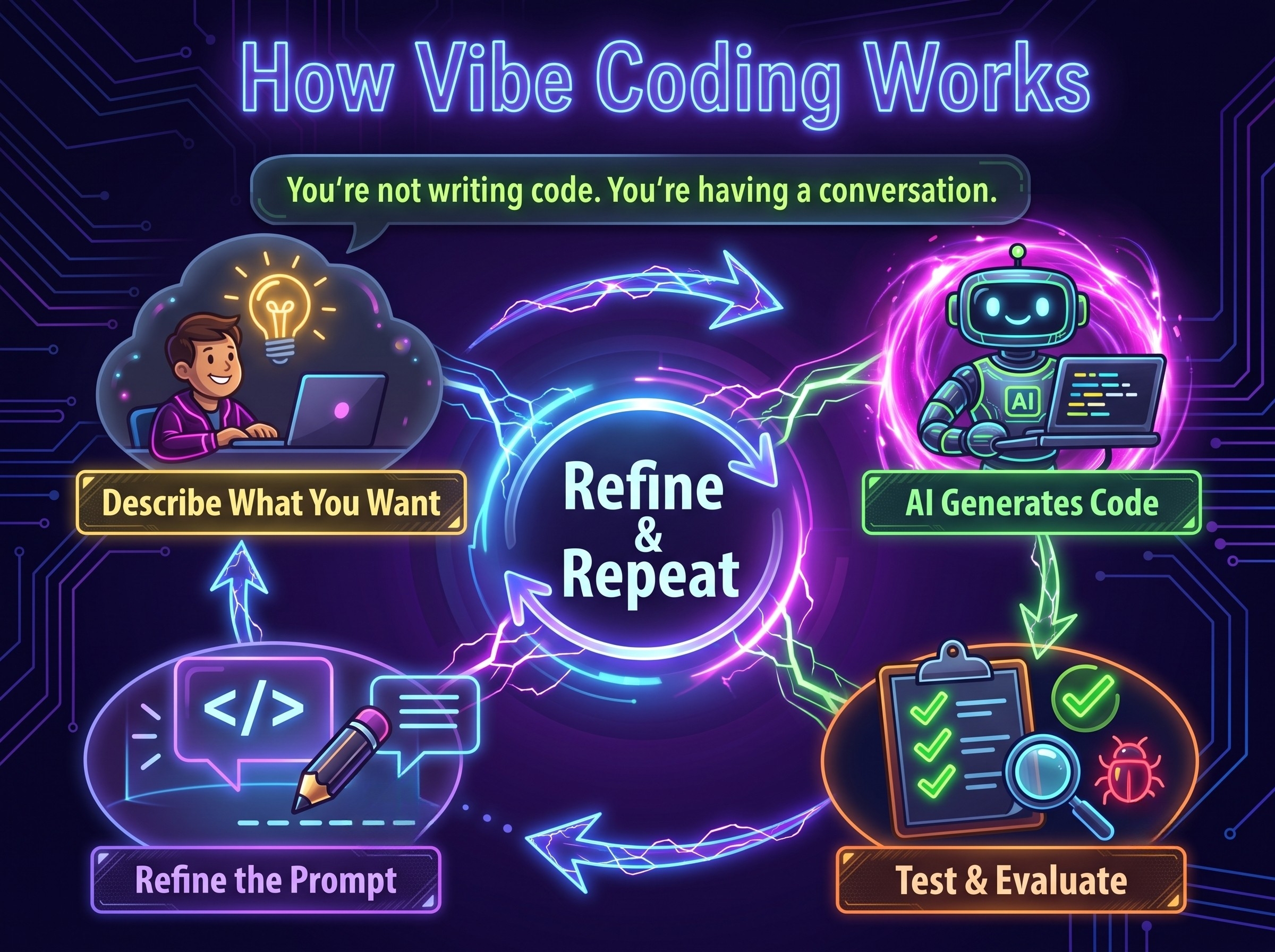
The vibe coding process follows a conversational loop that feels almost nothing like traditional programming. Here’s how it actually plays out:

Step 1: Describe what you want. You tell the AI what you’re trying to build using natural language. The more specific you are, the better the results.

Step 2: The AI generates code. Based on your description, the AI writes the initial code, sets up file structures, and even suggests libraries or frameworks.

Step 3: Test and evaluate. You run the code, test the functionality, and see how close it is to your vision.

Step 4: Refine and iterate. You provide feedback, point out issues, request changes, and the AI updates the code accordingly.

A modern neon-style infographic cycle titled "How Vibe Coding Works" on a dark, futuristic circuit background. It details the iterative human-AI collaboration process for software creation, with four key steps connected in a counter-clockwise loop: 'Describe What You Want', 'AI Generates Code', 'Test & Evaluate', and 'Refine the Prompt', connected to a central 'Refine & Repeat' core.

Let me give you a real example. Say you need a tool to automatically pull Instagram engagement metrics and format them for client reports. In the past, building something like this would take a developer 15-20 hours of work. Today, with vibe coding, you can have a working version in under two hours.

Here’s roughly how it goes:

Your prompt: “I need a Python script that uses the Instagram Graph API to pull engagement metrics for the last 30 days and export them to a formatted Excel spreadsheet with charts showing engagement trends over time.”

What the AI generates: A complete Python script with API authentication, data fetching logic, pandas for data manipulation, and openpyxl for Excel generation including basic charts.

What you refine: “The chart colors don’t match our brand. Use #2C5F8D for the primary color. Also, add error handling for when the API rate limit is hit, and include a progress indicator.”

Final result: A production-ready tool built in a fraction of the time traditional development would require.

The full application lifecycle for vibe coding looks like this: ideation (what problem are you solving?) → generation (AI creates initial code) → refinement (iterative improvements through conversation) → deployment (shipping to production with proper testing and review).

Vibe Coding vs. Traditional Programming

Understanding when to use vibe coding versus traditional programming is crucial. Here’s how vibe coding compares to traditional programming:

Aspect Vibe Coding Traditional Programming
Development Speed 5-10x faster for standard features Slower but more precise control
Required Expertise Basic technical understanding, strong problem-solving Deep programming knowledge, syntax mastery
Developer Role Product manager, reviewer, guide Hands-on builder, architect
Learning Curve Shallow—start building immediately Steep—months to years of learning
Best For Prototypes, internal tools, standard applications Complex algorithms, performance-critical systems, novel solutions
Code Quality Variable—depends on prompts and review Consistent with developer skill level
Debugging Can be challenging without code knowledge More straightforward with expertise

When deciding which approach to use, consider these factors:

Use vibe coding when:

  • You need something built quickly
  • The application is relatively standard (CRUD apps, dashboards, integrations)
  • You’re prototyping or validating ideas
  • Development resources are limited
  • You understand the domain even if you can’t code it yourself

Stick with traditional programming when:

  • Performance is absolutely critical
  • You’re building novel algorithms or unique solutions
  • Security requirements are extremely high
  • The codebase will need extensive long-term maintenance
  • You’re working on large-scale, complex systems

For most business applications and marketing tools, vibe coding wins hands down.

Vibe Coding vs. AI-Assisted Development

It’s also worth noting that you don’t have to choose pure vibe coding or traditional programming; you can also choose AI-assisted development, which is basically traditional coding with some help from AI.

Vibe coding sits at one end of the spectrum (fully conversational, AI generates entire features), traditional programming at the other end (hand-coding everything), and AI-assisted development falls somewhere in between (developers still write code but get AI suggestions and autocomplete).

Related approaches like no-code or low-code platforms exist as well, but they’re a different category entirely: these rely on drag-and-drop templates and visual builders rather than generating fully custom code through conversation with AI. They can be faster for simple apps, but much less flexible for complex or unique solutions.

Popular Vibe Coding AI Tools & Platforms

The vibe coding ecosystem has exploded over the past year. If you’re wondering what the best vibe coding AI tools are, here’s a breakdown of the major vibe coding AI tools and what they’re each good for:

Google AI Studio / Firebase Studio / Gemini Code Assist Google’s suite of vibe coding tools integrates beautifully if you’re already in their ecosystem. AI Studio is great for quick prototypes, Firebase Studio excels at full-stack applications with database integration, and Gemini Code Assist works within your existing IDE for code generation and assistance.

Replit This is where most people start with vibe coding. Replit’s interface is incredibly intuitive, and you can go from idea to deployed application without leaving the browser. Their AI agent handles everything from environment setup to deployment. Perfect for rapid prototyping and learning.

Cursor If you’re a developer who wants AI assistance within a professional code editor, Cursor is probably your best bet. It’s built on VS Code, so it feels familiar, but with powerful AI integration that can edit across multiple files and understand your entire codebase context.

GitHub Copilot More of a coding assistant than a pure vibe coding tool, but incredibly powerful for developers who want AI suggestions while they write. It autocompletes entire functions based on comments and context.

Claude Code A newer command-line tool that’s excellent for developers who live in the terminal. It’s particularly good at understanding complex codebases and making architectural decisions.

If you’re just starting, begin with Replit. Once you understand the fundamentals, you can experiment with the others based on your specific needs.

Real-World Applications: What You Can Build with Vibe Coding

Here’s where this gets exciting. We’re already using vibe coding at bgood media to build real tools that solve real business problems, fast. We can use vibe coding to build:

Business applications and internal tools: We’ve used vibe coding to spin up custom internal tools like lightweight CRMs, content production dashboards, and client reporting systems tailored to how we actually work. The kind of tools that replace $50–$200/month SaaS subscriptions — without forcing us into someone else’s workflow. Instead of adapting our processes to software, we build software around our processes. And we do it in days, not quarters.

Rapid prototypes for client projects: When a client comes to us with “what if we built…” energy, vibe coding lets us answer with “cool, let’s see it.”

We’ve used AI-assisted development to create working prototypes for new services, internal tools, and data workflows in hours instead of weeks. That means clients can validate ideas before committing serious budget to full-scale development. It’s faster feedback, lower risk, and way fewer expensive surprises.

Marketing automation tools: This is where vibe coding shines for marketing teams. We’ve built custom tools for things like:

  • Content planning and publishing workflows
  • SEO audits tailored to specific industries
  • Campaign tracking dashboards that pull from multiple platforms

Unlike bloated expensive marketing software, our AI marketing tools are built to do exactly what’s needed — nothing more, nothing less.

Custom integrations: Some of the most powerful use cases we’ve seen involve stitching systems together that were never meant to talk. With vibe coding, we’ve created tools that pull data from multiple sources, clean it, analyze it, and generate reports automatically — workflows that used to require a developer team, long timelines, and ongoing maintenance contracts.

And this isn’t just us experimenting on the fringes.

According to Y Combinator, 25% of their Winter 2025 batch had codebases that were 95% generated by AI. That’s not a future prediction; it’s happening right now. These are funded startups building real products that real customers use.

The Benefits of Vibe Coding for Businesses

Here’s why this matters for your business (TLDR: higher ROI):

Faster time-to-market: Development times are 5-10x faster than traditional coding for standard applications. Ideas that would’ve taken months can now ship in weeks or even days.

Lower barriers to entry: You don’t need to hire a full development team to build custom software anymore. Someone with business domain expertise and good communication skills can now build functional applications.

Democratization of development: Marketing teams can build their own tools. Operations managers can create custom dashboards. Sales teams can prototype new customer experiences. The power to create software is spreading beyond traditional engineering teams.

Significant cost savings: Traditional development might cost $50,000-$150,000 for a custom application. With vibe coding, you can build comparable solutions for 10-20% of that cost, especially if someone internal learns to do it.

Innovation enablement: When the cost and time to test ideas drops dramatically, you can experiment more. Multiple prototypes can be built and tested to discover what actually works.

For small to medium businesses especially, vibe coding levels the playing field. You can now build custom solutions that previously only enterprises with huge IT budgets could afford.

The Limitations & Challenges You Need to Know

Vibe coding is powerful, but it’s not perfect. Here are the challenges you need to understand:

Technical complexity for advanced use cases: When you need complex algorithms, intricate data structures, or highly optimized performance, AI-generated code often falls short. Complex projects may still require traditional developers.

Code quality and maintainability issues: AI sometimes generates code that works but is poorly structured, uses outdated patterns, or includes unnecessary dependencies. Without review and refactoring, technical debt builds up quickly.

Debugging difficulties: When something breaks in code you didn’t write and don’t fully understand, fixing it can be frustrating. Hours can be spent debugging AI-generated code that might have taken minutes with traditionally written code.

Security vulnerabilities: This one is serious. One cautionary example comes from the vibe coding platform Lovable: security researchers discovered that projects generated with Lovable were exposing sensitive data due to insufficient Row Level Security on database endpoints, highlighting the need to carefully review and secure AI-generated code (Matt Palmer, CVE-2025-48757).

When vibe coding is NOT appropriate:

  • Financial systems handling transactions
  • Healthcare applications with HIPAA requirements
  • Large-scale systems serving millions of users
  • Applications where downtime costs thousands per minute
  • Systems requiring custom algorithms or novel approaches

There’s also what some call the “vibe coding hangover.” It’s that moment when you realize the prototype built in two hours now needs to be production-ready, and you’re staring at AI-generated code you don’t fully understand. The key is building in time for review and refactoring from the start.

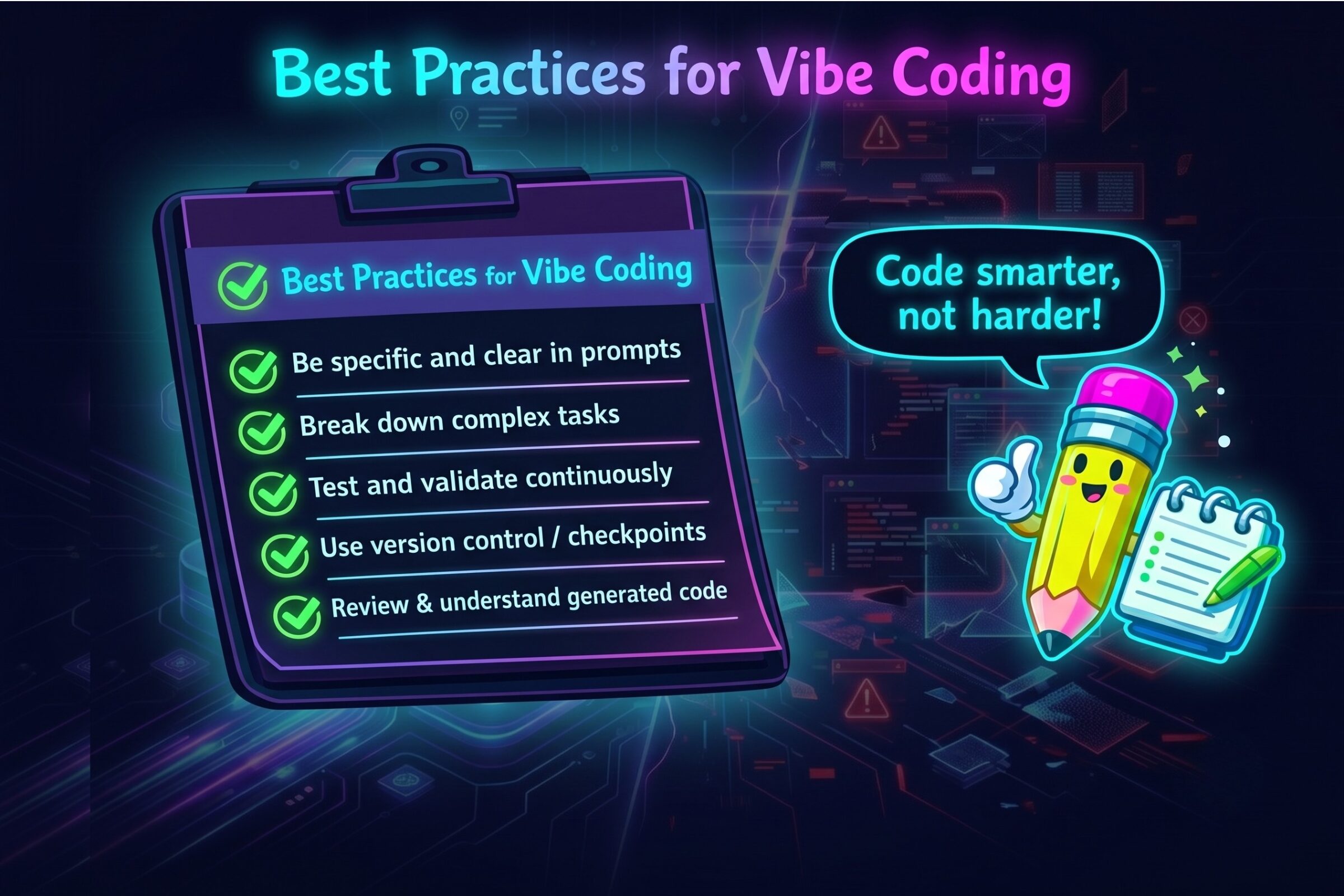
Best Practices for Effective Vibe Coding

Here’s what actually works when using vibe coding:

Be specific and clear in prompts. “Build a website” will get you garbage. “Build a landing page for a yoga studio with a hero section featuring a background video, three class package options with pricing cards, an instructor bio section with headshots, and a contact form that emails to studio@example.com” will get you something useful.

Break down complex tasks. Don’t ask the AI to build your entire application in one prompt. Build it piece by piece: first the data model, then the API endpoints, then the UI components, then the integration logic. This makes debugging much easier.

Test and validate continuously. Don’t wait until the AI has generated thousands of lines of code to test it. Test each component as it’s built to catch issues early.

Implement version control and checkpoints. Even with AI-generated code, use Git. Commit frequently. When something breaks (and it will), you want to be able to roll back to the last working version easily.

Review and understand generated code. You don’t need to understand every line, but you should understand the general approach, key functions, and data flow. If you can’t explain what the code does at a high level, you’re setting yourself up for problems.

A vibrant neon-style infographic featuring a cute cartoon pencil character giving a thumbs-up and a speech bubble reading "Code smarter, not harder!" Next to the character is a glowing checklist of five "Best Practices for Vibe Coding" on a dark digital background.

Security considerations:

  • Never trust AI with authentication code without review
  • Always sanitize user inputs
  • Use environment variables for sensitive data, never hardcode
  • Run security scans on generated code
  • Have a security-knowledgeable person review anything customer-facing

Successful vibe coders treat AI as a junior developer who’s incredibly fast but needs supervision, not as a senior architect who can be trusted blindly.

The Future of Vibe Coding & What It Means for Your Business

The future of software development isn’t just for developers anymore. It’s for anyone with good ideas and the willingness to learn.

Here’s where vibe coding/AI-assisted development is headed:

Multimodal programming is already emerging. Instead of just typing descriptions, we’re starting to see vibe coding that accepts sketches, screenshots, voice commands, and even video demonstrations. Imagine drawing a UI mockup on a napkin, taking a photo, and having AI generate the working application.

The evolution toward VibeOps means AI won’t just generate code—it’ll manage deployments, monitor performance, auto-scale infrastructure, and even debug production issues. We’re moving from “AI helps you code” to “AI manages your entire technical stack.”

Developer roles are shifting. The role isn’t disappearing, but it is changing. Developers are becoming architects, reviewers, and system designers rather than syntax writers. The valuable skill is knowing what to build and how systems should work together, not memorizing programming language syntax.

What businesses should prepare for:

  • Everyone needing to understand the tech, not just developers
  • Faster innovation, which means making decisions quickly and iterating often
  • Using software as a growth and strategy tool, not just a task manager
  • Teams creating their own custom tools instead of waiting on IT

Within three years, most business software will be at least partially AI-generated (you’ll be seeing a lot more AI-generated websites, too). The companies that learn to leverage vibe coding now will have a massive advantage over those who wait.

Frequently Asked Questions

Is vibe coding the same as AI coding? Vibe coding is a type of AI coding. The term specifically refers to describing what you want in natural language and having AI generate complete applications, rather than line-by-line coding assistance.

Do I need to know how to code to use vibe coding? Not necessarily, but basic technical understanding helps. You should understand concepts like variables, functions, databases, and APIs even if you can’t write them from scratch.

What skills are needed for vibe coding? You need a basic understanding of how software works, clear communication skills to explain what you want, and enough technical judgment to review, test, and refine AI-generated code. You don’t need to be an expert programmer—but you do need to know when something works, when it doesn’t, and how to guide the tool in the right direction.

Can you vibe code with ChatGPT or Claude? Yes, but with limitations. Chat interfaces can generate code snippets but aren’t full vibe coding platforms. For serious vibe coding, you’ll want dedicated platforms like Replit or Cursor that can execute and deploy code.

Is vibe coding suitable for production applications? It depends. For standard business applications and internal tools, yes—with proper review and testing. For critical systems handling sensitive data or high-traffic applications, use vibe coding cautiously with expert review.

Will vibe coding replace developers? No. Developers are becoming more productive and focusing on harder problems. Meanwhile, non-developers are building things they never could before. The demand for software is growing faster than AI can replace human developers.

Getting Started with Vibe Coding

The best way to understand vibe coding is to try it. Start small, be patient with the learning curve, and don’t expect perfection immediately.

Your next steps:

  1. Create a free account on Replit and build something simple—a simple website, a to-do app, anything that interests you
  2. Start with a clear, specific goal rather than a vague idea
  3. Test early and often, catching issues before they compound
  4. Join communities where people share prompts and solutions
  5. Build something real that solves an actual problem you have

The technology is accessible, powerful, and improving rapidly. The businesses that figure out how to leverage AI-assisted development now will be miles ahead of competitors still doing things the old way.

At bgood media, we’re already using vibe coding to build internal tools, prototype new services, and create custom solutions for clients faster than traditional development ever allowed. It’s become a core part of how we experiment, iterate, and turn ideas into working products without waiting months to see what’s possible.

Want to explore how AI-assisted development could transform your business? We’re always happy to talk about what’s possible. The question isn’t whether vibe coding will change how software gets built—it’s whether you’ll be ready when it does.

Reach out today and let’s see if we vibe!

Why Digging Into a Niche Is the Smartest Way to Grow Your Business

At bgood media, we’ve seen a lot of businesses with incredible potential stall out for one simple reason: they’re trying to talk to everyone. And when you try to speak to everyone, you end up connecting with almost no one.

In today’s hyper-personalized world, where the almighty algorithm curates your feeds, your recommendations, and basically your entire digital life — people expect brands to feel like they were built specifically for them. And that level of connection doesn’t come from broad messaging. It comes from owning your niche.

Generalists Don’t Stand Out. Specialists Do.

There was a time when saying “we work with anyone!” made you sound impressive. Today, it makes you sound like you haven’t figured out who you really serve.

When your message is too broad, it falls flat:

  • You can’t speak directly to someone’s pain points
  • You can’t hit the emotional cues that build trust
  • And you definitely can’t differentiate yourself in a crowded marketplace

In other words: generalists blend in. Specialists stand out. 

What Niching Down Really Does for You

Here’s a real-life example. We recently looked at ProSwift, a brand built specifically for construction project managers. Not “construction workers.” Not “anyone in the industry.” A clear, defined role with clear, defined needs.

Because they know exactly who they’re talking to, all of their messaging hits the mark:

  • Language that matches how project managers think
  • Search intent that reflects real questions
  • A tone that feels familiar and relevant

That’s what niche positioning does. We’ve seen businesses go from “kind of doing a little bit of everything” to “wow, this is exactly what we’ve been looking for.” And that shift happens because they finally picked a lane.

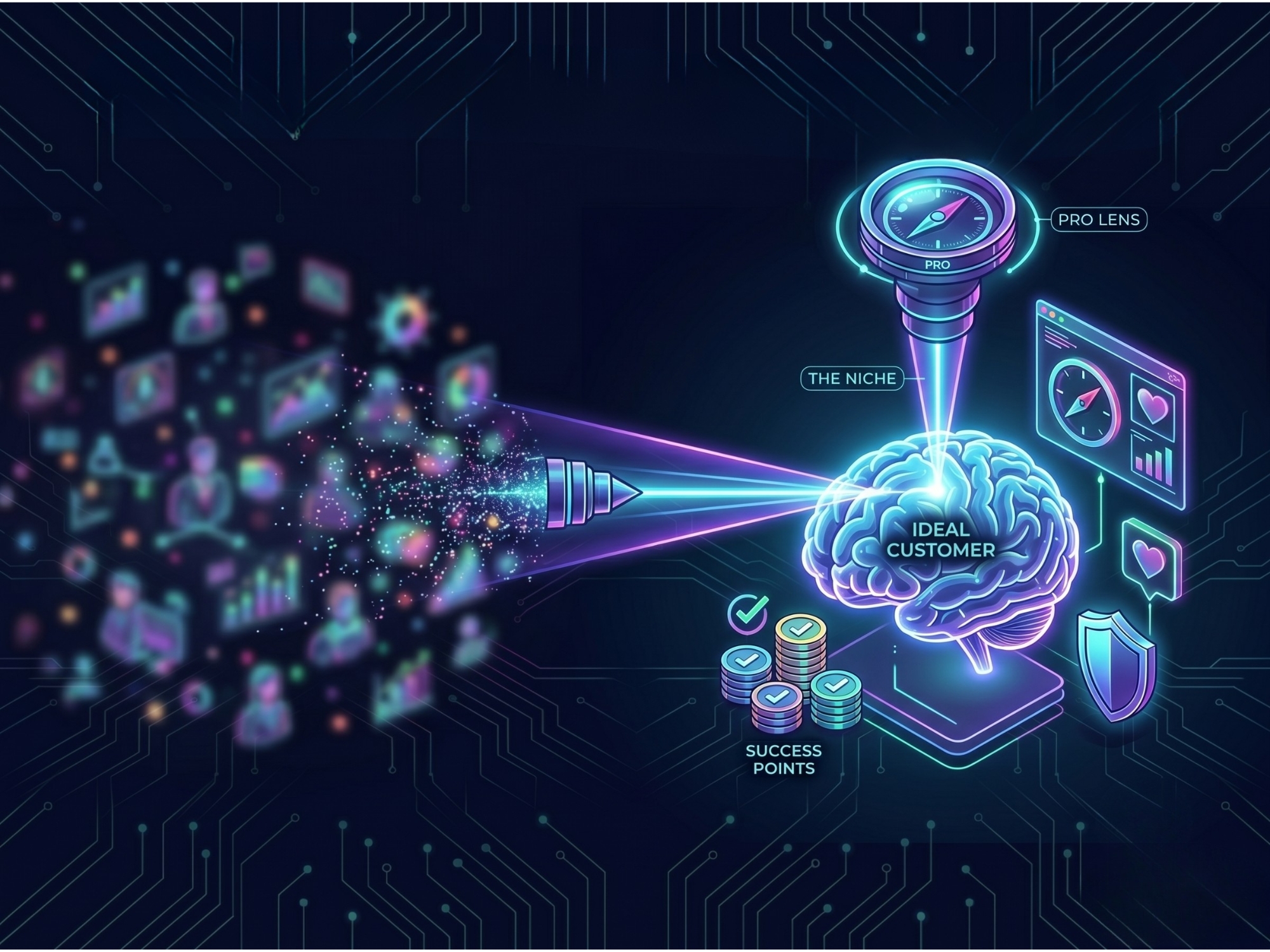
How We Think About It at bgood: PRO (Personalized Response Optimization)

At bgood, we use a simple framework we call PRO (Personalized Response Optimization). It’s our way of grounding everything in one goal: to make your messaging feel like it was written for a real human, not a category.

PRO means:

  • You know exactly who you’re serving
  • You speak their language
  • You create content and experiences that reflect their values, fears, questions, and aspirations
  • And you do it with authenticity, not manipulation

When brands embrace PRO, everything gets easier, from marketing and storytelling, to conversions and brand loyalty. It’s like your audience suddenly realizes, “Oh… they actually get me.”

People want to feel seen, and your niche helps them feel that way.

Why We Believe in Niche-Focused, People-First Marketing

bgood media exists because we watched too many agencies stop caring about the people they serve. These big agencies took on too many clients and spread themselves too thin, losing their edge (and their profitability!) along the way.

We wanted to bring the humanity back to marketing.

We built bgood to serve brands that care about doing good: financial, travel, and wellness companies that genuinely want to improve lives and communities. Our niche keeps us focused and aligned with our purpose. And we get to work with people who share our same mission.

Finding your niche can do the same for your business. When you embrace your niche, you make it easier for the right people to find you, connect with you, and choose you. 

The Bottom Line: Your Niche Is Your Advantage

It’s time to stop trying to win over everybody on the internet and start talking directly to the people who actually want to be there. 

When you dig into your niche, you gain:

  • Clearer messaging
  • More aligned customers
  • A stronger brand identity
  • Better conversions
  • And a deeper sense of purpose

Choosing your niche doesn’t shrink your business. It shapes it. It gives you direction, clarity, and a path to the work you actually want to be doing. And when you grow within a niche you care about, you end up doing more good than you ever expected.

Ready to Stand Out in Your Space?

If you’re tired of broad, forgettable marketing and you’re ready to build a brand that actually resonates with the people who matter most, we’d love to help. Reach out to bgood media, and let’s craft a niche-driven strategy that feels personal, purposeful, and powerfully you.

Should You Hire an In-House Marketing Team or Outsource It?

If you’ve hit that point in your business where “we really need marketing” keeps popping up in meetings, you’re probably also wondering:

Do we hire someone in-house… or just outsource it?

On paper, hiring internally sounds great. Someone who knows the brand, sits in the office, answers Slacks instantly … perfect! Right?

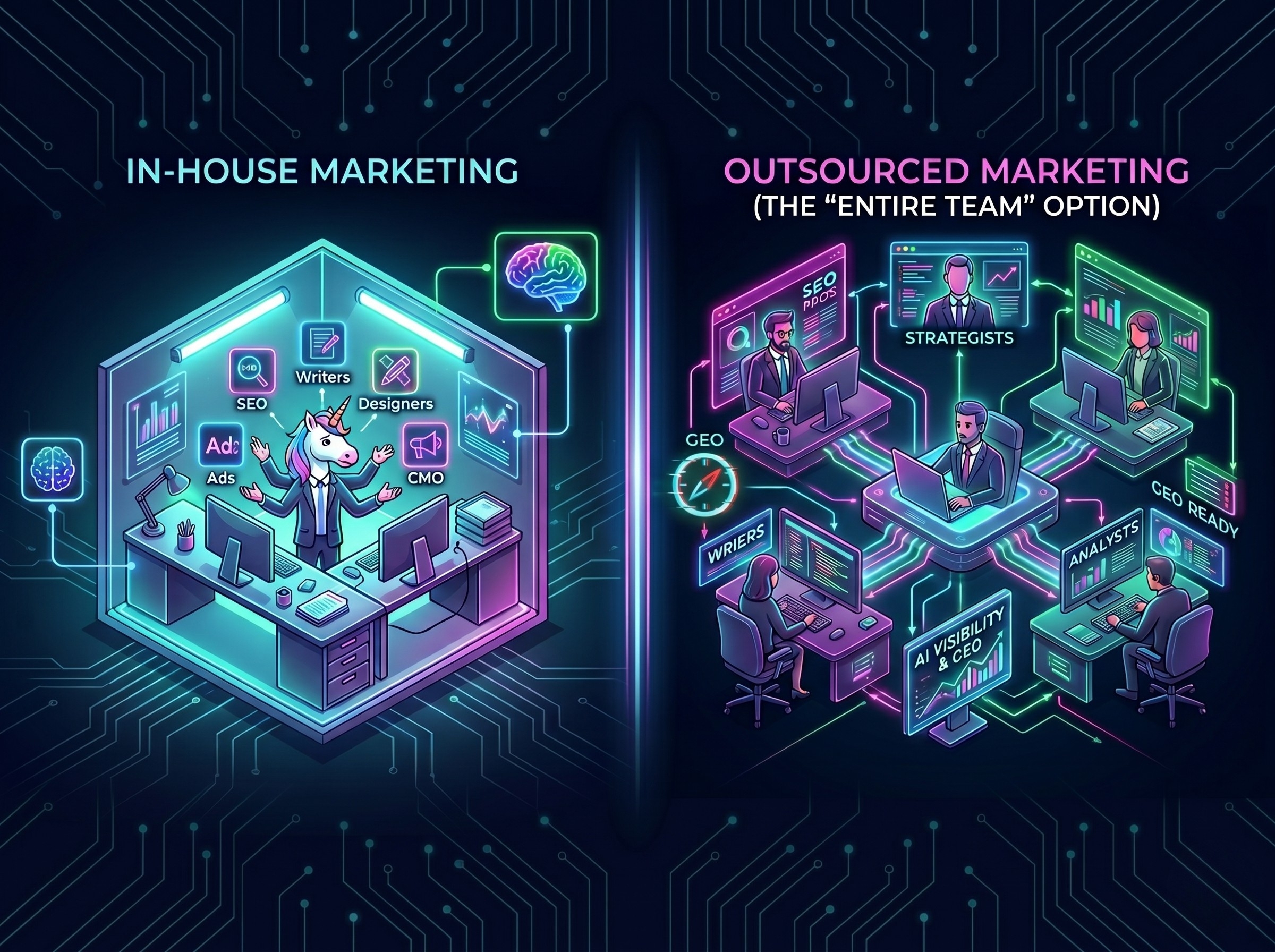
But the deeper you go into what’s actually needed for modern marketing (SEO, ads, AI visibility, content, analytics), the more it becomes clear:

You’re not hiring a marketer.

You’re hiring a whole team.

So let’s break down the real differences between hiring an in-house marketer vs. outsourcing and what we know from doing this every day.

The Real Appeal of Hiring In-House

Hiring internally feels comforting. You get:

  • Someone who “lives” your brand daily
  • Quick answers, tight collaboration
  • Long-term consistency
  • Easier alignment with sales and product

All good things.

But then reality hits:

Marketing isn’t one job. It’s… a lot of jobs.

A real in-house team requires:

  • SEO pro
  • Content strategist
  • Writers
  • Social media manager
  • Designer
  • Paid ads specialist
  • Analyst
  • Someone who understands AI search
  • A CMO to run it all

And unless your budget is sitting in the “enterprise-level” category, you’re probably not hiring all of these people anytime soon.

Most businesses end up trying to hire a “unicorn”, i.e., one marketer expected to do everything. And that’s exactly where things start breaking down.

Why Outsourcing Usually Makes Way More Sense

This is the part business owners don’t hear enough:

Outsourcing gives you an entire team of senior-level specialists for a fraction of what it costs to hire even one internally.

Here’s what you actually get when you outsource:

1. Senior talent without senior salaries

Agencies are full of people who’ve been doing SEO, analytics, ads, and content for years.

Hiring that level in-house? $120K+ per person. Outsourcing? A fraction of that.

2. Specialists instead of one overworked marketer

Instead of one person trying to “do it all,” you get:

  • SEO pros
  • Writers
  • Strategists
  • Designers
  • Analysts
  • AI visibility experts

Everyone working in their lane = way better output.

3. Faster ramp-up and proven experience

Agencies don’t need onboarding. They’ve already tested, failed, succeeded, iterated, and know what works in your industry.

4. Easier accountability

If an employee underperforms, you’re stuck.

If an agency underperforms, you fire them.

Simple.

But Here’s the Hybrid Sweet Spot Most Companies Choose

The “dream setup” is surprisingly simple:

  • One internal leader (CMO or Marketing Director) to keep strategy & brand consistent
  • An outsourced team to handle the heavy lifting

This keeps internal costs low while giving you access to senior-level execution.

Why “AI Visibility” Changes the Entire Conversation

This is the piece most businesses are missing.

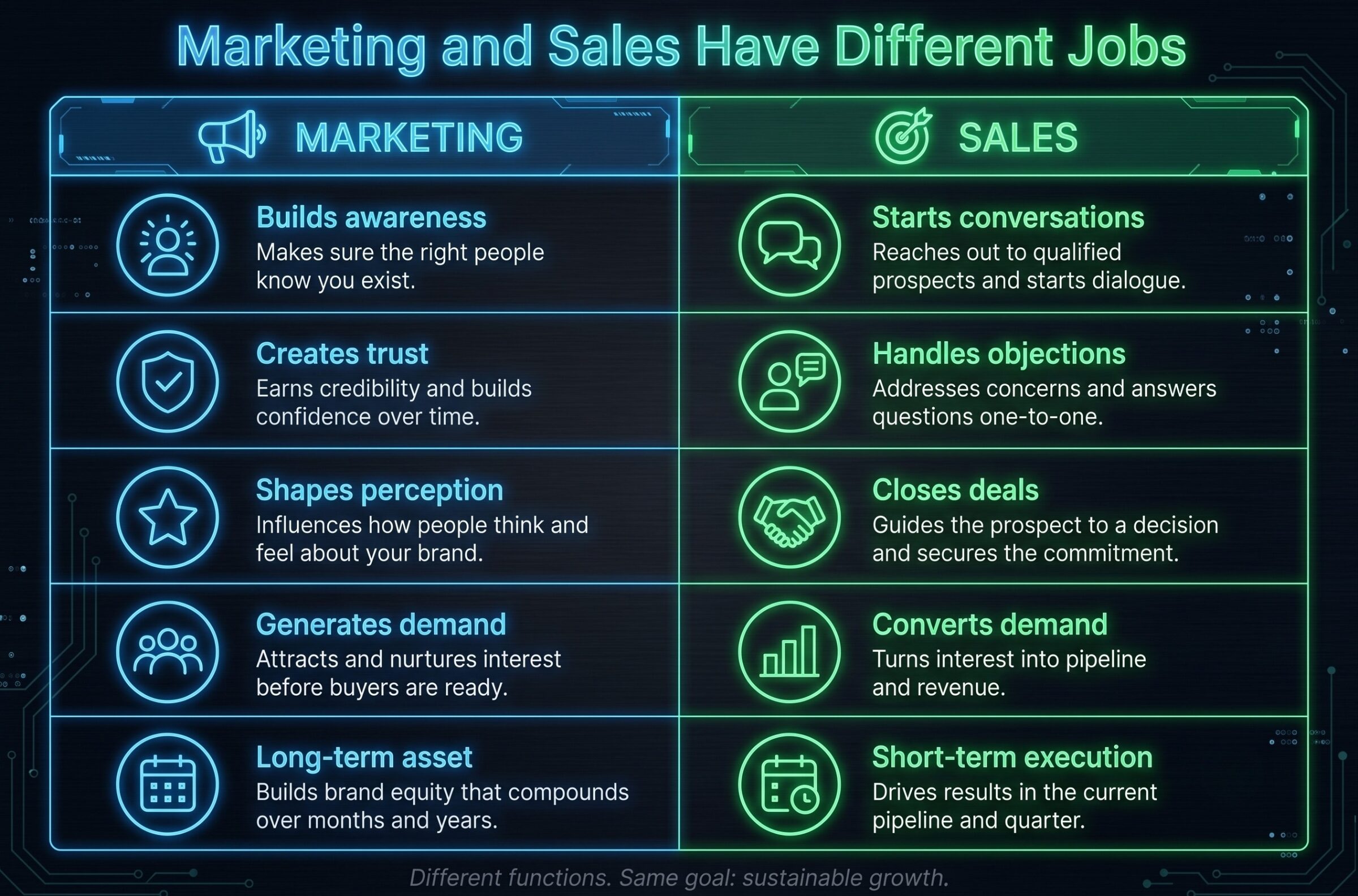
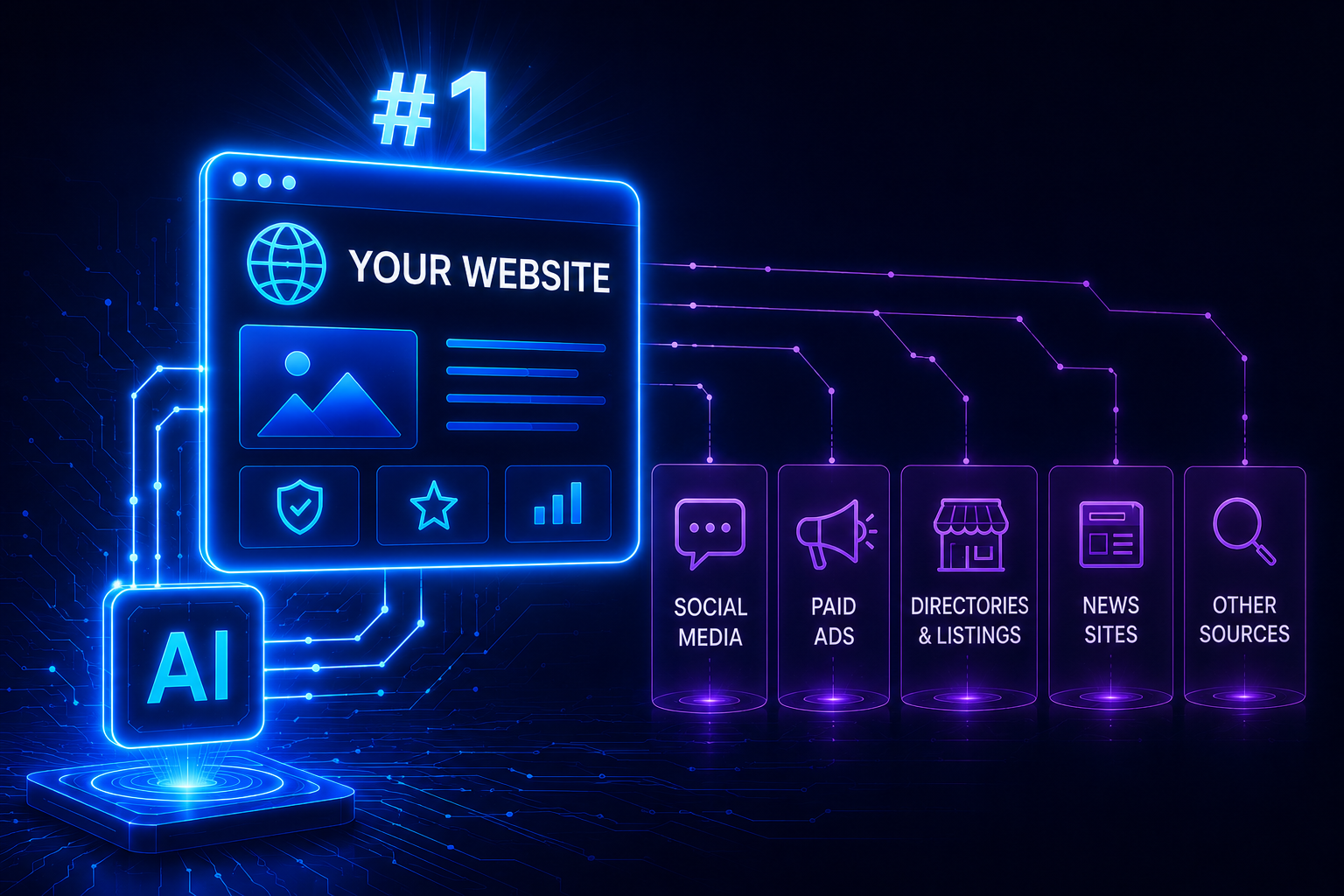
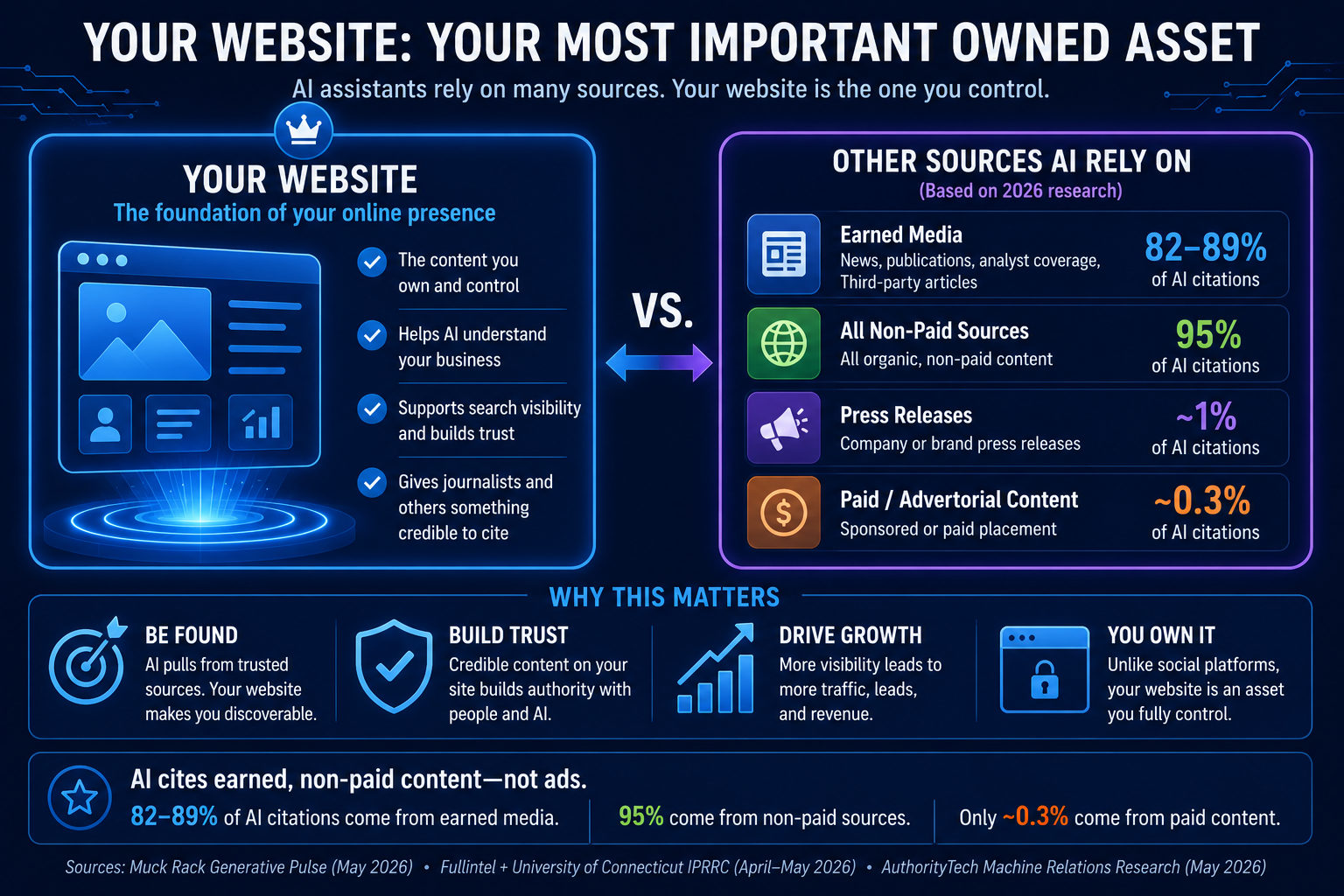
Marketing today goes beyond traditional Google search rankings. Marketing now includes traditional search and AI-driven discovery.

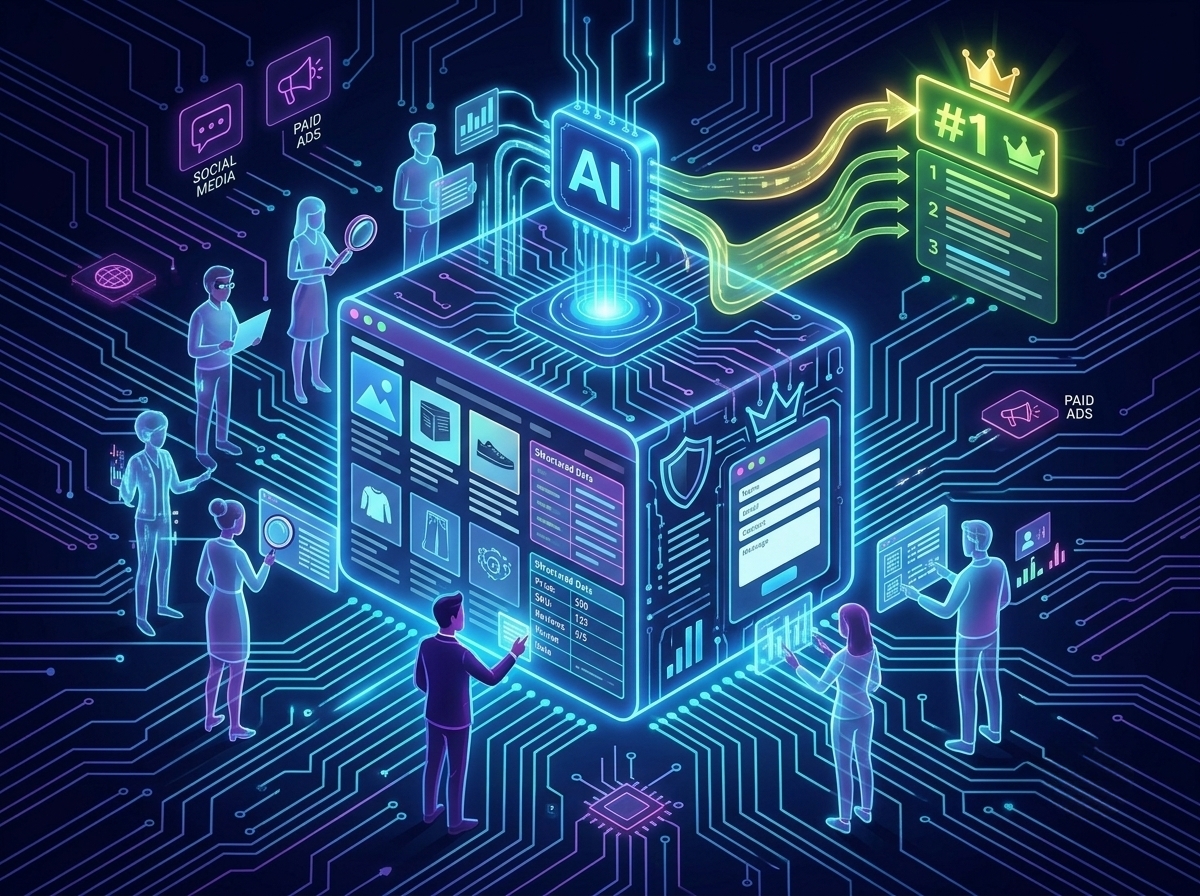
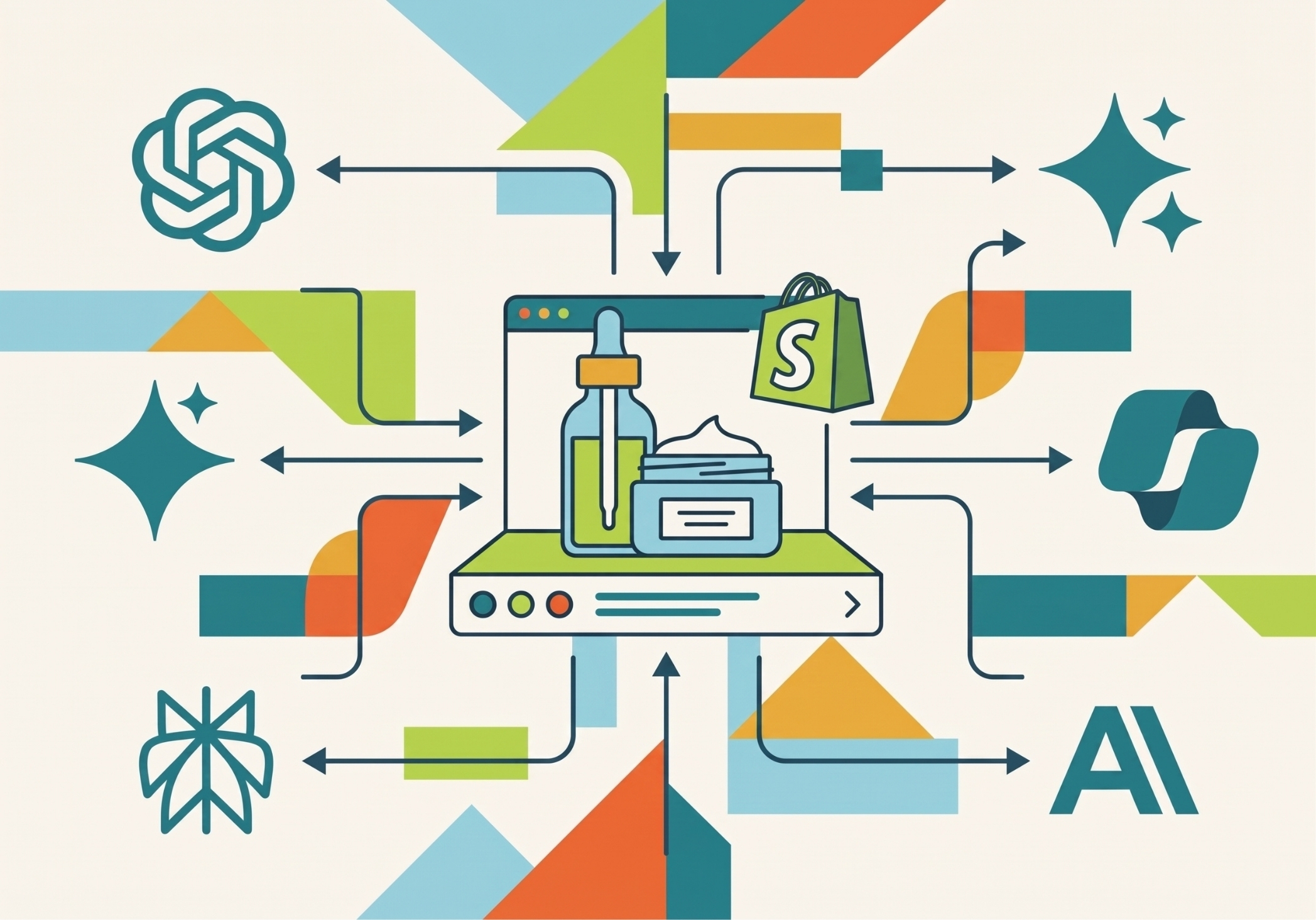
This means you need to rank in Google’s AI Overview as well as in standalone LLMs (large language models) like ChatGPT, plus GSEs (generative search engines) like Perplexity.

To earn visibility in AI models, you need some specific things:

  • Structured content
  • Topic clustering
  • Entity optimization
  • Clean technical SEO
  • Trust-building signals
  • And someone who understands how AI interprets content

This is not something a single in-house hire typically knows how to do. 

But agencies, and especially full-stack digital shops, are already adapting to this shift from SEO to GEO (generative engine optimization).

If you want your business to be visible in Google and in AI systems, it’s almost impossible to achieve that with a one-person in-house hire.

In-House vs. Outsourced: A Simple Comparison

In-House Team Outsourced Agency
Cost High (salaries + benefits + hiring) Lower overall for full team
Expertise Depends on who you can afford Senior specialists across multiple areas
AI Visibility Rarely a core skill Typically part of agency strategy
Scalability Slow — requires new hires Fast — add/remove resources as needed
Speed to Results Medium Faster (team already trained)
Flexibility Hard to “undo” a hire Easy to switch agencies or scale back
Brand Familiarity High Medium — improves over time
Output Quality Depends on the individual High — multiple specialists review work

So… Which One Should You Choose?

If your budget is tight and you’re hoping one marketer can “do it all”…
Outsourcing is the smarter choice every time.

If you have the resources to build a full internal team…
You can absolutely go the in-house route. But most companies still outsource specialist roles.

For everyone else?
A CMO + outsourced specialists is the highest-ROI setup we see across industries.

Want This Done the Right Way?

This is exactly what bgood media does:

  • Senior-level SEO
  • Industry-specific content
  • AI visibility strategy
  • Analytics & reporting
  • Paid media
  • Multi-specialist execution
  • Faster results
  • No hiring headaches

If you’re trying to decide whether to hire in-house or outsource, start with a free strategy session with bgood media.

We’ll look at your goals, your budget, and your current setup. Then, we’ll tell you exactly what mix of in-house vs outsourced talent will get you the best results for your money.