How to Tank Your Site’s SEO With Crap Backlinks

A client recently came to us after purchasing a backlink package that promised hundreds of high-quality links. Who doesn’t want a miracle, right?

The links went live, the report was delivered, and the vendor had checked every box they promised. It sounded like an easy SEO win… too good to be true, as always.

When we dug into the backlink profile, it was immediately clear what the client had actually purchased. Sh*tty backlinks.

How did we know? Maybe it was the fact that some of the links had been placed in the comment sections of Harry Potter fandom websites 🤦‍♂️

Others appeared on adult websites and unrelated blogs that had ABSOLUTELY nothing to do with the client’s industry. None of the placements looked like genuine editorial recommendations, and none came from websites that a potential customer would realistically visit.

It sucked, but that’s what you get for purchasing cheap backlinks.

Businesses looking for a quick SEO boost tend to purchase inexpensive link packages without realizing what they’re actually buying. Instead of earning mentions from relevant, trustworthy websites, they’re paying for links on domains that exist primarily to sell backlinks or publish low-quality content.

I mean, it makes a ton of sense. You have to save money wherever you can and you’re hoping you can trust a person or agency to do what they say. The problem is in the fine print. “Authoritative” websites is easy to lie about.

I’ve seen this way too often and it typically destroys the rankings of a good company all because they couldn’t afford to purchase quality backlinks at scale. This client was duped by something that seemed too perfect and we had to clean up the mess. Luckily, we did it just in time before all of the backlinks damaged their reputation with Google and other search engines.

Google has become much better at recognizing these patterns. A backlink profile filled with irrelevant or manipulative links is far less likely to help your rankings today than it was several years ago. As Google’s link spam systems continue to evolve, quality and relevance matter far more than sheer volume.

The good news is that once you know what to look for, most low-quality backlinks are surprisingly easy to spot.

TL;DR

Who wants to read a post this long?

Red flags that a backlink is junk:

  • Contextually irrelevant (a plumber getting linked from another blog’s article about European travel)
  • Comment section links on blogs, YouTube, forums, guestbooks
  • PBNs and link farms: sites that have a wide variety of industry topics and link to a bunch of irrelevant sites
  • Fandom sites, adult sites, low-quality directories
  • Site-wide footer or sidebar links with no legitimate relationship behind them

“Black hat SEO” tactics Google’s spam systems catch:

  • Hundreds of links acquired in days (unnatural growth curve)
  • Reciprocal link exchange schemes (aka link bartering) as your main strategy
  • Cheap guest posts on sites with no editorial standards
  • Exact-match anchor text repeated across dozens of links
  • Sponsored content without rel=”sponsored” or rel=”nofollow” tags
  • Links injected into hacked or outdated sites

Easy vetting checklist:

  1. Does the site rank for keywords relevant to your industry?
  2. Is the Domain Rating (aka Domain Authority) appropriate, or is DR the only thing it has going for it?
  3. Does it have real, stable organic traffic (no spike-then-crash patterns)?
  4. Does the content feel editorial? Named authors, subject expertise, consistent focus?
  5. Is the link placed naturally in relevant content, not a generic “Resources” page?
  6. Who else does the site link out to? Casinos, payday loans, crypto, cannabis, etc. Basically, anything that’s not federally legal.
  7. Does the anchor text sound like a human wrote it?

You’re welcome! Read the rest of the article if you want to get into the thick of it.

What Makes a Backlink “Crap”?
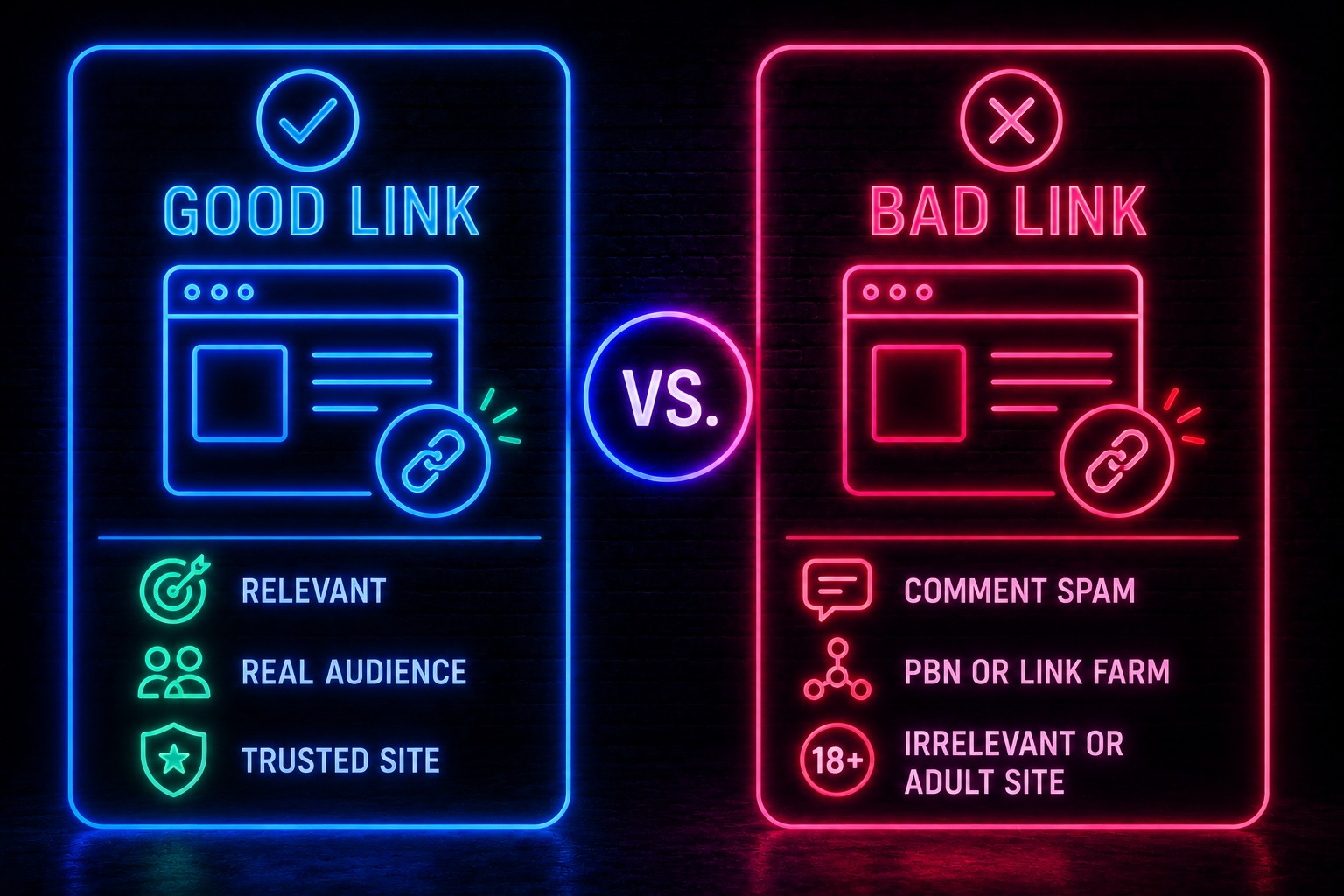
Neon graphic comparing good link attributes (relevant, real audience, trusted site) versus bad link attributes for SEO.

Not all backlinks are created equal. SEOs know this all too well; it’s why so many businesses don’t trust SEO agencies. Truly a bummer.

A single mention from a respected publication in your industry can carry far more value than hundreds of links from unrelated websites. That’s because Google doesn’t just count backlinks. It evaluates where they come from, how they’re placed, and whether they make sense in context.

This is all in Google’s Spam Policies. It catches people performing gamifying their SEO rankings all the time, and it’s really good at it.

If you’re reviewing your own backlink profile, here are some of the biggest red flags to watch for.

Contextually Irrelevant Links

One of the easiest ways to spot a low-quality backlink is to ask a simple question: Does this website have anything to do with my business?

Imagine a plumbing company earning a backlink from a blog that’s writing about European travel. Even if the website has decent authority, the connection feels random because it is.

Google looks for contextual relevance. Backlinks from websites that regularly cover your industry, your location, or topics closely related to your specific business niche send a much stronger signal than links from sites with no obvious connection.

Comment Section Links

Comment spam has been around almost as long as search engines themselves.

These are the links dropped into blog comments, YouTube comments, forum discussions, or guestbooks simply to create another backlink. Many are marked nofollow, but that isn’t the only issue. A backlink profile filled with comment links can suggest an attempt to manipulate rankings rather than earn legitimate recommendations.

As a rule, if the only reason a link exists is because someone pasted it into a comment section, it’s probably not adding much value.

Private Blog Networks (PBNs) and Link Farms

Private Blog Networks, commonly called PBNs, are groups of websites created primarily to sell backlinks.

Some look surprisingly legitimate at first glance, with polished designs and regularly published content. Once you start reading, though, the cracks become obvious. The topics jump from finance to gardening to HVAC with no editorial focus, and nearly every article exists to place links for paying customers.

Link farms operate similarly. Their purpose isn’t to publish useful content; it’s to generate as many backlinks as possible.

Fandom Sites, Adult Websites, and Irrelevant Directories

This was exactly what we found in our client’s backlink report.

Instead of earning mentions from websites in their industry, many of their purchased links had been placed on fandom sites, adult sites, and low-quality directories. None of those websites had any meaningful connection to the client’s business, and none were likely to send qualified visitors.

A few irrelevant backlinks won’t ruin your SEO, but when they’re repeated throughout your backlink profile, they begin to paint a picture that Google’s systems can recognize and penalize you for.

Site-Wide Footer and Sidebar Links

A backlink that appears on every page of a website might seem valuable because it generates hundreds or even thousands of links. However, Google views those placements differently.

Unless there’s a legitimate reason for the relationship—such as a web design company crediting its work in a client’s footer—site-wide links can appear manipulative because they’re repeated across an entire domain rather than earned within relevant content.

The Black Hat Playbook: What to Watch Out For

Google doesn’t expect every website to have a perfect backlink profile. It’s normal to pick up the occasional low-quality or irrelevant backlink over time, especially if your site has been around for years. The problem is when those links become a pattern.

Many black hat link-building tactics are designed to manipulate rankings rather than earn genuine recommendations. Google’s link spam systems are built to recognize these patterns, making the short-term gains increasingly difficult to justify.

Here are some of the biggest red flags.

Buying Thousands of Links in a Short Time

A sudden surge of backlinks might seem like a positive signal, but it often raises more questions than answers.

Most businesses earn backlinks gradually over time. Buying hundreds or thousands of links over the course of a few days creates an unnatural growth pattern that’s difficult to explain organically.

While there isn’t a specific number of new backlinks that’s considered “too many,” dramatic spikes can be a sign that links were purchased rather than earned.

Link Exchange Schemes

Trading links with another business isn’t always a problem. For example, it makes sense for two organizations that genuinely partner with one another to mention each other’s websites.

The issue arises when reciprocal linking becomes the strategy itself. Networks built around “I’ll link to you if you link to me” exist solely to influence search rankings, which is why Google identifies excessive link exchanges as a link scheme.

If a backlink exists only because another backlink was promised in return, it’s worth reconsidering.

Paid Guest Posts With No Editorial Standards

Guest posting can still be an effective way to build authority when it’s done for the right reasons.

Publishing an article on a respected industry website with an engaged audience is very different from paying $10 to publish content on a website that accepts articles on any topic from anyone willing to pay.

One is editorial, while the other is simply selling backlinks.

Before pursuing a guest post opportunity, ask whether the publication appears to have real editorial standards. If every article exists to promote another business, the website probably isn’t offering much value to readers, or to Google.

Exact-Match Anchor Text

Anchor text should describe the page it’s linking to in a way that feels natural within the surrounding content.

Problems start when every backlink uses the exact same keyword-rich phrase.

For example, if dozens of websites all link to your homepage using the anchor text “best SEO agency in New York,” that consistency doesn’t look natural. Most people don’t write identical recommendations, and Google’s algorithms understand that.

A healthy backlink profile typically includes a mix of branded anchors, page titles, natural phrases, and occasional keyword-rich anchors where they genuinely fit the context.

Sponsored Content Without Proper Disclosure

There’s nothing inherently wrong with sponsored content. Businesses sponsor publications, newsletters, and websites all the time. The issue is transparency.

Google recommends that paid links use the appropriate rel=”sponsored” or rel=”nofollow” attributes so they aren’t interpreted as editorial endorsements. When paid placements are disguised as organic recommendations, they can cross the line into manipulative link building.

Injected Links on Hacked Websites

Some of the most aggressive link sellers don’t even own the websites where they’re placing backlinks.

Instead, they inject links into compromised websites or exploit outdated software to insert links into existing pages without the owner’s knowledge.

These placements are often short-lived because they’re removed once the site owner discovers them. More importantly, they’re exactly the kind of manipulative behavior Google’s spam systems are designed to identify.

The Connection Between Bad Backlinks and AI Poisoning

Poor-quality backlinks don’t just exist in isolation. They’re often part of a much larger ecosystem of low-quality websites built to manipulate search engines, and now AI Search engines like ChatGPT.

As we discussed in our article on AI Poisoning: The New Ugly Phase of Black Hat SEO/GEO, researchers have demonstrated that it can take surprisingly little low-quality content to influence what AI systems learn about a topic. When hundreds of nearly identical articles appear across networks of spam websites, they don’t just affect search rankings—they can also distort the information AI models retrieve and summarize.

That doesn’t mean every low-quality backlink will affect AI systems. The broader concern is association. If your brand is consistently appearing alongside the same kinds of websites used to manipulate search engines and AI models, you’re participating in an ecosystem built around quantity rather than credibility.

As AI-generated answers become a larger part of how people discover businesses online, earning mentions from trustworthy, relevant publications will only become more important.

The Backlink Vetting Formula

Not every paid backlink is automatically harmful, and not every free backlink is automatically valuable.

The difference usually comes down to the quality of the website, the relevance of the content, and whether the link looks like something that would exist naturally without Google’s ranking algorithm.

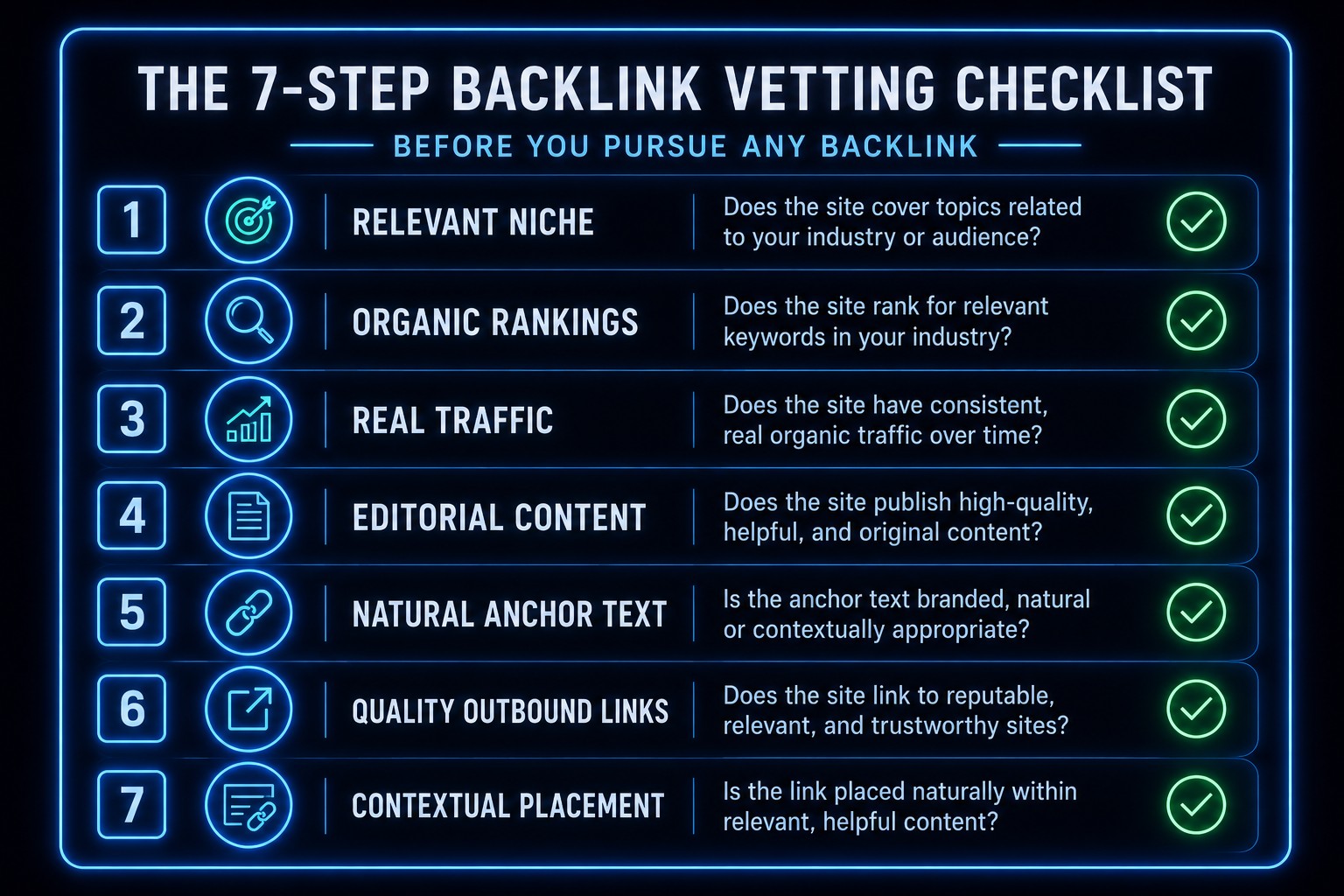
Before pursuing any backlink opportunity, run through this checklist.

1. Does the Site Rank for Relevant Keywords?

Start by looking at what the website actually ranks for, not just its Domain Rating.

A site might have an impressive authority score but rank for topics that have nothing to do with your industry. If you’re a law firm evaluating a backlink from a website that primarily ranks for cryptocurrency and casino terms, the contextual value is likely to be minimal.

Tools like Ahrefs’ Site Explorer make this easy. Review the site’s top-ranking keywords and ask whether they’re closely related to your business or audience.

2. Is the Domain Rating Appropriate for the Site?

Domain Rating can be helpful, but it shouldn’t be the deciding factor.

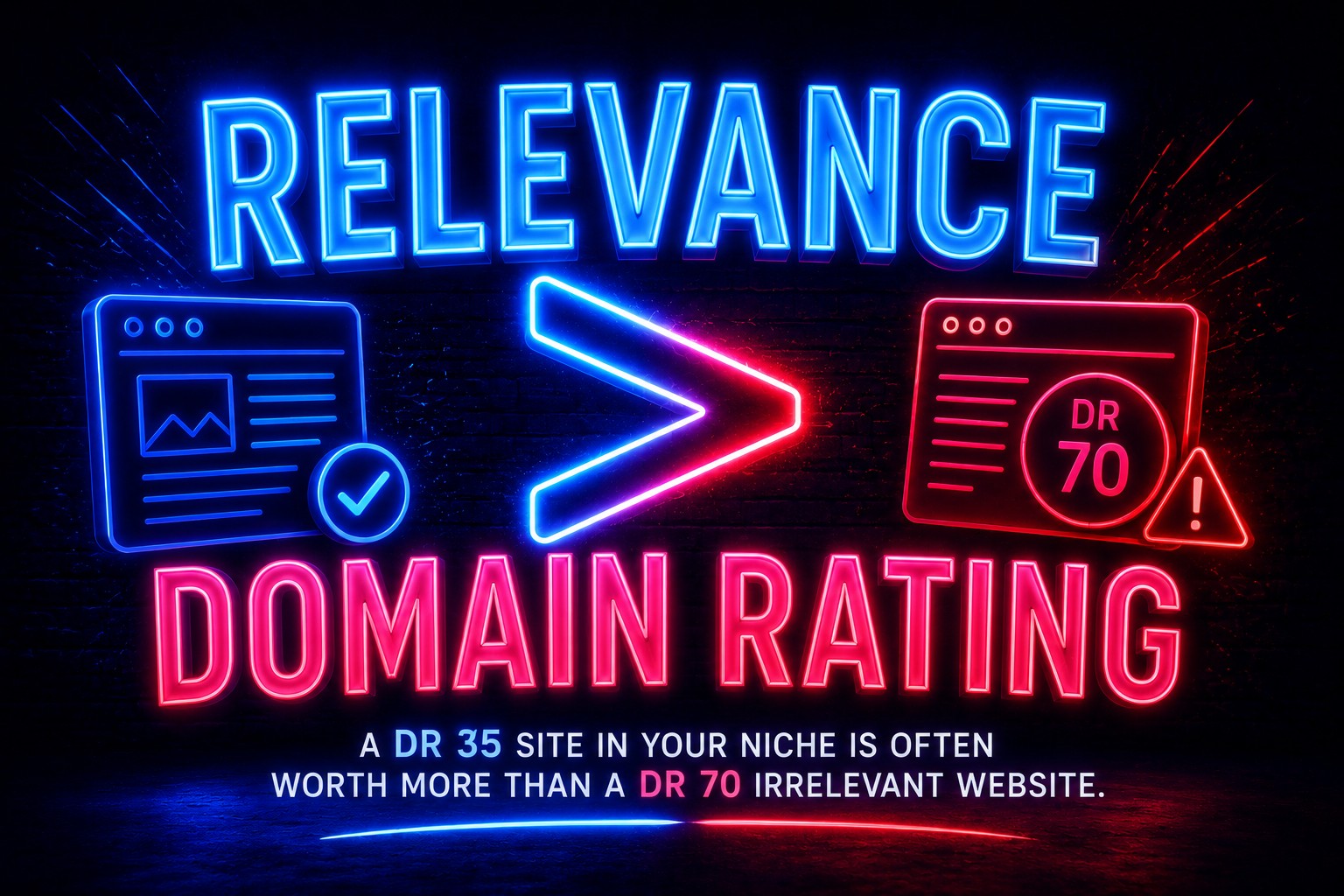
A niche publication with a DR of 35 and a loyal audience in your industry is often a better backlink opportunity than a DR 70 website covering unrelated topics simply because it sells links.

Treat Domain Rating as one signal among many, not the entire evaluation. 

Neon sign graphic stating Relevance is greater than Domain Rating for SEO backlinks, comparing a DR 35 site to a DR 70 site.

3. Does the Site Have Real Organic Traffic?

Look for traffic that’s relatively stable or growing steadily. A sudden spike followed by a sharp decline can sometimes indicate a Private Blog Network, expired domain manipulation, or another tactic designed to inflate authority temporarily.

Traffic alone doesn’t guarantee quality, but the absence of meaningful organic traffic should encourage a closer look.

4. Does the Content Feel Editorial?

Spend a few minutes reading the website.

Do the articles appear to have been written by people with subject matter expertise? Is there a consistent editorial focus? Are authors identified? Does the content provide useful information?

Or does every article feel like it exists to place another backlink?

You don’t need a technical SEO tool to recognize the difference between a publication created for readers and one created for search engines.

5. Is the Link Placed Naturally Within Relevant Content?

Context matters. A backlink that appears naturally within an article about your industry is typically far more valuable than one buried in a generic “Resources” page or inserted into unrelated content.

Ask yourself whether the link genuinely helps readers understand the topic. If it feels forced, Google may see it the same way.

6. Who Else Does This Website Link To?

Outbound links can reveal a lot about a website’s editorial standards.

If every article links to reputable businesses, respected publications, and helpful resources, that’s usually a positive sign.

If the site links to online casinos, payday loans, cryptocurrency schemes, adult websites, and dozens of unrelated businesses, it’s worth asking whether you want your brand associated with that neighborhood.

7. Does the Anchor Text Sound Natural?

The best anchor text usually doesn’t sound like it was written for a search engine.

Instead of forcing exact-match keywords into every backlink, aim for anchors that fit naturally within the sentence. Brand names, article titles, descriptive phrases, and occasional keyword-rich anchors all have a place in a healthy backlink profile.

If every backlink uses the exact same keyword phrase, that’s a pattern Google can recognize.

A Quick Reality Check

Before investing in any backlink opportunity, ask yourself these two questions:

  • Would this link still make sense if Google didn’t exist?
  • Would I be proud if a potential customer discovered this page and saw my business featured there?

If the answer to either question is “no,” it’s probably best to walk away.

The 7-Step Backlink Vetting Checklist infographic outlining 7 criteria: relevant niche, organic rankings, real traffic, editorial content, natural anchor text, quality outbound links, and contextual placement.

How to Use Ahrefs (Inside a Claude Project) to Vet Links

Evaluating backlinks isn’t just about checking a Domain Rating or glancing at a traffic estimate. Every potential link should be viewed in the context of the website as a whole.

At bgood media, our workflow starts in Ahrefs Site Explorer, where we review the referring domain’s organic keyword profile. The first question isn’t “How authoritative is this website?” It’s “What is this website actually known for?”

If the domain ranks for keywords that are closely related to the client’s industry, that’s a good sign. If its top-ranking pages cover an unrelated mix of topics or appear to exist solely for link placements, we dig deeper before recommending it.

Next, we review the site’s traffic history and backlink profile to identify suspicious patterns. Sharp spikes, sudden drops, or dramatic fluctuations can sometimes indicate expired domains, Private Blog Networks, or other manipulative tactics. We also examine the site’s top-performing pages to determine whether people are linking to genuinely useful content or thin articles created primarily to host backlinks.

To streamline the process, we combine Ahrefs with an AI-assisted analysis inside a Claude Project we’ve built. Ahrefs has an MCP, so this makes it much easier to identify crap links that will damage our partners’ sites. (What’s an MCP? It’s this.)

Instead of jumping between multiple reports, we can review traffic trends, keyword data, backlink profiles, and editorial quality in a single workflow. AI doesn’t replace human judgment, but it does make it easier to analyze large amounts of data and identify patterns that deserve a closer look. Our instructions mainly take care of that.

The goal isn’t simply to find websites with high authority. It’s to identify websites that are trustworthy, relevant, and likely to provide lasting SEO value.

What Quality Link Building Actually Looks Like

If bad link building is about shortcuts, good link building is about earning recommendations.

The strongest backlinks come from websites that genuinely find your content, expertise, or business worth mentioning. In other words, they exist because they add value for readers.

Link building works best when it’s part of a broader SEO strategy rather than a standalone tactic.

Here are the types of backlinks worth pursuing.

Contextually Relevant Editorial Mentions

An editorial mention from a website in your industry is one of the most valuable backlinks you can earn. These links are typically included because your content supports the topic being discussed, not because someone paid to have it placed.

Guest Posts on Legitimate Publications

Guest posting still works when it’s done with reputable publications that have real editorial standards and an audience that overlaps with your own.

The focus should be on contributing useful content, not simply finding another place to insert a backlink.

Original Research, Data, and Tools

Some of the best backlinks are earned rather than requested.

Publishing original research, industry surveys, calculators, templates, or other useful resources gives writers and journalists something worth citing. These assets often continue attracting backlinks long after they’re published.

PR and Media Coverage

Mentions from journalists, news outlets, podcasts, and industry publications remain one of the strongest signals of authority.

Unlike purchased links, these placements are editorial by nature. They help build both search visibility and brand credibility.

Local Citations

For local businesses, consistent citations across trusted directories, industry associations, and business listings remain an important part of a healthy backlink profile.

These links may not carry the same authority as a feature in a major publication, but they help reinforce your business’s legitimacy and local relevance.

Genuine Partnerships

Some of the best backlink opportunities come from real business relationships.

Partners, suppliers, nonprofit organizations, professional associations, and complementary businesses often provide relevant linking opportunities because there’s an authentic connection between the organizations.

Conclusion: Don’t fall for sh*t links

Buying cheap backlinks is super tempting, especially when they’re packaged as a quick path to higher rankings. But as our client discovered, what looks like a bargain can quickly become a backlink profile filled with irrelevant, low-quality websites that do little to support your SEO and might even destroy all of your hard work.

The strongest backlink profiles aren’t built overnight, and they aren’t measured by the total number of links pointing to your website. They’re built by earning relevant mentions from trustworthy websites that make sense for your business and your audience.

If you’re evaluating a backlink opportunity, don’t start by asking how many links you’ll receive. Start by asking whether the website is one you’d genuinely be proud to be associated with. That’s a much better indicator of long-term value than any link package can promise.

Not sure whether your backlinks are helping or hurting your SEO? Our elite SEO team can audit your backlink profile, identify risky or low-value links, and help you build an authority strategy that’s designed for long-term growth. Let’s chat!

Businesses Have the Wrong Expectations for Marketing

A neon blue megaphone and pink bullseye target on a scale, representing lead volume versus targeted conversion balance.

Marketing is not sales.

For some reason, this seems to be the largest misconception business owners have.

I’ve been meaning to make a post about this for a long time because I think it’s important to create a distinction for people so they know what real success looks like for marketing. Not going to go on a rant, but this definitely needed to be said.

It’s not responsible for hitting your monthly revenue number; it’s not a lever you pull when the pipeline looks thin, and it’s definitely not the department to put immediate blame on when a bad quarter happens. I know a lot of people might become defensive hearing that, but it’s the truth.

I’ve sat across from enough founders and marketing leads to know the pattern. Revenue dips, leadership panics, and the first question in the room is “what is marketing doing about this?” Or even worse, “which part of marketing should we cut?”

Never mind that the product had a rough launch, or the sales team lost two reps, or the market itself softened. Marketing gets treated like a faucet you can just turn up. It isn’t, and treating it that way is quietly wrecking a lot of good marketing teams and businesses.

The Misconception That Is Killing Your Marketing Team

Maybe we’ve got bias since we’re a digital marketing studio, but we know where we stand in marketing compared to the rest of the company. So many things affect marketing, and marketing can help or damage every other part of the business.

Think about it: Marketing is meant for getting your brand’s message out there and reaching your consumers.

Sales is for hitting concrete numbers and knocking down doors.

Here’s the pattern I keep running into: leadership wants every dollar of marketing spend tied to a specific closed deal. Sounds reasonable on paper, but in practice, it doesn’t work.

Direct revenue attribution works fine for the last click before checkout. It falls apart the moment you try to apply it to everything marketing actually does, because most of marketing’s job isn’t the last click: it’s the twelve touchpoints before the purchase.

It’s the blog post someone read eight months before they became a lead. It’s the brand impression that made them open your email instead of deleting it. The social post that made a stranger recognize your logo when a competitor pitched them. None of that shows up cleanly in a CRM report, but none of it is any less real, and it’s hard to measure.

When a marketing team is judged purely on what can be attributed to a dollar figure this month, something predictable happens: they stop taking risks.

Why would they publish anything that doesn’t have an obvious, immediate payoff? Why pitch the bold campaign when the safe one is easier to defend in a meeting? I’ve watched genuinely talented marketers get boxed into producing the same three “safe” content types on repeat, not because they lacked better ideas, but because leadership made it clear that anything else wouldn’t be forgiven if it didn’t convert.

That’s how you end up with a marketing team full of smart people producing forgettable work.

What Marketing Is Actually For

Strip away the KPI dashboards for a second and ask what marketing is actually supposed to do. It comes down to three things.

Brand awareness.

Before anyone buys from you, they have to know you exist. Sounds obvious, but it’s the part businesses skip past fastest when they’re impatient for results. That long-term investment matters because most potential customers aren’t ready to buy today anyway. In fact, research from the Ehrenberg-Bass Institute and LinkedIn’s B2B Institute found that 95% of B2B buyers are out of market at any given time. That means most of the people you’re trying to reach aren’t ready to buy today—but they still need to know who you are when they eventually are.

Industry authority and positioning.

This is the work that makes you the name people think of first in your category. Content, social presence, PR, showing up consistently with a point of view. It’s the reason some businesses get inbound leads that already trust them, while their competitors are cold-calling into a void.

Perception building.

How someone feels about your brand before they ever talk to a salesperson. Great marketing pre-sells. It shapes the story in someone’s head before your sales team says a word, which is exactly why sales conversations go faster and close rates go up when marketing has done its job well upstream.

None of these three things are optional add-ons or side benefits to marketing. They are the job. They are the foundation that makes sales easier in the first place.

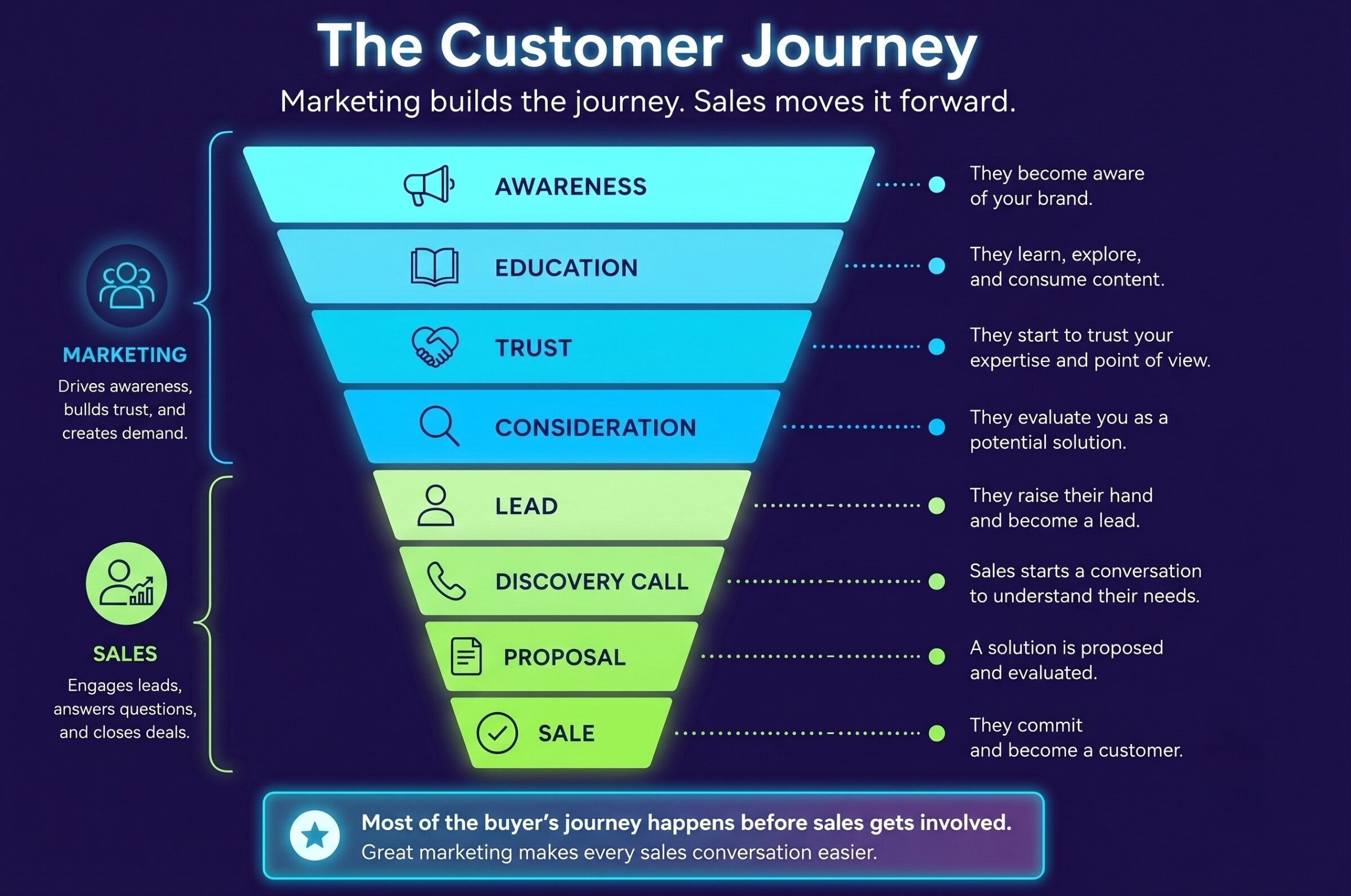
Marketing Supports the Entire Customer Journey

Every customer moves through a journey before making a purchase. Marketing supports every stage of that journey by building awareness, establishing credibility, and creating positive brand experiences long before someone reaches out to your sales team.

Full-funnel diagram showing The Customer Journey strategy including awareness, education, trust, consideration, lead, discovery, proposal, and sale stages.

Marketing vs. Sales: The Real Distinction

Sales is a conversation. It’s a pipeline, a series of calls, a close. Marketing builds the world in which that conversation is even possible in the first place.

Think of it like this: sales is the person knocking on the door. Marketing is the reason the person on the other side already recognizes the name on the business card and decides to answer. You can have the best closer in the world, but if nobody’s ever heard of you and nothing about your brand feels credible, that closer is starting every single conversation from zero.

The mistake I see over and over is businesses asking marketing to do sales’ job: close the deal, hit the number, own the revenue outcome directly. That’s not marketing’s function, and forcing it into that role doesn’t make your revenue problem go away. It just makes your marketing worse at the thing it’s actually good for.

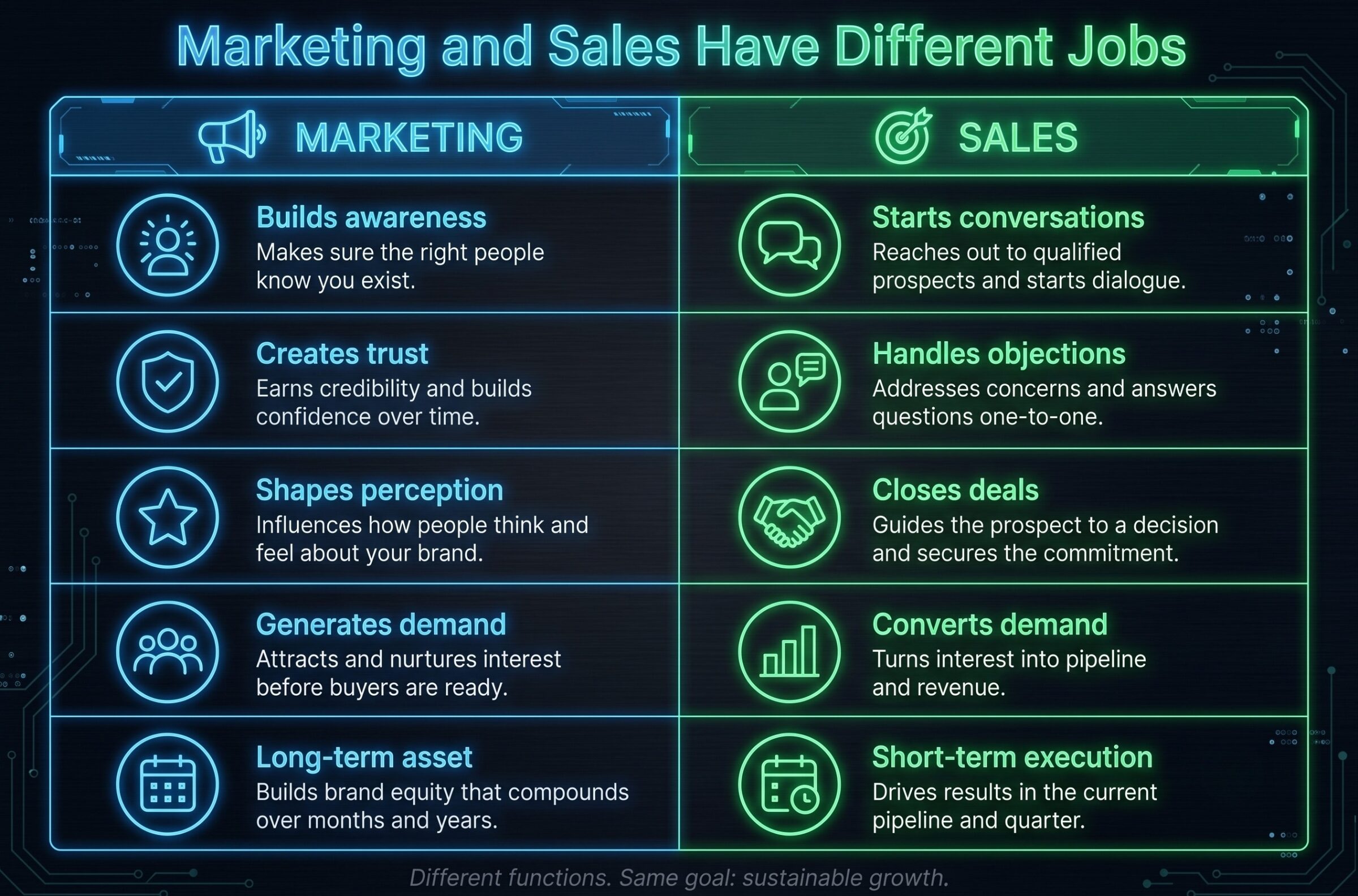
Marketing and Sales Measure Success Differently

One of the biggest mistakes businesses make is assuming marketing and sales should be judged by the same metrics. While both contribute to revenue, they do so in different ways. Marketing builds the foundation that makes sales easier, while sales focuses on converting that momentum into customers.

Cyberpunk-themed infographic table comparing the roles of Marketing in blue (demand generation, trust building, perception) against Sales in green (conversation starting, objection handling, closing deals).

The KPI Trap: What Marketing Metrics Should Actually Look Like

I’m not telling you to throw out measurement. Direct revenue attribution to a single campaign is often genuinely misleading, though, because brand-building doesn’t move in a clean straight line from touchpoint to close.

The better question isn’t “did this post make us money this week.” It’s whether share of voice in your category is growing. Whether organic traffic is trending up over months, not days. Whether people are searching your brand name more than they used to. Whether engagement quality is improving, not just impression counts. Whether the leads coming through content are converting at a healthier rate over time, even if you can’t point to the exact post that did it.

Redefine what you’re measuring instead of measuring nothing. A marketing team with no accountability is its own problem. But holding brand-level work to a sales-level yardstick just guarantees you’ll misjudge the work every time.

None of this means marketing exists separately from business outcomes. Great marketing should, of course, ultimately contribute to growth. The mistake is expecting every activity to produce immediate, directly attributable revenue when much of marketing works by influencing decisions over time.

Modern SEO/GEO strategies and thoughtful website design are good examples of this long-term approach to marketing. When properly implemented, success compounds over time rather than delivering instant revenue.

What Happens When Everyone Starts Dictating Marketing

Once every stakeholder in the building has an opinion on marketing’s output, creative work starts getting run through committee. Every post gets softened until it says nothing controversial, and nothing controversial usually means nothing memorable either. Marketers who joined the company because they wanted to make sharp, opinionated work end up spending their time defending safe, forgettable work instead. Eventually the good ones leave, and you’re left with a team that’s optimized for not getting blamed rather than for actually building the brand.

I’ve seen this exact cycle play out at businesses of every size: a marketing team starts strong, leadership gets nervous about a slow quarter, oversight increases, creative risk drops, results flatten out, and leadership concludes marketing “isn’t working”… never connecting that the flattening happened right after they started micromanaging it. 

How to Set Marketing Expectations That Actually Work

If you want marketing that actually moves your business forward, here’s where to start.

  1. Define marketing’s role in writing, before the campaigns launch, not after a bad quarter forces the conversation. 
  2. Agree on brand-level metrics that are separate from sales metrics, so nobody’s comparing apples to a completely different fruit. 
  3. Give the team creative autonomy inside a clearly defined brand framework, so they know the boundaries without having every decision run through a dozen people. 
  4. Separate your marketing budget from your sales budget, measuring each against its own goals instead of one number that neither was ever designed to hit alone.

Implementing these changes requires drawing clearer lines. However, it does not require a bigger marketing budget.

What Great Marketing Actually Looks Like

Marketing is not a revenue machine you can turn up and down on demand. When it’s working, you’ll know. Here are some of the telltale signs that your marketing team is doing a great job:

  • Consistent brand presence that builds recognition over months and years, not a single viral moment. 
  • Content that educates and positions the brand well before the audience is anywhere near ready to buy. 
  • Marketing that makes people want to work with you before your sales team ever picks up the phone. 
  • A team that’s trusted enough to do good work without fifteen rounds of committee approval standing between an idea and the world.

These are the things you’re actually paying for when you invest in marketing. Marketing is a long-term asset that makes every other part of your business easier, sales included. Set it up that way, and stop asking it to be something it was never built to be.

Ready to build a marketing strategy that supports long-term growth? Let’s talk.